
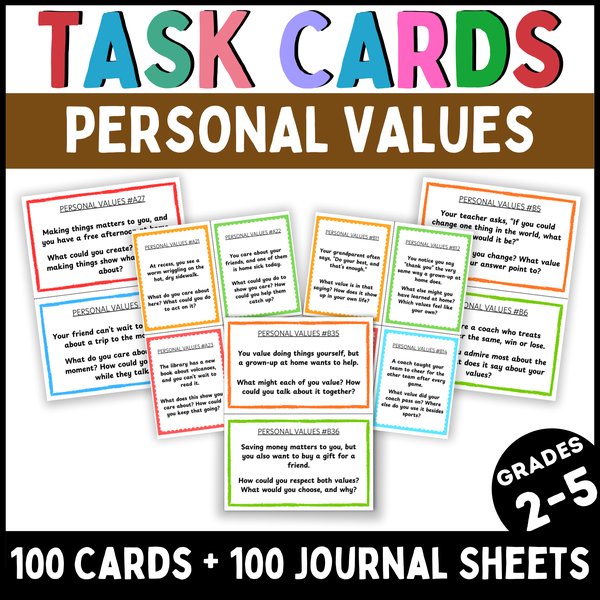
Personal Values Task Cards — Printable & Digital
Values are hard to name until a choice puts them on the spot.
This resource is in the full SEL Resource Library. See what’s included or start with 10 free resources. Have an account? Log in.
About this resource
Values are hard to name until a choice puts them on the spot. These personal values task cards give students 100 of those choices, from a worm wriggling on a hot, dry sidewalk to a family yard sale on the same morning as science club, for Grades 2–5. Each card asks what the student cares about and how to act on it, which builds Self-Awareness, the CASEL competency of knowing who you are.
What students practice
- Naming what matters most to them
- Seeing where values come from, like family sayings and traditions
- Noticing when a choice doesn’t match what they care about
- Speaking up calmly for something that matters
- Weighing two values that pull in different directions
What’s inside
- 100 cards: Set A (Grades 2–3) and Set B (Grades 4–5), 50 in each
- Set A: what matters to me; my family and me; acting on what I care about; when my choices don’t match; standing up for what matters
- Set B: discovering my values; where my values come from; values in everyday choices; when values clash; my values and my future
- Ten cards per theme, printable 2 or 4 to a page
- Reflection sheets in a second file, one per card (81 pages of cards, 103 journal pages)
A look inside
- Set A: “You love nature, but you dropped your wrapper on the playground. What doesn’t match here? What could you do now and next time?”
- Set B: “Your family has a tradition of shoveling snow for neighbors every winter. What value might this tradition teach? How has it shaped what you care about?”
- Set B: “Saving money matters to you, but you also want to buy a gift for a friend. How could you respect both values? What would you choose, and why?”
How to use these personal values task cards
- Morning meeting: a what-matters-to-me card like A6 (extra recess, a new book or time with your best friend) gets quick, varied answers
- Small groups or an SEL lesson: the when-values-clash cards (B31–B40) give older students real trade-offs to talk through
- Counseling sessions: Set A’s when-my-choices-don’t-match cards help a student look at a choice that didn’t fit, like forgetting the hamster’s water
- Personal journaling: the my-values-and-my-future cards (B41–B50) with their reflection sheets
Grade fit
Set A (Grades 2–3) keeps values close to home: a family good-night routine, sharing blocks with a little brother, flowers the class planted. Set B (Grades 4–5) asks where values come from and what to do when two collide, such as a big game on the same day as Grandma’s birthday party.
Digital version
The interactive digital task cards share as one link: you choose Set A or Set B, and students type their answers on any device with no student logins. At the end they download an answer sheet to hand in.
Good to know
Several where-my-values-come-from cards in Set B invite students to share a family saying, tradition or custom from their culture, so answers will reflect home life.
Pairs well with
These task cards for students sit well next to Personal Values Scenario Cards and Personal Values Worksheets.
Questions teachers ask
Which set should I start with?
Set A is labeled Grades 2–3 and Set B Grades 4–5. Set B’s when-values-clash cards suit students who can already name a few of their values.
What are the journal pages?
A second file with one reflection sheet for each of the 100 cards: the card’s prompt, a name and date line and space to write.
More for Self-Awareness
See all in the library →

Every resource, one library.
572 SEL resources for elementary classrooms — printables, digital activities and answer sheets, and every new one we add.

