
Active Listening and Clear Expression Activity Kit
Most classroom conversations move too fast for anyone to really listen.
This resource is in the full SEL Resource Library. See what’s included or start with 10 free resources. Have an account? Log in.
About this resource
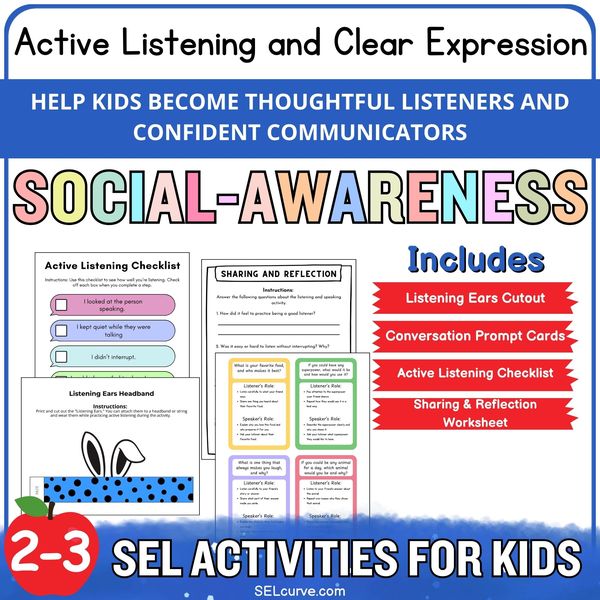
Most classroom conversations move too fast for anyone to really listen. This active listening and clear expression activity kit slows them down for Grades 1–3: students practice tracking what a partner says and proving they heard it, instead of waiting for their turn. It is a Relationship Skills lesson for morning meeting, daily SEL time or a communication group, built around one visible move, the restate.
What students practice
- Speaking clearly and taking turns
- Listening without interrupting
- Restating what a partner said
- Asking a follow-up question
- Checking their own listening habits
What’s inside
- A teacher guide with a detailed script and a flexible outline: three steps, about 25 minutes
- Listening Ears Cutouts, printable ears with headband strips to cut, paste and wear (14 pages)
- 12 Conversation Prompt Cards, each with a Listener’s Role and a Speaker’s Role, in color and black-and-white
- An Active Listening Checklist with six check-off behaviors, from eye contact to a follow-up question, in 2 versions
- A four-question Sharing and Reflection Worksheet; 32 pages in all
A look inside
- From the teacher script: “You said your favorite thing is playing on the swings because it makes you feel free.”
- Conversation Prompt Card: “Who is someone you look up to, and what makes them special to you?”
- Sharing and Reflection: “Was it easy or hard to listen without interrupting? Why?”
How to use this active listening and clear expression kit
- Ask what makes a good listener and let students name what they notice, such as looking at the speaker and waiting their turn
- Hold up the talking stick: only the person holding it speaks, and students can wear the Listening Ears headband as a cue
- Pairs draw a prompt card; the speaker answers, the listener restates, then adds a question before partners switch
- Close with a whole-class talk about how it felt to be heard, then the checklist and reflection sheet
Grade fit
The headband and friendly prompts, such as a favorite weekend activity or what you would do with a superpower, suit Grades 1–3 in early elementary. It is one of those communication skills activities that fits alongside other SEL activities, since the restate step works in any discussion.
Good to know
Any small object can serve as the talking stick.
Pairs well with
For younger students, try Listening Ears, or add practice with Polite Communication Practice.
Questions teachers ask
What is the talking stick?
Any small object you choose. Only the student holding it speaks, which settles whose turn it is.
How long does the lesson take?
The teacher script runs three steps in about 25 minutes.
More for Relationship Skills
See all in the library →

Every resource, one library.
572 SEL resources for elementary classrooms — printables, digital activities and answer sheets, and every new one we add.

