
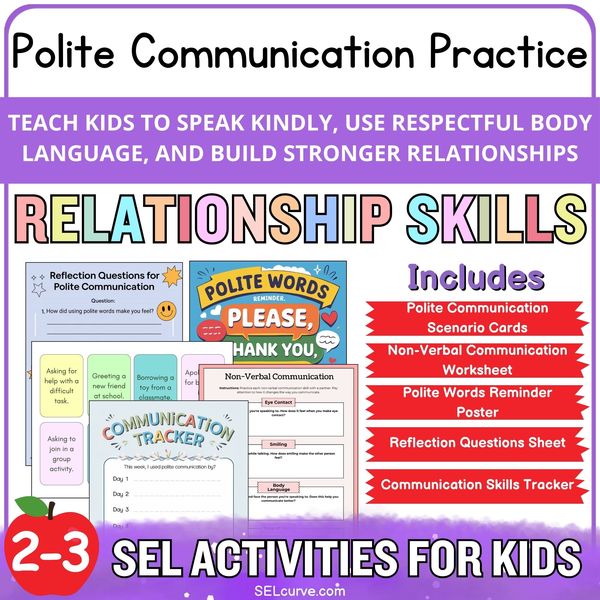
Polite Communication Practice — Communication Skills Kit
Politeness is more than a nicety. This polite communication practice kit treats it as a strategy for Grades 1–3: deliver a message in a way that keeps the other person open to hearing it.
This resource is in the full SEL Resource Library. See what’s included or start with 10 free resources. Have an account? Log in.
About this resource
Politeness is more than a nicety. This polite communication practice kit treats it as a strategy for Grades 1–3: deliver a message in a way that keeps the other person open to hearing it. Students learn through role-play of everyday situations, in a communication skills SEL lesson that builds Relationship Skills.
What students practice
- Choosing polite words for a situation
- Matching tone of voice to the message
- Using eye contact, smiling and posture
- Practicing requests and refusals in role-play
- Tracking polite words week to week
What’s inside
- A teacher guide with a detailed script and a flexible outline: three steps, about 25 minutes
- 24 Polite Communication Scenario Cards for partner role-play, in color and black-and-white
- A Non-Verbal Communication Worksheet covering eye contact, smiling, body language and tone of voice
- A Polite Words Reminder Poster for the wall
- A four-question Reflection Questions Sheet and a weekly Communication Skills Tracker; 19 pages in all
A look inside
- From the teacher script: “Polite communication isn’t just about what we say—it’s also how we say it.”
- Scenario Cards: “Politely asking someone to stop a behavior that bothers you.” and “Welcoming a new student to the classroom.”
- Reflection: “How does your tone of voice change the way people hear your message?”
How to use this polite communication practice kit
- Contrast a mumbled request with “Could you please help me?” said kindly, looking at the person and smiling
- Pairs act out scenario cards, from greeting a new friend to politely declining an invitation, and switch roles each round
- Practice eye contact, smiling, posture and tone one at a time on the Non-Verbal Communication worksheet
- Use it in morning meeting, SEL small groups or back-to-school community building
Grade fit
Everyday scenes and short role-plays suit Grades 1–3 in early elementary. As SEL activities go, it is easy to repeat, because the scenario cards give you a fresh scene every round.
Pairs well with
Add listening practice with Active Listening and Clear Expression, or move to conflict language with My Conflict Resolution Plan.
Questions teachers ask
What kinds of situations do the scenario cards cover?
Everyday ones, such as welcoming a new student or politely asking someone to stop a behavior that bothers you.
How long does it take?
About 25 minutes across three steps.
More for Relationship Skills
See all in the library →


Every resource, one library.
572 SEL resources for elementary classrooms — printables, digital activities and answer sheets, and every new one we add.

