
Self-Reflection Worksheets — Multiple-Choice Scenarios
The party is over, the car is quiet, and there’s a chance to think back.
This resource is in the full SEL Resource Library. See what’s included or start with 10 free resources. Have an account? Log in.
About this resource
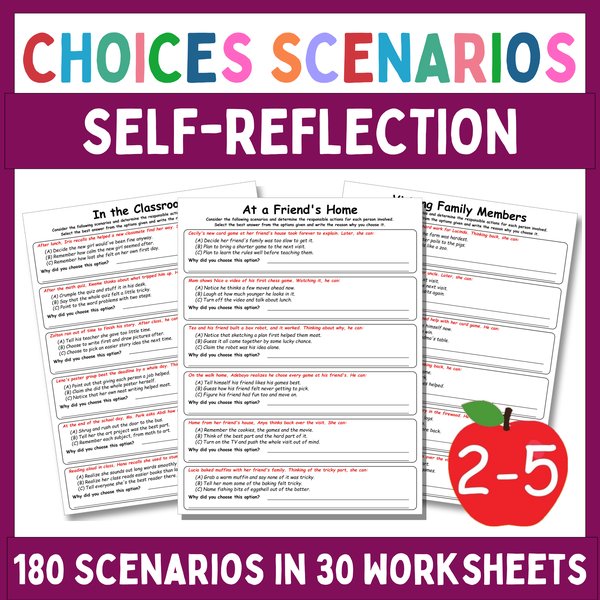
The party is over, the car is quiet, and there’s a chance to think back. These self-reflection worksheets turn those after-moments into practice for Grades 2–5: each of the 180 scenarios shows a student looking back on a beach day, a chore, a game or a video call, and asks which way of looking back actually helps. Students pick A, B or C and write why, growing the SEL skill of Self-Awareness that makes next time go better.
What students practice
- Thinking back over my day
- Noticing what went well and why
- Naming what was hard
- Seeing how my actions affected others
- Planning what to do differently
- Noticing how I have changed
What’s inside
- 30 printable worksheets, each set in one place, from Pet Care to With Neighbors
- 180 multiple choice scenarios, 6 per worksheet, each with a “Why did you choose this option?” line
- Scenarios set after the moment: the drive home, bedtime, the end of the school day
- 4 teacher pages
- 35 pages
A look inside
- At the Dinner Table: “Callum knocked his cup over twice while waving his hands. Later, he can:” (A) Tell Dad the table is the real problem here. (B) Ask for a cup with a lid from now on. (C) Make a note to keep his cup far from his elbow.
- On the School Bus: Sora remembers she used to cry at the bus stop. Now she “waves goodbye and hops right on.”
- Community Parks: Leah fed the ducks bread, then saw a sign asking people not to.
How to use these self-reflection worksheets
- Morning meeting: Sora’s bus scenario opens a talk about how students have changed since last year
- Small groups: compare B and C in Callum’s scenario; both are plans, but one is more specific
- Independent reflection: the why line works as a short journal response
Grade fit
Scenarios are short look-backs at familiar events (a relay win, laundry day, a farm visit at Uncle Ray’s), and the options model reflection language Grade 2 can borrow. Grades 4–5 can explain why a vague look back is weaker than a specific one.
Digital version
The interactive digital version shares as one link: students pick A, B or C and type their reason, or just pick if you choose the choices-only format, on any device with no student logins. At the end they download an answer sheet to hand in.
Good to know
Per the scoring note, a specific, useful look back is strongest, a vague or self-focused one is weaker, and blaming others or pretending nothing happened is the poor choice.
Pairs well with
Keep the reflection going with the Self-Reflection Conversation Cards in morning meeting, or the Self-Reflection What Would You Do? Cards.
Questions teachers ask
Are students reflecting on their own lives?
They reflect through the characters first. The why line and the discussion are where many students start connecting it to their own day.
Is there an answer key?
No. A scoring note on the discussion page explains what makes a look back stronger or weaker.
Does the digital version need student logins?
No. Share one link; it opens on any device.
More for Self-Awareness
See all in the library →

Every resource, one library.
572 SEL resources for elementary classrooms — printables, digital activities and answer sheets, and every new one we add.

