
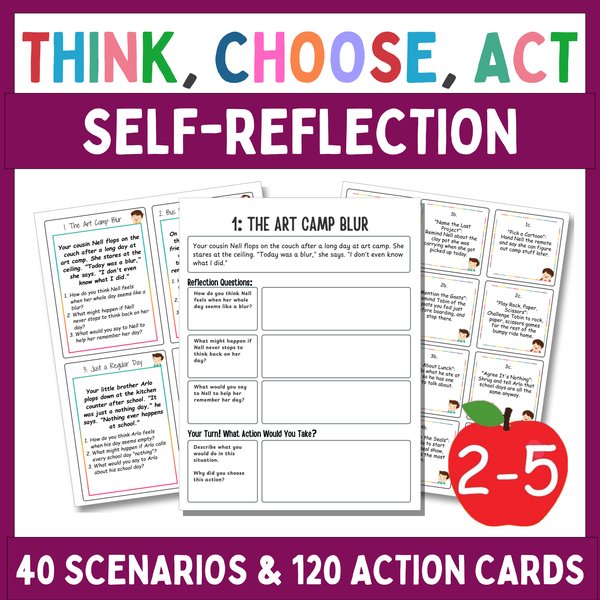
Self-Reflection What Would You Do? Cards — Think, Choose, Act
“Today was a blur,” cousin Nell says after art camp.
This resource is in the full SEL Resource Library. See what’s included or start with 10 free resources. Have an account? Log in.
About this resource
“Today was a blur,” cousin Nell says after art camp. “I don’t even know what I did.” These self-reflection what would you do scenarios ask Grades 2–5 students how they’d help someone look back on a day, a practice or a family party, with three action cards to choose from each time. Across 40 cards they build Self-Awareness: what went well, what was hard, and what to change next time.
What students practice
- Thinking back over a day in order
- Noticing one thing that went well
- Naming what was hard without calling the whole day bad
- Seeing how their actions helped or upset someone
- Choosing one small thing to do differently
What’s inside
- 40 scenario cards in five groups of eight: Thinking Back Over My Day, Noticing What Went Well, Noticing What Was Hard, Seeing How My Actions Affected Others, and Planning What I’d Do Differently
- 120 action cards that give each scenario one best, one partial and one impulsive response
- 40 reflection sheets
- A teacher guide; 77 pages total
A look inside
- The Art Camp Blur: action cards Start at the Morning, Name the Last Project and Pick a Cartoon.
- Three Tugs of War: Gemma mutters that field day was “no fun at all” because her team lost three times. Name the Hard Part sits beside Blame the Big Kids.
- Zooming Ahead on Bikes: Ione raced ahead all ride, and now Paavo won’t talk to her. The best card has students “Help Ione think about what the ride was like for Paavo, way behind her.”
How to use these self-reflection what would you do cards
- Open with The Practice Wrap-Up and the guide’s prompt, “Have you ever faced a similar situation? What did you do?”
- Role-play Zooming Ahead on Bikes, then use Perspective Swap so the actor playing Ione becomes Paavo
- Ask for the best choice for The Missed Cue as an exit ticket
- Keep finished reflection sheets in SEL portfolios and review them over the year or at student-led conferences
- Run learning stations where students act out, debate and write about the self-reflection scenarios
Grade fit
The moments come at the end of something, at home (14), school (13) or in the community (13): a farm trip bus ride, a plant sale, a band concert. Coaching a friend or cousin keeps it low-stakes for younger children, and Grades 4 and 5 can push further on how actions affect others. Together they make steady self-reflection activities for Grades 2–5.
Digital version
The interactive digital version shares as one link: students answer the think questions (or just read them in the quick format), choose an action card and say why, on any device with no student logins. At the end they download an answer sheet to hand in.
Pairs well with
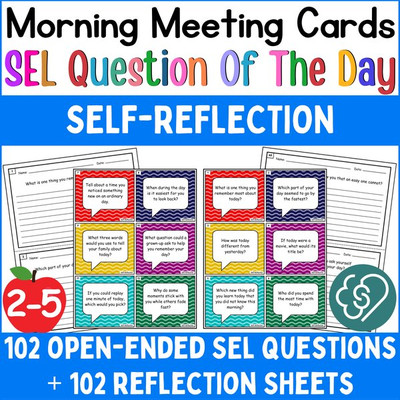
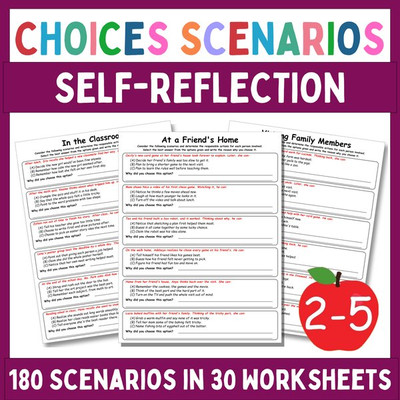
Start the day with Self-Reflection Conversation Cards, or try Self-Reflection Worksheets for multiple-choice practice.
Questions teachers ask
Can the reflection sheets go into student portfolios?
Yes. The teacher guide suggests storing them in SEL journals or portfolios, reviewing them over time and using them at student-led conferences.
Do students need accounts for the digital version?
No. You share one link, and students open it on any device without logging in.
More for Self-Awareness
See all in the library →
Every resource, one library.
572 SEL resources for elementary classrooms — printables, digital activities and answer sheets, and every new one we add.

