
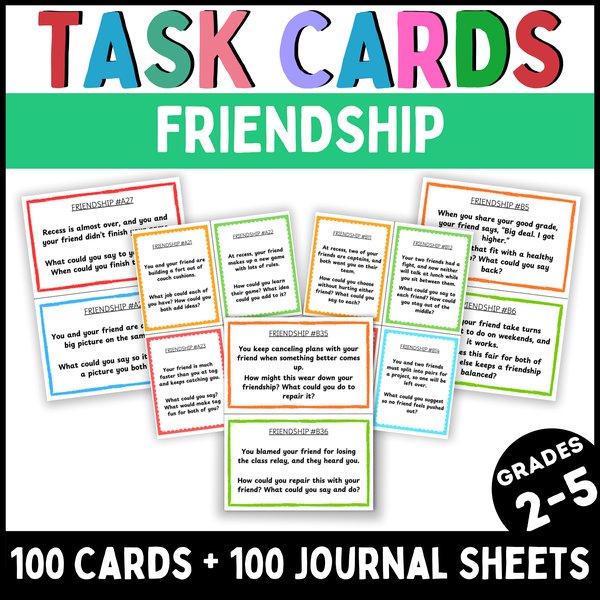
Friendship Task Cards — Printable & Digital
“Maybe tomorrow” can sound a lot like no when you’re seven and asking someone to play.
This resource is in the full SEL Resource Library. See what’s included or start with 10 free resources. Have an account? Log in.
About this resource
“Maybe tomorrow” can sound a lot like no when you’re seven and asking someone to play. These friendship task cards walk students through their own friendships: how they start, what keeps them going and how to mend them when things go wrong. The 100 cards are written for Grades 2–5 and build Relationship Skills, from inviting a new friend over for the first time to handling a group of three.
What students practice
- Starting a friendship from something in common
- Playing in ways that are fun for both friends
- Disagreeing without ending the friendship
- Coping when a friend moves or plays with new kids
- Keeping a friend’s private things private
What’s inside
- Two sets of 50: Set A (A1–A50, Grades 2–3) and Set B (B1–B50, Grades 4–5)
- Set A’s five themes: Making a new friend; Being a good friend; Playing together; When friends disagree; Missing or losing a friend
- Set B’s five themes: What makes a healthy friendship; Being a friend to more than one person; Trust and loyalty; Friendship problems and repair; Changing friendships
- Cards print 2 or 4 to a page, and the journal file adds a reflection sheet for each card (81 card pages, 103 journal pages)
A look inside
- Set A: “You and your friend are drawing one big picture on the same paper. What could you say so it turns into a picture you both like?”
- Set B: “You and two friends must split into pairs for a project, so one will be left over. What could you suggest so no friend feels pushed out?”
- Set B: “You realize you’ve been bossy all week, and your friend has grown quiet. What could you change, not just say, to make things right?”
How to use these friendship task cards
- Morning meeting: a Playing together card (A21–A30) before recess
- Small groups or counseling sessions on friend trios, with B11–B20
- An SEL lesson on making things right with Friendship problems and repair (B31–B40)
- Personal journaling: the Missing or losing a friend cards (A41–A50) can be easier to answer on a private reflection sheet
Grade fit
Set A, for Grades 2–3, finds friendships at the art table, on the bus and in a snow fort, where the big questions are how to start and how to share. Set B, for Grades 4–5, takes on groups of three, a friend’s private worries, drifting apart and friend groups that shuffle in fifth grade.
Digital version
The interactive digital task cards share as one link: you choose Set A or Set B, and students type their answers on any device with no student logins. At the end they download an answer sheet to hand in.
Good to know
The cards are about each student’s own friendships; bullying and peer pressure aren’t part of this set. A46 (“I don’t want to be best friends anymore”) and B30, about a friend crying in the hallway, may need a gentle hand in a group.
Pairs well with
For more friendship activities, pair these task cards for students with Friendship Scenario Cards or Friendship Stop Think Act Cards.
Questions teachers ask
Does this set cover bullying?
No. The cards stay on making, keeping and repairing friendships; bullying and peer pressure are outside this set.
Is Set B right for a fourth grade class?
Set B is labeled Grades 4–5 and takes on trust, groups of three and changing friendships. If your class needs simpler practice first, Set A’s When friends disagree cards (A31–A40) are a good warm-up.
More for Relationship Skills
See all in the library →

Every resource, one library.
572 SEL resources for elementary classrooms — printables, digital activities and answer sheets, and every new one we add.

