
How to Teach Self-Advocacy to Kids: 10 Games, a 4-Step Routine + Free Scenario Cards
Self-advocacy is the skill of knowing what you need and saying it in a calm, clear way. Here's how to teach self-advocacy in grades 2–5: a 4-step routine, 10 quick games, real examples, and free scenario cards to practice with.
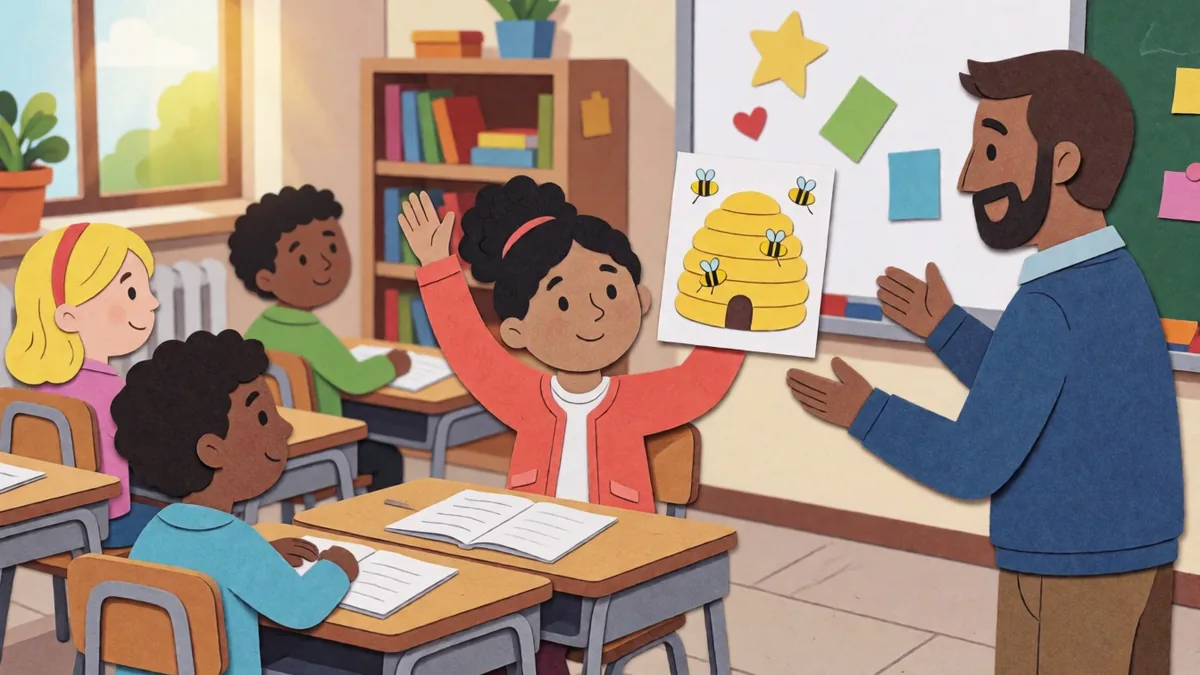
Self-advocacy is the skill of knowing what you need and saying it in a calm, clear way: “I can’t see the board,” “I need two more minutes,” “I have an idea.” Many kids stay quiet instead, because speaking up feels risky or they aren’t sure their need counts. The good news: self-advocacy can be taught, and the practice can be short. Below is how to teach self-advocacy in grades 2–5: a 4-step routine students can learn to run on their own, real examples to share with your class, 10 quick games and activities (most take 5 to 15 minutes), and free social-emotional learning (SEL) scenario cards to get started.
What is self-advocacy for kids?
Self-advocacy means speaking up for yourself: noticing what you need, want or think, and telling the right person in a respectful way. In kid-friendly words: “Know it, then say it.”
It has two halves, and students need both:
- Knowing yourself. What am I good at? What is hard for me? What helps me learn? You can’t ask for what you need if you haven’t noticed it yet. This is the self-awareness half.
- Speaking up. Choosing the right words, the right person and the right moment, then listening to the answer. This is the relationship skills half, and it’s where most students need the most practice.
Self-advocacy is not being bossy or getting your way every time. A student can ask clearly, hear “not right now,” and still have advocated well. Asking is the skill; the answer is not the score.
Self-advocacy examples for students
Students learn faster when they can picture it. Share a few of these examples, then ask your class to add their own:
- In class: “Could you show me one more example?” · “I can’t see the board from here. May I move closer?” · “I need a few more minutes to finish.”
- In a group: “I have an idea too.” · “Could I have a turn reading?” · “Can we try my way for the next part?”
- With friends: “I need to walk, not race. My foot hurts.” · “I don’t like that game. Can we play something else?”
- At home: “Tuesday chores are hard for me because of soccer. Could I swap days?”
- For someone else: “He’s new and doesn’t know the rules yet. Can we explain them?”
Every example has the same shape: a clear need, said kindly, to someone who can help. That shape is what the routine below teaches.
How to teach self-advocacy in 4 steps
Give students a short routine they can run on their own when they need something. Teach it with one scenario, model it out loud, then use the same four words in every game below:
- Know. What do I need, want or think right now? Name it to yourself first. self-awareness
- Plan. Who can help, and when is a good moment to ask? problem solving
- Say. Use a calm voice and an “I” sentence: “I need…”, “I’m stuck on…”, “I have an idea…” communication
- Listen. Hear the answer. If it’s “not now,” ask when, or try another way. flexibility
Post the four words where students can see them. Model a think-aloud first: “Know: I can’t read the board from back here. Plan: I’ll ask the teacher when she finishes the instructions. Say: ‘I can’t see the board from my seat. Could I move closer?’ Listen: she said yes, after the warm-up.” After a few weeks, students start using the steps on their own.
Asking for help is a skill, not a weakness. The more often students see a classmate ask and get help, the more normal it becomes for everyone.
10 self-advocacy games and activities
Practice is where the skill grows. Each game lists how long it takes and the grades it suits. Mix quick daily ones (1, 2, 3) with deeper ones once a week (4 to 8).
1. Strength detective
Read a short moment and ask, “What strength is this person using?” A student who listens to a friend’s long story to the end is using patience and kindness. Naming strengths in others helps students spot their own, and knowing your strengths is the first half of self-advocacy. Takes 5 minutes, grades 2–5.
2. “I need…” quick round
Write three starters on the board: “I need… so I can…”, “I’m stuck on…”, “Could you please…”. Call out a quick situation (“You can’t find your reading book,” “The pencil sharpener is broken”) and students turn to a partner and say a full sentence. Short, clear and kind is the goal. Takes 5 minutes, grades 2–4.
3. The halfway hand
Describe a student whose hand rises halfway to share an idea, then drops back down. Ask: “What made the hand stop? What could help it go all the way up?” Students list the worries (people might laugh, the idea might be wrong) and one brave thought for each. Takes 10 minutes, grades 2–5.
4. Ask-for-help role play
In pairs, one student is stuck (a missing worksheet, not enough time, a confusing direction) and the other plays the teacher, who is busy. The stuck student practices the four steps, including finding a good moment. Then they switch. Talk afterward: “What made the ask easy to say yes to?” Takes 10 to 15 minutes, grades 2–5. The Self-Advocacy Role Play Scenarios give you ready-made scenes.
5. Help signals
Set up a quiet class system for asking: a colored card on the desk, a sticky note on the corner, or a “stuck” cup. Practice it on purpose for a week, and praise the asking, not just the work. A low-pressure way to ask is often what shy students need to start. Takes 5 minutes to teach, then daily, grades 2–5.
6. Brave-voice ladder
Give students six speaking-up situations on slips, from easy (“Ask a friend to pass the glue”) to hard (“Tell a group you don’t want to play that game”). In small groups, they put the slips in order on a ladder from easiest to hardest and talk about why. Then each student picks one step to try this week. Takes 15 minutes, grades 3–5. Saying no to a group is its own skill; our guide on how to teach kids to say no to peer pressure goes deeper.
7. Stay sure of your idea
Read a moment where someone doubts a student’s idea: an older cousin says your backyard obstacle course is too hard to build. Ask: “What do you believe about your idea? What could you say back that is kind and still sure?” Practice a few replies out loud. Being sure of yourself without arguing is a big part of self-advocacy. Takes 10 minutes, grades 4–5.
8. “How I learn best” card
Each student fills in an index card: “I learn best when…”, “Something that’s hard for me is…”, “Something that helps me is…”. Collect them, read them, and hand them back for students to keep in their desks. It gives students the words for their needs before they need them. Takes 15 minutes, grades 3–5.
9. Speak up for someone else
Self-advocacy grows into advocating for others. Read The Job Chart scenario (below, #58): a tablemate who was out last week isn’t on the new class job chart, and he quietly lines up his pencils. Ask: “Why might he stay quiet? How could you speak up for him in a helpful way?” Students practice one sentence they could say to the teacher. Takes 10 minutes, grades 3–5. Speaking up for others is also the heart of being an upstander; see teasing vs. bullying and the upstander steps.
10. Friday “I asked” check-in
Once a week, students finish one sentence on a sticky note: “This week I asked for…” or “This week I shared…”. Post the notes on the board. Seeing many small asks together shows students that speaking up is normal and that it works. Takes 5 minutes, any grade. The Self-Advocacy Conversation Cards give you more questions for check-ins like this.
A look inside the free self-advocacy scenarios
The free Relationship Skills Scenario Cards cover ten areas of relationship skills, with six scenarios each. One whole area is Speaking Up for Yourself and Others. Here are three of its scenarios, with the guided questions:
What do you still need to finish your owl? Why is it hard to speak up when everyone is cleaning? Which words could you use to ask for more time?
Who has been reading the chapters aloud? Why could your family forget to give you a turn? What is one way to ask for a turn tonight?
What problem do you hear in the new chore plan? What could explain Dad putting you on Tuesdays? How might you ask for a swap that still helps the family?
Every scenario comes as an open-ended card and a guided card with three questions, plus a matching journal page for each. The same area also has #58 The Job Chart (used in game 9) and #59 The Wrong Name, two moments of speaking up for a classmate.


Quick practice: free self-advocacy task cards
For faster rounds, the free Relationship Skills Task Cards are short, one-moment prompts. Ten of them (A46–A50 and B46–B50) are about speaking up for yourself and others. Two examples:
Each card has a matching reflection sheet, so a card can be a quick talk at morning meeting or a written answer at a center. For the “know yourself” half, the free Self-Awareness Scenario Cards include twelve scenarios on knowing your strengths and feeling sure of who you are.
Use them on screens, too
The free sets also work as digital activities. You share one link, choose the format (open-ended or guided scenarios, or task card Set A or B), and students answer on any device with no student logins. At the end, each student downloads an answer sheet to hand in. It works well for a quiet reflection center, where students who find it hard to speak up can think it through in writing first.
Looking for more? Browse all our self-advocacy worksheets, task cards and role plays in the SEL resource library.
Self-advocacy resources for your classroom
 Free Relationship Skills Scenario Cards — Printable & DigitalGrades 2–6 · Print + digitalFREE
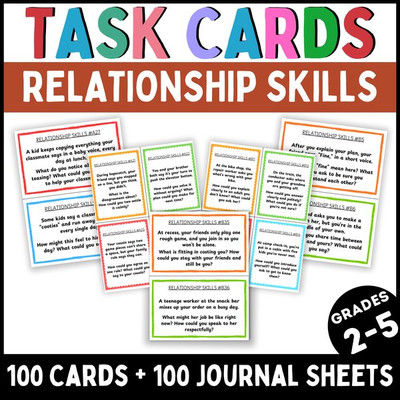 Free Relationship Skills Task Cards — Printable & DigitalGrades 2–5 · Print + digitalFREE
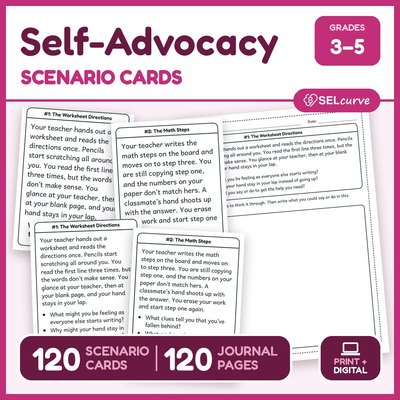 Self-Advocacy Scenario Cards — Printable & DigitalGrades 2–6 · Print + digitalFULL LIBRARY
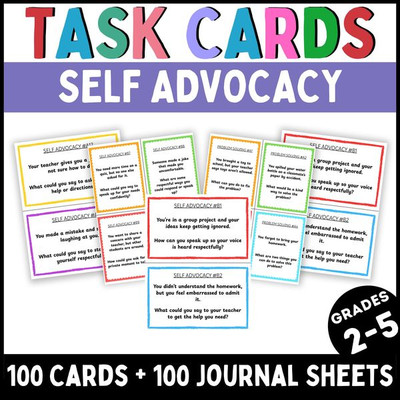 Self-Advocacy Task Cards — Printable & DigitalGrades 2–5 · Print + digitalFULL LIBRARY
 Self-Advocacy Role Play ScenariosGrades 2–5 · PrintFULL LIBRARY
 Free Self-Awareness Scenario Cards — Printable & DigitalGrades 2–6 · Print + digitalFREE
See everything on the Self-Advocacy resources page or browse all free SEL resources.
Frequently asked questions
How do you teach self-advocacy to elementary students?
Teach a short routine (know, plan, say, listen), model it out loud with a real-life scenario, and practice it often in small doses: sentence starters, role plays, help signals and weekly check-ins. Praise the asking itself, not only the result.
What is self-advocacy for kids?
Self-advocacy is knowing what you need, want or think, and telling the right person in a calm, respectful way. For kids, the simplest version is “know it, then say it.”
What are examples of self-advocacy for students?
Asking a teacher to explain a direction again, telling a group “I’d like a turn,” saying “I can’t see the board,” asking for more time to finish, or sharing an idea in a class meeting. Speaking up for a classmate who is left out is advocacy too.
Is self-advocacy the same as being bossy?
No. Self-advocacy is asking clearly and respectfully, then listening to the answer. A student can hear “not right now” and still have advocated well. Being bossy is insisting on your way without listening.
Are the self-advocacy scenario cards really free?
Yes. The Relationship Skills Scenario Cards (60 scenarios with journal pages) and the Relationship Skills Task Cards (100 cards with reflection sheets) are complete sets, free with a free SELcurve account. No card needed. Both include a digital version you can share as one link.
More SEL ideas
 Relationship SkillsHow to Teach Conflict Resolution to Kids: A 5-Step Talk-It-Out Routine, 10 Games + Free Scenario Cards
 Relationship SkillsHow to Say No to Peer Pressure: A 4-Step Plan to Teach Kids, 10 Practice Games + Free Scenario Cards
 Relationship SkillsTeasing vs. Bullying: How to Teach Kids the Difference (+ 4 Upstander Steps and Free Scenario Cards)


