
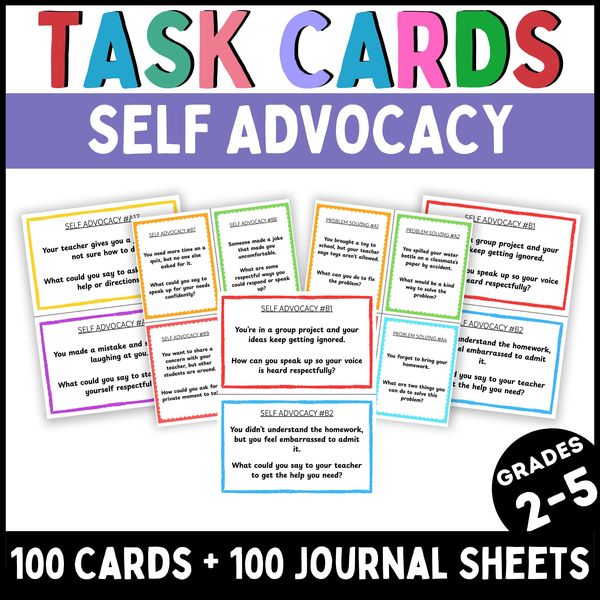
Self-Advocacy Task Cards — Printable & Digital
Asking for help, setting a limit or naming what you need are skills students don’t always know they’re allowed to use.
This resource is in the full SEL Resource Library. See what’s included or start with 10 free resources. Have an account? Log in.
About this resource
Asking for help, setting a limit or naming what you need are skills students don’t always know they’re allowed to use. These self-advocacy task cards give Grades 2–5 enough practice that when the words feel hard to find, they already know what to reach for. They build Relationship Skills, with self-awareness alongside.
What students practice
- Identifying what they need
- Choosing a respectful way to say it
- Setting a kind and clear boundary
- Speaking up to a teacher
- Thinking through an honest, constructive response
What’s inside
- 100 task cards in two sets: Set A (50 cards, Grades 2–3) on asking for help, expressing needs and basic limit-setting, and Set B (50 cards, Grades 4–5) on fairness, group work and speaking up to adults
- Print 2 per page for discussion or 4 per page to save paper
- 100 reflection sheets, one per card
- 182 pages: 80 in the card file and 102 in the reflection sheet file
A look inside
- Set A: “Someone keeps borrowing your things without asking. What can you say to set a kind and clear boundary?”
- Set B: “You feel uncomfortable when your name is mispronounced, but you’re not sure how to correct it. What could you say to politely advocate for yourself?”
- Set B: “You disagree with a rule in class that feels unfair. What’s a respectful way to share your perspective with your teacher?”
How to use these self-advocacy task cards
- SEL lessons on communication, confidence and setting limits
- Morning meetings and class community circles
- Small group support for students working on assertiveness
- Partner discussions or role-play practice
Grade fit
These task cards for students come in two sets. Set A is labelled for Grades 2–3 and covers moments like someone borrowing your things. Set B is for Grades 4–5 and includes disagreeing with a class rule or correcting a mispronounced name.
Digital version
The interactive digital task cards share as one link: you choose Set A or Set B, and students type their answers on any device with no student logins. At the end they download an answer sheet to hand in.
Pairs well with
For more self-advocacy activities, follow up with longer situations and guided questions in Self-Advocacy Scenario Cards, or open the talk with Self-Advocacy Conversation Cards.
Questions teachers ask
What do the cards ask students to say?
Each card sets up a decision point and asks what the student would do, what they might actually say and why it is worth saying.
Do students need accounts for the digital version?
No. You share one link, and students open it on any device without logging in.
More for Relationship Skills
See all in the library →


Every resource, one library.
572 SEL resources for elementary classrooms — printables, digital activities and answer sheets, and every new one we add.

