
How to Teach Conflict Resolution to Kids: A 5-Step Talk-It-Out Routine, 10 Games + Free Scenario Cards
Conflicts are a normal part of classroom life. The goal is to help students work them out on their own. Here's how to teach conflict resolution in grades 2–5: a 5-step talk-it-out routine, 10 quick games to practice it, and free scenario cards to start with.
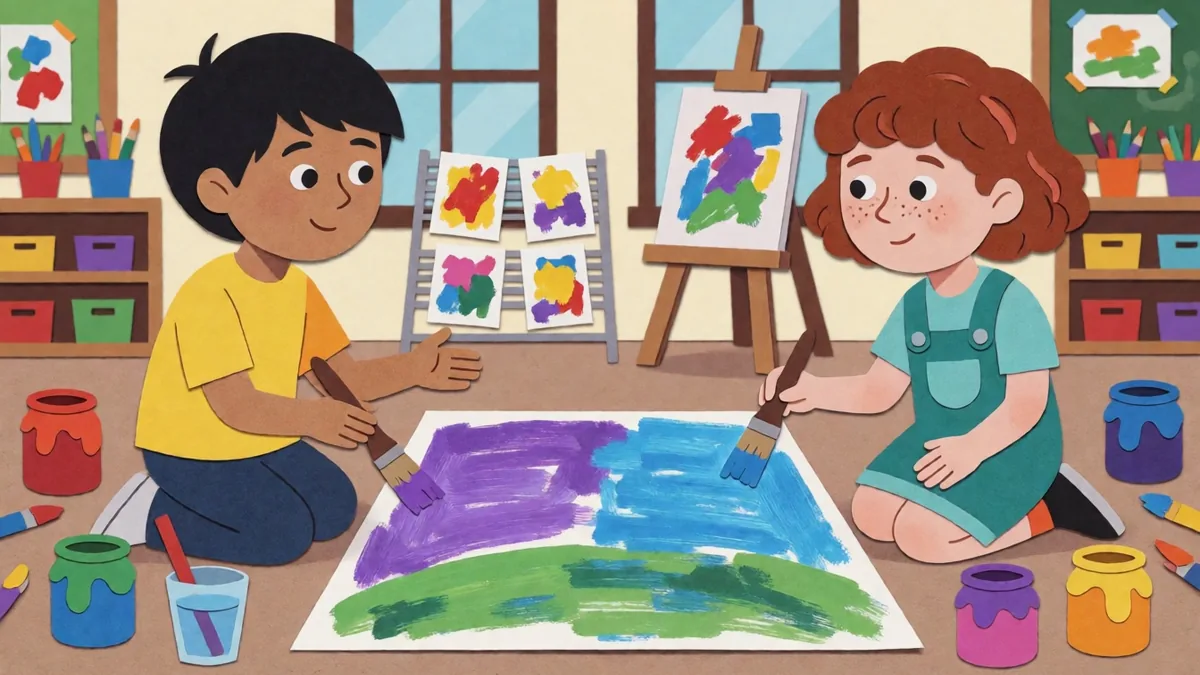
Here’s how to teach conflict resolution in one sentence: give students one routine they can run on their own (cool down, say your side, listen, brainstorm fixes, pick one) and to practice it on made-up conflicts before the real ones come up. And they will come up: two students want the same job, a partner paints over your sky, someone is sure the plan was “the swings,” not “the slide.” That’s not a sign something went wrong. It’s a chance to practice one of the most useful social-emotional learning (SEL) skills there is. Below is how to teach conflict resolution in grades 2–5: the 5-step talk-it-out routine, 10 quick games to practice it (most take 5 to 15 minutes), and free scenario cards to get started.
What is conflict resolution for kids?
Conflict resolution is the skill of working out a disagreement so that both people can live with the result. In kid-friendly words: “We both want something. Let’s find a way that works for both of us.”
It helps to tell students three things clearly:
- Conflict is normal. Friends disagree. Brothers and sisters disagree. Good teams disagree. A disagreement doesn’t mean someone is bad or the friendship is over.
- Both sides usually have a reason. In most classroom conflicts, each student wants something that makes sense to them: a breeze from the window, papers that stay put.
- The goal is a fix, not a winner. “Who’s right?” keeps the argument going. “What could work for both of us?” ends it.
Conflict resolution belongs to relationship skills, one of the five CASEL competencies. It also leans on other skills: calming down first (self-management) and seeing the other person’s side (perspective taking).
Why teaching conflict resolution matters in grades 2–5
In the early grades, adults solve most conflicts for students: “Give it back. Say sorry. Go sit down.” That works in the moment, but students don’t learn how to solve the next one. Somewhere between grades 2 and 5, the goal shifts from “the teacher fixes it” to “we can fix it ourselves, and we know when to get help.”
Students who can talk out a disagreement:
- Lose less learning time to arguments, because small conflicts stay small.
- Keep their friendships, because a disagreement doesn’t have to become a fight.
- Work better in groups, because “we see this differently” becomes a normal sentence.
- Know when it’s too big to handle alone, and when to bring in an adult.
How to teach conflict resolution in 5 steps
The most useful thing you can teach is one routine that students use for every disagreement. Teach it with a scenario, model it out loud, then use the same five steps in every game below:
- Cool down. Take a breath or a short break before talking. Nobody solves anything while they’re steaming. self-management
- Say your side. Use an I-message: “I feel ___ when ___ because ___.” No blaming words. communication
- Listen and repeat back. “So you want ___ because ___. Did I get it?” listening
- Brainstorm fixes. Come up with at least two ideas: take turns, split it, combine it, ask for a rule. problem solving
- Pick one and try it. Choose a fix you can both live with. If it doesn’t work, come back to step 4, or get an adult. responsible decision-making
Model a “think-aloud” with a real example: “Cool down: I’m going to take one breath first. Say my side: I feel frustrated when the window closes, because I get hot. Listen: so you want it shut because your papers fly off? Brainstorm: we could open it halfway, or you could use a book on your papers. Pick one: let’s try halfway today.” Post the five steps where students can see them, and point to them every time a disagreement comes up. If your class already uses Stop, Think, Act, step 1 is the same pause, so the two routines fit together.
10 conflict resolution games and activities
Students learn the steps best on made-up conflicts, when nobody’s feelings are on the line. Each game below lists its time and grades. Rotate the quick ones (1 to 3) through the week, and save the longer ones (4 to 9) for an SEL block.
1. “Both of us are right” retell
Read a mix-up scenario where both students honestly remember the plan differently, like two friends who each waited at a different spot in the park. Ask: “What does each person think happened? How could both of them be right about what they heard?” This takes the blame out of the room before students solve anything. Takes 5 to 10 minutes, grades 2–5. The free relationship skills scenario cards include six conflict scenarios, each with three guided questions.
2. I-message makeover
Write a blaming sentence on the board: “You always take the good markers!” Pairs rewrite it as an I-message: “I feel left out when the markers are gone, because I need them for my poster.” Do three in a row. Students quickly hear how much calmer the second version sounds. Takes 5 minutes, grades 2–5.
3. Repeat-back relay
Partner A says what they want and why in one sentence (“I want the window open because I get hot”). Partner B repeats it back in their own words before saying their side. Then they switch. The rule: you can’t share your side until your partner says, “Yes, you got it.” Takes 5 minutes, grades 2–5.
4. Fix-it brainstorm
Give small groups one conflict and two minutes to list as many fixes as they can. Then sort them: which ones would both people accept? Students learn that most conflicts have more than one answer, and that “you get it, I don’t” is rarely the only option. Takes 10 minutes, grades 2–5.
5. Fair-decider practice
Some conflicts are just “who goes first?” Teach a handful of fair deciders students can use without you: rock-paper-scissors, taking turns by the clock, “you split, I choose,” flipping a coin, or going in alphabetical order. Practice with quick prompts: two friends both want to turn the jump rope. Takes 5 minutes, grades 2–4.
6. Make-it-right apology
A quick “sorry” rarely fixes much. Teach a three-part apology for the end of a conflict: say what you did (“I’m sorry I painted over your sky”), say what you’ll do next time (“Next time I’ll ask first”), and offer a fix (“Can we make the left half a sunset?”). Pairs practice turning a bare “sorry” into all three parts. Takes 5 to 10 minutes, grades 2–5.
7. Fishbowl talk-it-out
Two volunteers sit in the middle and talk out a scenario using the five steps, while the rest of the class watches with a checklist of the steps. Every time observers hear a step, they tick it. Afterward, they share one step the pair did well and one that got skipped. Takes 10 to 15 minutes, grades 3–5. The Conflict Resolution Role Play Scenarios give you ready-made scenes for the fishbowl.
8. Small problem or big problem?
Read a list of situations and have students sort them: small problems we can solve ourselves (who sits by the window, whose turn it is) and big problems that need an adult (someone is hurt, it keeps happening, or it isn’t safe). Knowing the difference helps students try the steps on small problems, and know where to go with big ones. Takes 10 minutes, grades 2–5.
9. Talk-it-out spot
Set up a corner with two chairs and the five steps on a poster. When two students disagree, they can ask to use the spot and work through the steps on their own, then tell you the fix they chose. Start by walking them through it; after a few weeks, many pairs can do it alone. Takes 5 to 10 minutes per conflict, grades 2–5.
10. Both-sides journal
After a scenario talk, students fold a page in half and write one person’s side on each half: what each one wanted, and what each one could say. Then they write the fix that works for both across the bottom. Quieter students often have their best ideas on paper. Every free scenario also has a ready-to-print journal page in an open-ended and a guided version. Takes 5 to 10 minutes, grades 2–5.
A look inside the free conflict scenarios
The free Relationship Skills Scenario Cards cover ten areas of relationship skills, with six scenarios each. One whole area is Solving Conflicts Peacefully. Here are three of its scenarios, with the guided questions:
What does each of you think the plan was? How could you both be right about what you heard? What plan could make the rest of the day go well?
How did each of you picture the sky? How might your partner explain painting over the purple? What might you two do to decide on the sky together?
Which choice does each of you want for the lane? What might make the bumpers matter so much to her? How can you find a way that works for both players?
Each scenario has two card versions, an open-ended card (“What could you say or do here?”) and a guided card with three questions, and a journal page for each version.


Quick practice: free conflict resolution task cards
For faster rounds, the free Relationship Skills Task Cards are short, one-moment prompts. Ten of them (A21–A25 and B21–B25) are about solving conflicts peacefully. Two examples:
Every task card is numbered to a reflection sheet, so the same card works as a morning meeting prompt or a written answer at a center. For longer units, browse all the conflict resolution resources in the SELcurve library.
Use them on screens, too
Both free sets also work as digital activities. You share one link, choose the format (open-ended or guided scenarios, or task card Set A or B), and students answer on any device with no student logins. At the end, each student downloads an answer sheet to hand in. It works well for a talk-it-out center, a small group with the counselor, or a sub plan.
Conflict resolution resources for your classroom
 Free Relationship Skills Scenario Cards — Printable & DigitalGrades 2–6 · Print + digitalFREE
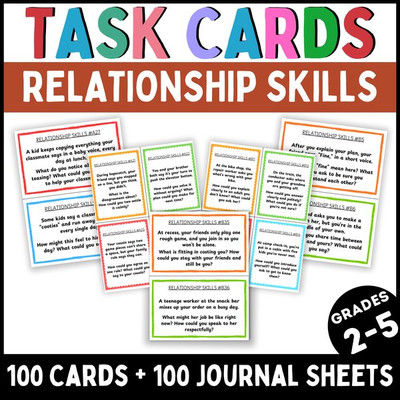 Free Relationship Skills Task Cards — Printable & DigitalGrades 2–5 · Print + digitalFREE
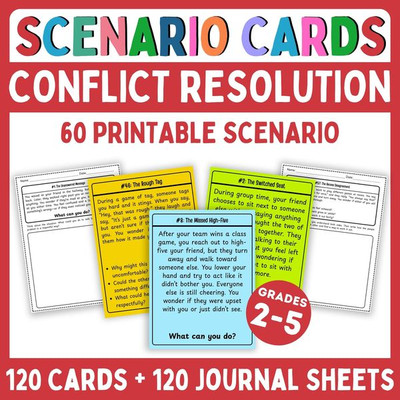 Conflict Resolution Scenario Cards — Printable & DigitalGrades 2–6 · Print + digitalFULL LIBRARY
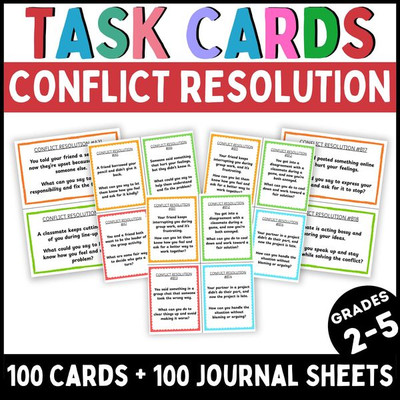 Conflict Resolution Task Cards — Printable & DigitalGrades 2–5 · Print + digitalFULL LIBRARY
 Conflict Resolution Role Play ScenariosGrades 2–5 · PrintFULL LIBRARY
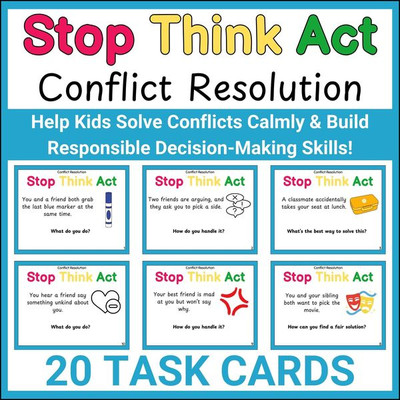 Conflict Resolution Stop Think Act Cards — Printable & DigitalGrades 2–5 · Print + digitalFULL LIBRARY
See everything on the Conflict Resolution resources page or browse all free SEL resources.
Frequently asked questions
How do you teach conflict resolution to elementary students?
Teach one routine and practice it often on made-up conflicts: cool down, say your side with an I-message, listen and repeat back, brainstorm fixes, and pick one to try. Scenario cards, fishbowl talks and quick fair-decider practice keep it short and regular.
What are conflict resolution skills for kids?
The core skills are calming down before talking, saying what you feel and need without blaming, listening to the other side, coming up with more than one solution, agreeing on a fix, and knowing when a problem is too big to handle without an adult.
Should kids always solve conflicts on their own?
No. Students can learn to solve small, everyday disagreements themselves, like turns, rules of a game or shared space. Anything that involves someone getting hurt, keeps happening on purpose, or doesn’t feel safe needs an adult right away.
What is the difference between a conflict and bullying?
A conflict is a disagreement between people who both want something, and both have a say. Bullying is hurtful behavior that is done on purpose and keeps happening, usually by someone with more power. Conflicts can be talked out; bullying always needs an adult. For how to teach the difference, see teasing vs. bullying.
Are the conflict resolution scenario cards really free?
Yes. The Relationship Skills Scenario Cards (60 scenarios with journal pages) and the Relationship Skills Task Cards (100 cards with reflection sheets) are complete sets, free with a free SELcurve account. No card needed. Both include a digital version you can share as one link.
More SEL ideas
 Relationship SkillsHow to Teach Self-Advocacy to Kids: 10 Games, a 4-Step Routine + Free Scenario Cards
 Relationship SkillsHow to Say No to Peer Pressure: A 4-Step Plan to Teach Kids, 10 Practice Games + Free Scenario Cards
 Relationship SkillsTeasing vs. Bullying: How to Teach Kids the Difference (+ 4 Upstander Steps and Free Scenario Cards)


