
How to Say No to Peer Pressure: A 4-Step Plan to Teach Kids, 10 Practice Games + Free Scenario Cards
Saying no to friends is hard at any age. Here's how to teach kids in grades 2–5 how to say no to peer pressure in their own words: a 4-step plan, 10 quick practice games, and free scenario cards with everyday, kid-sized examples.
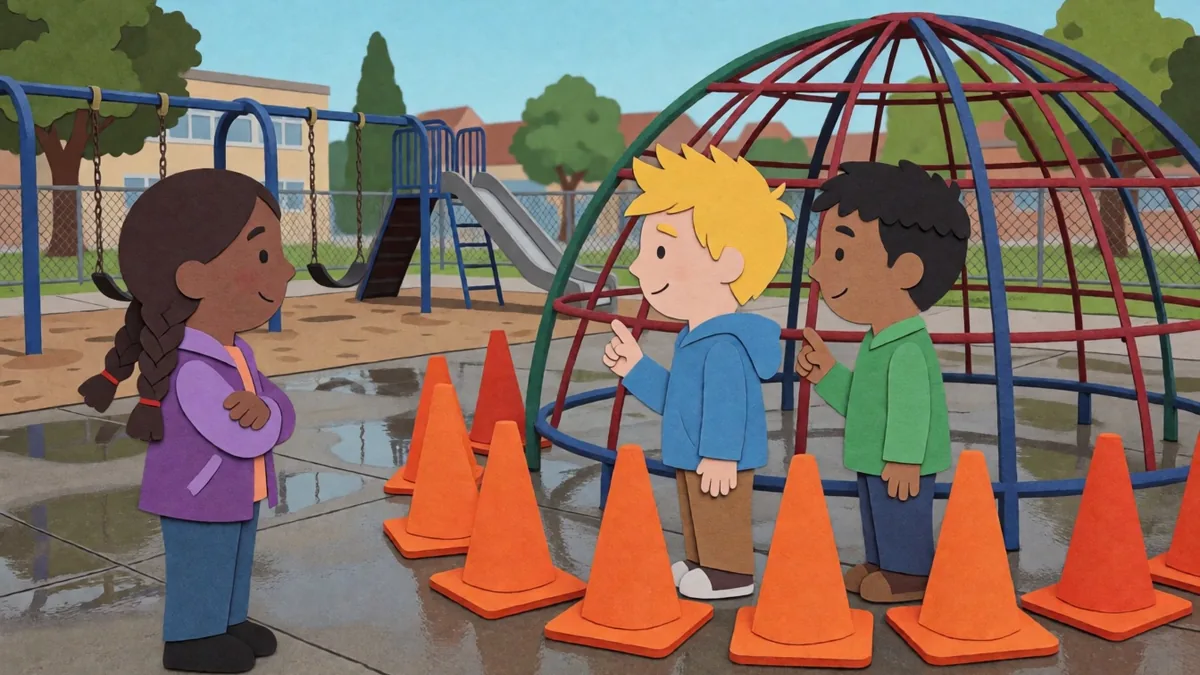
The best way to teach kids how to say no to peer pressure is to give them the words ahead of time and let them rehearse on made-up, kid-sized situations, long before a real one shows up. And it shows up early: “Everybody does it.” “Nobody’s even looking.” “Come on, it’s just a joke.” Kids hear these lines at the store, on the playground and at sleepovers. Saying no to a friend is a skill, not a personality trait, and like any social-emotional learning (SEL) skill, it grows with practice. Below: a 4-step plan students can use on their own, real peer pressure examples for grades 2–5, 10 quick practice games (most take 5 to 15 minutes), and free scenario cards.
What is peer pressure for kids?
Peer pressure is when friends or classmates push you, out loud or without words, to do something you wouldn’t choose on your own. In kid-friendly words: “When friends pull you toward a choice that doesn’t feel right.”
It helps to show students that peer pressure comes in two kinds:
- Loud (direct) pressure: someone says it out loud. “Open one too.” “Ring the doorbell and run!” “Come on, the lifeguard isn’t looking.”
- Quiet (indirect) pressure: nobody says anything, but you feel it anyway. Everyone wears the same sneakers. Everyone suddenly loves one game. You laugh at a joke you don’t think is funny.
Friends’ influence isn’t always bad, either. A friend who gets you to try out for the team or join a club is pushing you, too. The question to teach isn’t “Is my friend pushing me?” but “Is this a choice I would make on my own?”
Peer pressure examples for kids: negative and positive
Real examples make the idea click. These come from everyday elementary life, and several are taken from the free scenario cards and task cards below:
| Kind of pressure | What it looks like | Example for grades 2–5 |
|---|---|---|
| Negative, direct | Someone pushes out loud | Friends at the store open a sealed pack of trading cards: “Everybody does it. Open one too.” |
| Negative, direct | A dare when no adult is near | At the pool: “Come on, run! The lifeguard isn’t looking.” |
| Negative, indirect | No one says a word, but you feel it | Your teammates make fun of a song you like, and you start saying you hate it too. |
| Negative, indirect | Going along to fit in | Laughing at an unkind joke you don’t think is funny. |
| Positive | Friends pull you toward a good choice | A friend talks you into trying out for the team, or your table decides to save a seat for the new student. |
Ask students to add examples from their own lives, without names, and sort them into the same three kinds.
Why teach it in grades 2–5?
In the elementary years, friends start to matter a lot, and fitting in starts to feel important. Students are also more often out of an adult’s direct sight: at recess, on the bus, at a friend’s house. That’s exactly when “Nobody’s even looking” starts to work.
Practicing now, with low-stakes, kid-sized situations, gives students:
- Words ready ahead of time, so they don’t have to invent a “no” while three friends are waiting.
- A way to say no without losing the friendship, like suggesting something else to do.
- Confidence that their own choice counts, even when “everybody” seems to agree. Saying no is a close cousin of self-advocacy: both start with knowing your own mind.
- A habit of finding a grown-up when a situation feels unsafe, which matters more and more as they get older.
How to say no to peer pressure: a 4-step plan to teach
Teach one simple plan and practice it often, so it’s ready when a real moment comes. Introduce it with a scenario, then use the same four steps in every game below:
- Notice the push. What are they asking me to do? Listen for pressure lines like “Everybody does it” or “Nobody will know.” self-awareness
- Check with yourself. Is it safe? Is it kind? Would a grown-up I trust be okay with it? How do I feel inside? responsible decision-making
- Say it your way. A short, clear no: “No thanks.” “That’s not for me.” Add a reason or another idea if you want: “Let’s play tag instead.” communication
- Step away or get help. Walk to another friend or activity. If something is unsafe, go to a grown-up. self-management
Model a “think-aloud”: “Notice: they want me to step past the cones. Check: the cones are there for a reason, and it doesn’t feel safe. Say it: ‘No thanks, I’m staying here. Want to play four square?’ Step away: I’ll go find the recess aide if they keep going.” Post the four steps and point to them in every scenario talk.
10 games to practice saying no to peer pressure
A no that has been said out loud ten times in class is much easier to say on the playground. Each game lists its time and grades: use the short ones (1 to 3) as warm-ups, and give the longer games (4 to 8) a full SEL block.
1. Pressure-line detectives
Read a scenario aloud and ask students to find the “pressure line”: the words meant to push. In one free scenario card, a friend at the store says, “Everybody does it. Open one too.” Ask: “Why might ‘everybody does it’ make it harder to say no?” Once students can spot pressure lines, they stop working as well. Takes 5 minutes, grades 2–5. The free relationship skills scenario cards include six peer pressure scenarios, each with three guided questions.
2. Ways-to-say-no wall
Brainstorm as many ways to say no as the class can think of and post them: “No thanks.” “Not today.” “That’s not my thing.” “I’ll pass.” “My family doesn’t do that.” Students pick a favorite that sounds like them. A no in your own words is easier to say out loud. Takes 10 minutes, grades 2–5.
3. Say no, offer an idea
Practice the friendliest kind of no: turn down the idea and suggest another one. At the pool, friends say, “Come on, run! The lifeguard isn’t looking.” Students answer in one breath: “No, but let’s race in the water instead.” It keeps the fun and the friendship. Takes 5 minutes, grades 2–5.
4. Broken record
Some friends push more than once. Partner A keeps pushing with different lines (“It’s just for a second.” “Don’t be a baby.”). Partner B repeats the same calm no each time, without arguing or explaining more. Then switch. Students learn they don’t need a new reason every time; one clear no is enough. Takes 5 to 10 minutes, grades 3–5.
5. Beat the countdown
Some pressure comes with a clock: a table plans to drop pencils at exactly ten o’clock, and a tablemate is counting down. Read the scenario and stop it at “three.” Ask: “What could you do before the countdown reaches one?” Practicing a decision under time pressure makes the real thing less scary. Takes 5 to 10 minutes, grades 2–5.
6. Role play with a coach
Three students act it out: two friends pushing, one student saying no. A fourth student is the “coach” who can call a timeout and whisper an idea to the student saying no. Then rotate roles so everyone practices being the one who says no. Takes 10 to 15 minutes, grades 2–5. The Peer Pressure Role Play Scenarios give you ready-made scenes.
7. Quiet pressure talk
Read a quiet-pressure moment: everyone at your table wears the same sneakers, and you feel you need them to fit in. Ask: “What is the pressure telling you? How could you find your place without those sneakers?” This is the kind of pressure students rarely name, so naming it helps. Takes 10 minutes, grades 4–5.
8. Buddy backup
It’s easier to say no when someone says it with you. Practice being the friend who backs someone up: “Yeah, I don’t want to either. Let’s go.” Talk about how one person speaking up often makes it easier for others to follow. Takes 5 to 10 minutes, grades 2–5.
9. If-then plans
Students write two plans for pressure they might really meet: “If someone says ___, I’ll say ___ and go ___.” For example: “If someone says, ‘Nobody’s looking, come on,’ I’ll say, ‘No thanks,’ and go to the swings.” Remind them that “go to a grown-up” is always a good answer for the last blank. Students keep their plans in a desk folder and add to them. Planning the exact words and the exact place to go turns a hard moment into a rehearsed one. Takes 10 minutes, grades 3–5.
10. “My own choice” journal
After a scenario talk, students write their answer to the pressure line in their own words, then one sentence on how it felt to write it. A no that’s already on paper is easier to say later. Each free scenario comes with a printable journal page in an open-ended and a guided version. Takes 5 to 10 minutes, grades 2–5.
A look inside the free peer pressure scenarios
The free Relationship Skills Scenario Cards cover ten areas of relationship skills, with six scenarios each. One whole area is Handling Peer Pressure. Here are three of its scenarios, with the guided questions:
What are your friends asking you to do? Why might “everybody does it” make it harder to say no? What could you say to them in your own words?
Where are the kids going, and what do they want? Why could the cones be there in the first place? What might you say while they wave you over?
What is your table planning to do? Why would a whole table join a plan like this? What might you do when the countdown reaches one?
Each of these scenarios also comes as an open-ended card (“What could you say or do here?”), so you can start with the guided questions and move to the open card once students know the four steps.


Quick practice: free peer pressure task cards
For faster rounds, the free Relationship Skills Task Cards are short, one-moment prompts. Ten of them (A31–A35 and B31–B35) are about handling peer pressure. The grades 2–3 cards are mostly loud pressure; the grades 4–5 cards are mostly the quiet kind. Two examples:
A matching reflection sheet for every card lets students write their no down after they say it. For more practice, browse all the peer pressure resources in the SELcurve library.
Use them on screens, too
Both free sets also work as digital activities. You share one link, choose the format (open-ended or guided scenarios, or task card Set A or B), and students answer on any device with no student logins. At the end, each student downloads an answer sheet to hand in. Private answers on a screen also make it easier for students to admit when they’d find a no hard to say.
Peer pressure resources for your classroom
 Free Relationship Skills Scenario Cards — Printable & DigitalGrades 2–6 · Print + digitalFREE
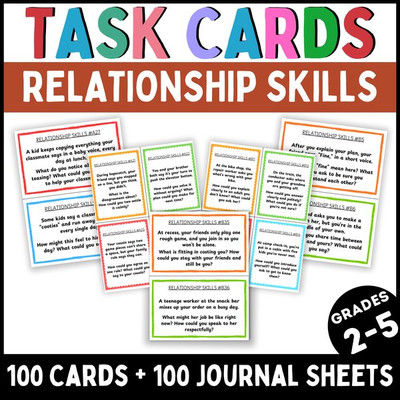 Free Relationship Skills Task Cards — Printable & DigitalGrades 2–5 · Print + digitalFREE
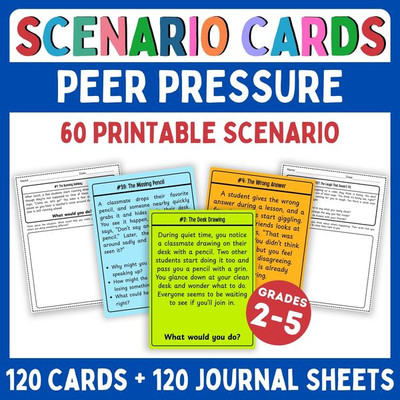 Peer Pressure Scenario Cards — Printable & DigitalGrades 2–6 · Print + digitalFULL LIBRARY
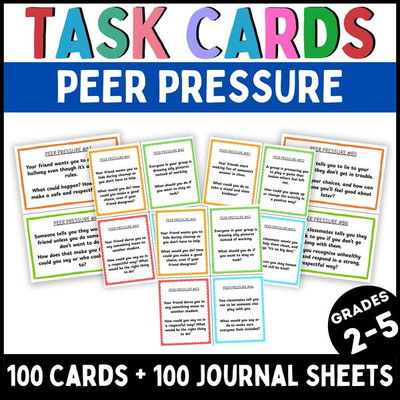 Peer Pressure Task Cards — Printable & DigitalGrades 2–5 · Print + digitalFULL LIBRARY
 Peer Pressure Role Play ScenariosGrades 2–5 · PrintFULL LIBRARY
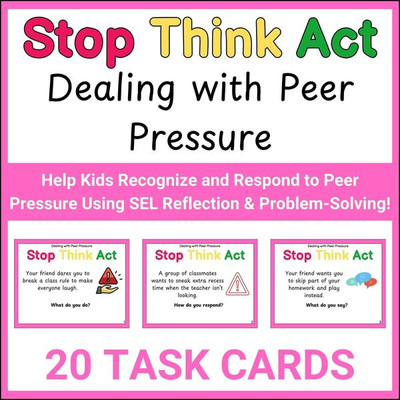 Peer Pressure Stop Think Act Cards — Printable & DigitalGrades 2–5 · Print + digitalFULL LIBRARY
See everything on the Peer Pressure resources page or browse all free SEL resources.
Frequently asked questions
How do you teach a child to say no to peer pressure?
Give them a simple plan and lots of low-stakes practice: notice the push, check with yourself (is it safe, is it kind?), say no in your own words, and step away or get help. Rehearse with kid-sized scenarios so the words are ready before a real moment comes.
What are examples of peer pressure for kids?
For elementary students, peer pressure often looks like: friends urging you to break a rule when “nobody’s looking,” to join an unkind joke, to play a prank, to run where you’re not allowed, or quietly feeling you need the same sneakers or the same favorite game to fit in.
What are some easy ways for kids to say no?
Short and clear works best: “No thanks.” “That’s not for me.” “I’ll pass.” Kids can add a reason (“My family doesn’t do that”) or another idea (“Let’s play tag instead”), and repeat the same no calmly if friends keep pushing.
What are examples of positive peer pressure?
Positive peer pressure is when friends pull each other toward good choices: a friend talks you into trying out for a team, your group decides to include a new student, or classmates cheer each other on to finish a hard project. The useful question for kids is “Would I make this choice on my own?” rather than “Is someone pushing me?”
Are the peer pressure scenario cards really free?
Yes. The Relationship Skills Scenario Cards (60 scenarios with journal pages) and the Relationship Skills Task Cards (100 cards with reflection sheets) are complete sets, free with a free SELcurve account. No card needed. Both include a digital version you can share as one link.
More SEL ideas
 Relationship SkillsHow to Teach Self-Advocacy to Kids: 10 Games, a 4-Step Routine + Free Scenario Cards
 Relationship SkillsHow to Teach Conflict Resolution to Kids: A 5-Step Talk-It-Out Routine, 10 Games + Free Scenario Cards
 Relationship SkillsTeasing vs. Bullying: How to Teach Kids the Difference (+ 4 Upstander Steps and Free Scenario Cards)


