
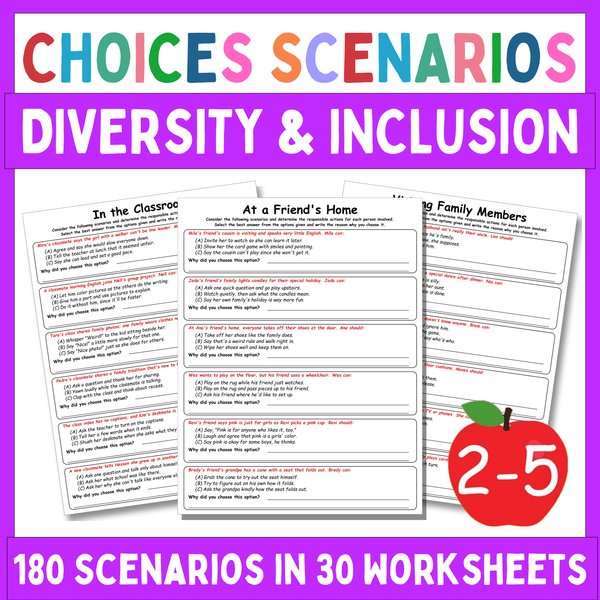
Diversity and Inclusion Worksheets — Multiple-Choice Scenarios
A classmate who signs, a cousin still learning English, a friend whose two moms pick her up from the party.
This resource is in the full SEL Resource Library. See what’s included or start with 10 free resources. Have an account? Log in.
About this resource
A classmate who signs, a cousin still learning English, a friend whose two moms pick her up from the party. These diversity and inclusion worksheets put moments like those in front of Grades 2–5 and ask what they would do: pick A, B or C, then write why. All 180 scenarios build Social Awareness around one question: does everyone get to belong?
What students practice
- Noticing differences in looks, language, family and food
- Asking respectful, curious questions
- Including someone who is different in the game or the group
- Kindly correcting an unfair assumption
- Learning about traditions that aren’t their own
- Adjusting a plan so everyone can take part
What’s inside
- 30 printable worksheets, one everyday setting each, from Community Parks to Public Libraries
- 180 multiple choice scenarios (A, B, C), six to a page, each followed by “Why did you choose this option?”
- 4 teacher pages: a welcome, ideas for using the set, a guide to running a scenario discussion (with a scoring note) and a note on differentiation
- 35 pages
A look inside
- At a Friend’s Home: “Wes wants to play on the floor, but his friend uses a wheelchair. Wes can:” (A) Play on the rug while his friend just watches. (B) Play on the rug and pass pieces up to his friend. (C) Ask his friend where he’d like to set up.
- Home Responsibilities: “Rory’s friend says dads can’t braid hair.” One of Rory’s options is to say, “My dad braids my sister’s hair!”
- In the Classroom: the class video has no captions, and Kim’s deskmate is hard of hearing.
How to use these diversity and inclusion worksheets
- Morning meeting: read the Wes scenario aloud and talk about why asking his friend is different from deciding for him
- Small groups or an SEL lesson: after students share their reasons, use the guide’s question about how each choice would make the person who is different feel
- Before a field trip, choose the At Museums or On the School Bus page
- Use the Pro Tip from the teacher pages and act out all three choices
Grade fit
The stems are one sentence long, and the differences are ones children meet in their own week: new glasses, a hearing aid, a family dance after dinner, a family with two dads. Second graders can do a page aloud, and the differentiation note suggests older students write diversity and inclusion scenarios of their own.
Digital version
The interactive digital version shares as one link: students pick A, B or C and type their reason, or just pick if you choose the choices-only format, on any device with no student logins. At the end they download an answer sheet to hand in.
Good to know
One worksheet is set During Religious Services; its scenes stay general, like following along quietly at a friend’s service.
Pairs well with
For the same skills as open-response cards, try Diversity and Inclusion Task Cards, or build belonging as a class with The Friend Circle — Inclusion Activity Kit.
Questions teachers ask
Is there an answer key?
No. The discussion guide includes a scoring note on what makes the strongest choice (respecting the difference and letting the person take part their own way), and students' written reasons give you the rest.
Do students need accounts for the digital version?
No. You share one link, and students open it on any device without logging in.
More for Social Awareness
See all in the library →


Every resource, one library.
572 SEL resources for elementary classrooms — printables, digital activities and answer sheets, and every new one we add.

