
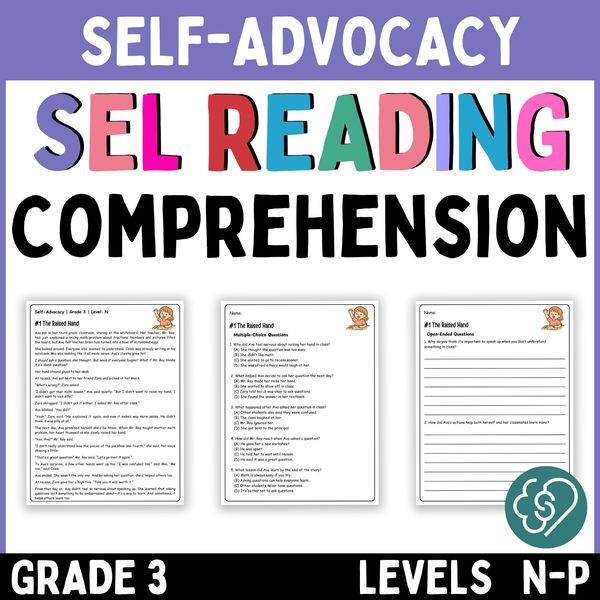
Self-Advocacy Reading Comprehension Passages — Grade 3
The student who needs help but doesn’t ask. The student whose idea got ignored.
This resource is in the full SEL Resource Library. See what’s included or start with 10 free resources. Have an account? Log in.
About this resource
The student who needs help but doesn’t ask. The student whose idea got ignored. These self-advocacy reading comprehension passages give Grade 3 readers ten texts at F&P levels N–P with the words and models to speak up. The set supports Relationship Skills, a CASEL competency, with self-management too, and treats speaking up as a learnable skill.
What students practice
- Using your voice in class and in a group
- Setting boundaries with a respectful tone
- Planning and delivering your message
- Advocating for inclusion and for health needs
- Saying no without hurting feelings
What’s inside
- 10 passages at F&P levels N–P, from narrative nonfiction to a student-initiative news feature and a youth-activist sketch
- 5 multiple-choice questions per passage
- 2 open-ended questions per passage for written answers or discussion
- Multiple-choice answer key for all 10 passages on one page
- 37 pages, including an overview of the passages with F&P levels and SEL focus
A look inside
- The Raised Hand: narrative nonfiction about advocating for understanding in class.
- My Plan to Be Heard: a first-person reflection on planning and delivering a message.
- The Allergy Table: a passage on advocating for inclusion and health needs.
- The Playground Petition: a news feature on group advocacy and respectful civic action.
- From Shy to Spokesperson: The Story of Marley Diaz: a biographical sketch of a youth activist.
How to use these self-advocacy reading passages
- Guided reading groups at levels N–P
- Partner reading, with the open-ended questions as a talk prompt
- SEL reading comprehension: read “What It Means to Use Your Voice” and talk about speaking up respectfully
- Independent practice or homework, checked with the answer key
Grade fit
These reading passages with questions are written for Grade 3, with levels rising from N to P. Hand-raising, group projects and petitions are where third graders first test their voice, and the P-level biography gives strong readers a real activist to follow.
Digital version
With the interactive digital version, you share one link and students read each passage and answer the questions on any device, with no student logins. At the end they download an answer sheet to hand in.
Pairs well with
After the reading, Self-Advocacy Scenario Cards and Self-Advocacy Worksheets carry the topic into a different format, with more self-advocacy activities.
Questions teachers ask
Which reading levels does the Grade 3 self-advocacy set cover?
The ten passages run from F&P level N to P. Text types include narrative nonfiction, how-to, student profile, science-based informational.
Is there an answer key?
Yes. The multiple-choice answers for all ten self-advocacy passages sit together on one page. The open-ended questions have no fixed answer.
Can students read the self-advocacy passages on a device?
Yes, through the digital version. You share one link and students open it on any device without logging in.
More for Relationship Skills
See all in the library →

Every resource, one library.
572 SEL resources for elementary classrooms — printables, digital activities and answer sheets, and every new one we add.

