
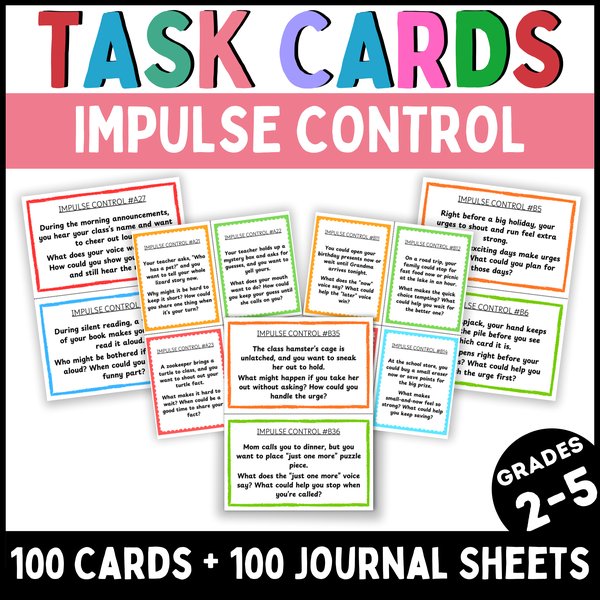
Impulse Control Task Cards — Printable & Digital
The urge often wins by a second: the hand is already on the dice, the answer is already out.
This resource is in the full SEL Resource Library. See what’s included or start with 10 free resources. Have an account? Log in.
About this resource
The urge often wins by a second: the hand is already on the dice, the answer is already out. These impulse control task cards give students in Grades 2–5 100 chances to find that second: waiting a turn, keeping hands to themselves, saving a story for the right time, not peeking at the last page of a mystery. They build Self-Management through SEL practice in pausing, waiting and choosing.
What students practice
- Waiting their turn without grabbing or calling out
- Keeping hands and body to themselves
- Raising a hand instead of blurting
- Noticing an urge early and naming it
- Waiting for something better later
- Staying in control when a group gets wild
What’s inside
- 100 task cards: Set A (50 cards, Grades 2–3) and Set B (50 cards, Grades 4–5)
- Set A themes: Waiting my turn; Keeping my hands and body to myself; Raising my hand instead of blurting; “I want it now!” (treats, toys, surprises); Stop, listen, then start
- Set B themes: Noticing the urge before it wins; Waiting for something I really want (later is better); Words I can’t take back; Resisting temptation (peeking, sneaking, grabbing extra); Self-control when the group gets wild
- Both sets in 2-per-page and 4-per-page versions, with a reflection journal page per card
- 81 pages of task cards, 103 pages of journal
A look inside
- Set A: “Your uncle is showing you how to cast a fishing line, and you start swinging the rod. What could happen if you swing now? What could you tell yourself as you watch?”
- Set B: “Your classmate is working out a math problem aloud, and you blurt the answer for her. What made the answer jump out? How could you give her time to finish her thinking?”
- Set B: “Your crystal kit says not to open the last packet until day three, and it’s only day one. What makes the packet so tempting? How could you keep your curiosity for two more days?”
How to use these impulse control task cards
- Morning meetings: a Raising my hand instead of blurting card, such as the turtle fact a student wants to shout out (A23)
- Small groups: Self-control when the group gets wild (B41–B50), with bus chants, flying streamers at a class party and tag between the desks
- Journal pages for writing about waiting, pausing and self-talk
Grade fit
Set A is labelled for Grades 2–3 and uses lines, games and busy places, plus simple self-talk like “My turn is coming.” Set B is labelled for Grades 4–5 and looks at the urge itself: how it rises and fades, weighing a small reward now against a better one later, and the pause before words you can’t take back.
Digital version
The interactive digital task cards share as one link: you choose Set A or Set B, and students type their answers on any device with no student logins. At the end they download an answer sheet to hand in.
Pairs well with
Round out your impulse control activities with Impulse Control Scenario Cards or the think-first Impulse Control What Would You Do? Cards.
Questions teachers ask
Which set should I use?
Set A is labelled for Grades 2–3 and Set B for Grades 4–5. Set A practices waiting and keeping hands to yourself; Set B adds noticing an urge early and resisting temptation.
Is there an answer key?
No. The prompts ask about each student’s own urges and choices, so answers will vary.
More for Self-Management
See all in the library →



Every resource, one library.
572 SEL resources for elementary classrooms — printables, digital activities and answer sheets, and every new one we add.

