
Identifying Triggers Task Cards — Printable & Digital
A wobbly chair, a spoiled movie ending, a dad singing loudly at drop-off: small things can set off big feelings.
This resource is in the full SEL Resource Library. See what’s included or start with 10 free resources. Have an account? Log in.
About this resource
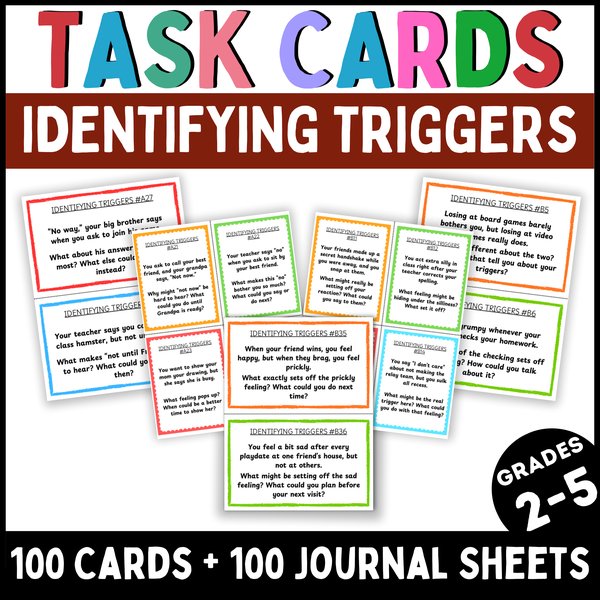
A wobbly chair, a spoiled movie ending, a dad singing loudly at drop-off: small things can set off big feelings. These identifying triggers task cards help students in Grades 2–5 find their own, with 100 everyday moments that ask what set the feeling off and when it tends to happen. The set builds Self-Awareness, the CASEL competency of understanding yourself well enough to plan ahead.
What students practice
- Naming everyday things that bug them
- Spotting trigger moments like rushing, waiting and hearing “not now”
- Finding hidden triggers such as feeling left out or embarrassed
- Noticing patterns in when and where feelings flare
- Making a trigger plan and changing it when it stops working
What’s inside
- 100 SEL task cards in two leveled sets of 50: Set A for Grades 2–3, Set B for Grades 4–5
- Set A themes: things that bug me; hurry, rush and waiting; being told ‘no’ or ‘not now’; things people say or do; getting ready for tricky times
- Set B themes: spotting my triggers; hidden triggers: feeling left out or embarrassed; patterns in when and where; triggers with friends; making a trigger plan
- 2-per-page and 4-per-page layouts, ten cards per theme
- Separate journal file with a reflection sheet per card; 81 task-card pages plus 103 journal pages
A look inside
- Set A: “Your teacher says you have one minute left to finish your writing. Why might a short time limit set off big feelings? What could you do next time?”
- Set B: “You often feel left out in the gym, but almost never in the art room. What might be different about these places? How could this help you plan?”
- Set B: “Your plan for feeling left out at recess worked last week but not this week. What might have been different this time? How could you change your plan?”
How to use these identifying triggers task cards
- Morning meeting: a things-that-bug-me card such as the leaky water bottle (A9) starts an easy, low-stakes conversation
- Small groups or counseling sessions: work through the making-a-trigger-plan cards (B41–B50) toward a plan of the student’s own
- Ahead of a tricky time: the getting-ready cards (A41–A50) cover a class party, a relay race and leaving the playground
- Writing prompts: the reflection sheets give students a private place to write what sets them off
Grade fit
Set A (Grades 2–3) sticks to triggers younger students can point to, like a dried-up glue stick or a “no” from the coach. Set B (Grades 4–5) works backward from a mood to its cause and looks for patterns, such as feeling irritable late on long school days or moody on weekend afternoons with nothing planned.
Digital version
The interactive digital task cards share as one link: you choose Set A or Set B, and students type their answers on any device with no student logins. At the end they download an answer sheet to hand in.
Good to know
The triggers here cover many feelings, not just anger: cranky, sad, embarrassed and even so happy you can’t sit still. Naming feelings and choosing calming tools are not the focus; the cards stop at spotting the trigger and planning ahead.
Pairs well with
For identifying triggers activities with longer scenes, add Identifying Triggers Scenario Cards or Identifying Triggers What Would You Do? Cards.
Questions teachers ask
Is this set just about anger?
No. The cards look at what sets off many strong feelings, including sadness, embarrassment, frustration and overexcitement.
Do students need accounts for the digital version?
No. Share one link; students open it on any device without logging in.
More for Self-Awareness
See all in the library →

Every resource, one library.
572 SEL resources for elementary classrooms — printables, digital activities and answer sheets, and every new one we add.

