
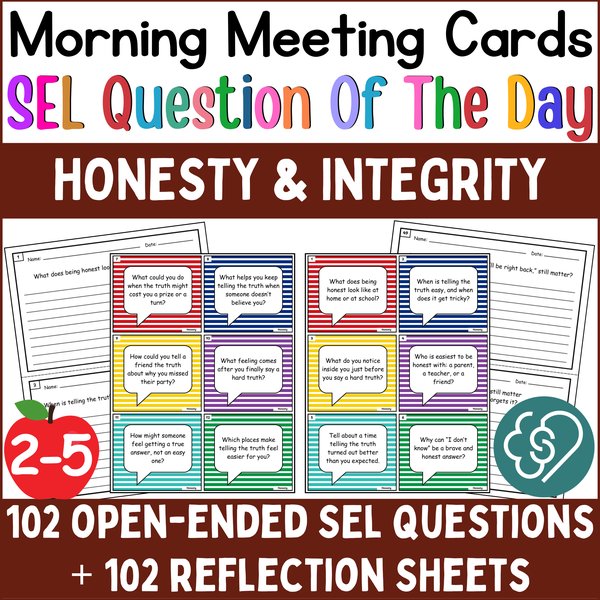
Honesty Conversation Cards — Morning Meeting Questions
Honesty gets tested in small places: a peek during hide-and-seek, a weekend story that grows, a pinky promise.
This resource is in the full SEL Resource Library. See what’s included or start with 10 free resources. Have an account? Log in.
About this resource
Honesty gets tested in small places: a peek during hide-and-seek, a weekend story that grows, a pinky promise. These honesty conversation cards give you 102 morning meeting questions about telling the truth, fibs, promises and doing right when no one is watching. For Grades 2–8, they build Responsible Decision-Making by asking students to think about their own honest choices.
What students practice
- Telling the truth when it is hard
- Noticing small fibs and stretched stories
- Keeping promises
- Doing right when no one is watching
- Being honest and kind at once
- Seeing why honesty matters
What’s inside
- 102 discussion questions arranged in six focus areas of 17: telling the truth when it is hard, small fibs and stretching the truth, keeping promises, doing right when no one is watching, being honest and kind, and why honesty matters to me and others
- 17 pages of cards, six per page
- 102 matching reflection sheets, two per page
- A numbered question list with types, led by Analytical (20)
- 75 pages
A look inside
- “How can something be true but still unkind to say?”
- “Why does peeking while counting in hide-and-seek spoil the game?”
- “What would you do if a store gave you too much change back?”
- “How is being honest different from being perfect?”
How to use these honesty conversation cards in morning meeting
- Morning meeting: read a card, have partners turn and talk, then invite a few answers
- Conversation circles where students draw a card at random from the fibs set
- Small-group or counseling sessions on keeping promises
- SEL reflection journals with the matching sheet for each card
Grade fit
Younger students know these moments from game time and a saved treat nobody would miss. Older students can wrestle with white lies, calling their own foul or a test marked too kindly, which makes these good conversation starters for middle school.
Digital version
The digital version turns the questions into one link: students answer on any device with no student logins and download an answer sheet to hand in.
Good to know
The set keeps to everyday honesty. Secrets about safety and online honesty are outside its scope, so plan those conversations separately.
Pairs well with
Take it further with Honesty What Would You Do? Cards or Honesty Scenario Cards.
Questions teachers ask
Does the set cover owning up to mistakes?
No. It stays with truth-telling, fibs, promises, doing right when no one is watching and being honest in a kind way.
Is there a question about white lies?
Yes. One card asks why some people tell white lies to protect feelings, and another asks what to say when a friend asks if you like their new haircut.
More for Responsible Decision‑Making
See all in the library →

Every resource, one library.
572 SEL resources for elementary classrooms — printables, digital activities and answer sheets, and every new one we add.

