
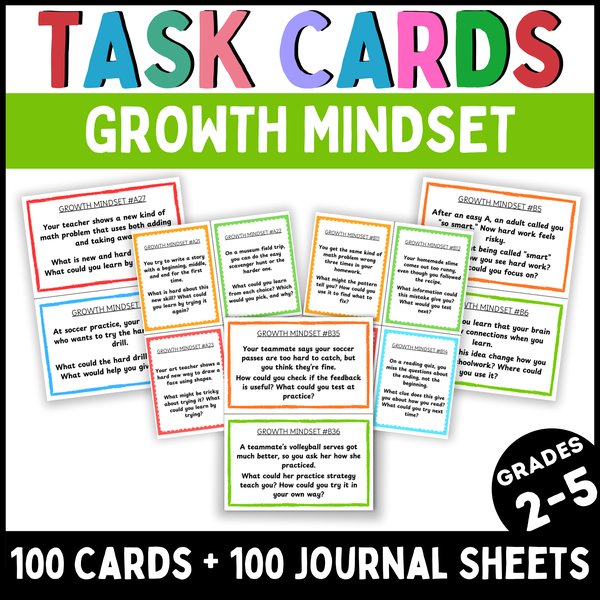
Growth Mindset Task Cards — Printable & Digital
A circled “frend” on a spelling test can end a conversation, or start one.
This resource is in the full SEL Resource Library. See what’s included or start with 10 free resources. Have an account? Log in.
About this resource
A circled “frend” on a spelling test can end a conversation, or start one. These growth mindset task cards turn moments like that into practice: 100 prompts for Grades 2–5 about mistakes, the word “yet,” feedback and smarter ways to practice. The skills on the cards are real ones, from rope climbing and chess to knitting a scarf, and the set builds Self-Awareness, the CASEL competency behind how students see their own learning.
What students practice
- Treating a mistake as something to learn from
- Adding “yet” to “I can’t”
- Choosing the harder option on purpose
- Learning from feedback and from a classmate’s success
- Combining effort with a new strategy and some help
What’s inside
- Set A, 50 SEL task cards for Grades 2–3: mistakes help me learn; the power of ‘yet’; trying hard things; learning from feedback; getting better with practice
- Set B, 50 cards for Grades 4–5: fixed vs. growth thinking; mistakes as information; choosing challenge over easy; using feedback and others’ success; effort + strategy + help
- A themes page showing which ten cards belong to each theme
- Two print layouts, 2 or 4 cards per page
- A companion file with one reflection sheet per card: 81 task-card pages and 103 journal pages
A look inside
- Set A: “Your first dragon drawing looks wobbly. Your tenth one looks much better. What changed between the first and the tenth? What does this show about practice?”
- Set B: “Your homemade slime comes out too runny, even though you followed the recipe. What information could this mistake give you? What would you test next?”
- Set B: “You think asking for help means you aren’t smart enough. Where might that belief come from? How do you think strong learners use help?”
How to use these growth mindset task cards
- Morning meeting: read a power-of-‘yet’ card (A11–A20) and hear a few answers
- Small groups: the mistakes-as-information cards (B11–B20) ask students to look for a pattern, from runny slime to a paper bridge that collapses
- Counseling sessions: the choosing-challenge cards (B21–B30) open a talk about why the easy level feels comfortable
- Writing center: pair a getting-better-with-practice card with its reflection sheet
Grade fit
Set A (Grades 2–3) keeps to skills younger students can picture, like mixing up b and d, a sagging block bridge or paper frogs that hop farther. Set B (Grades 4–5) asks students to question beliefs such as “I’m just not an art person” and to notice when hard work needs a better strategy, not just more effort.
Digital version
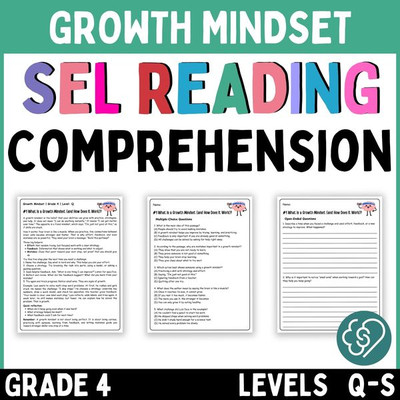
The interactive digital task cards share as one link: you choose Set A or Set B, and students type their answers on any device with no student logins. At the end they download an answer sheet to hand in.
Good to know
The cards are about learning a skill, subject, sport or craft. Bouncing back from bigger life setbacks and getting started on a task belong to other topics, so you won’t find them here.
Pairs well with
For more growth mindset activities, add The Power of Yet — Growth Mindset Activity Kit for a hands-on lesson, or Growth Mindset Scenario Cards for longer situations.
Questions teachers ask
Can I teach one theme at a time?
Yes. Each theme is ten numbered cards (A1–A10, A11–A20 and so on), and the themes page lists them, so you can pull just the ‘yet’ cards or just the feedback cards.
Is there an answer key?
No. The cards are open-ended and ask about the student’s own learning, so there is no single right answer.
Do students need logins for the digital version?
No. One link opens it on any device.
More for Self-Awareness
See all in the library →

Every resource, one library.
572 SEL resources for elementary classrooms — printables, digital activities and answer sheets, and every new one we add.

