

Self-Awareness Worksheets — Multiple-Choice Scenarios
Free self-awareness worksheets for Grades 2–5, and this is the full set: it’s free with a free account (no card needed).
Free with a free account — no credit card. Create a free account or log in.
About this resource
Free self-awareness worksheets for Grades 2–5, and this is the full set: it’s free with a free account (no card needed). Each page gives students six short moments where they look inward, like Farah frowning over lost glue while her partner thinks she’s mad at him. They pick A, B or C, then write why, across all ten areas of Self-Awareness.
What students practice
- Naming a feeling out loud instead of acting it out
- Reading body signals like a racing heart or a dizzy head
- Spotting strengths that aren’t school subjects
- Choosing by their own values
- Noticing what sets off a mood
What’s inside
- 30 printable worksheets, three per sub-topic, each set in one everyday place
- 180 multiple choice scenarios (A, B, C), each with a “Why did you choose this option?” line
- Ten sub-topics, from Identifying and Naming Your Emotions to Noticing What Triggers Your Feelings
- 4 teacher pages, including a guide to running a scenario discussion; 35 pages
A look inside
- In the Classroom: “Farah frowns about the lost glue. Her partner thinks she’s mad at him. She can:” (A) Tell him, “I’m grumpy about the glue, not you.” (B) Tell him, “I’m grumpy,” and keep looking. (C) Keep frowning and let him think it’s him.
- On the School Bus, Kira can think “That was hard, and I did it. Go me!” or “I did it. It was easy for me.”
- At Museums: “Leaving the bug room, Esme finds she liked the spiders she used to fear.”
How to use these self-awareness worksheets
- Morning meeting: read the Kira scenario and ask which thought sounds most like a good coach
- Small groups: compare reasons, then ask the guide’s question, “What did the character notice about themselves, and how did knowing that help them choose?”
- Independent reflection, early finishers or sub plans, since each worksheet stands alone
- After a rough week, pick the three triggers worksheets
Grade fit
The scenes come from a child’s week (the dinner table, sports teams, a bike ride with Dad) and each scenario is one or two short sentences, so second graders can follow a read-aloud and older students can stretch the why line.
Digital version
The interactive digital version shares as one link: students pick A, B or C and type their reason, or just pick if you choose the choices-only format, on any device with no student logins. At the end they download an answer sheet to hand in.
Good to know
The teacher pages note that in-between answers often do the right thing but miss the feeling’s real cause, so they make good SEL discussion points.
Pairs well with
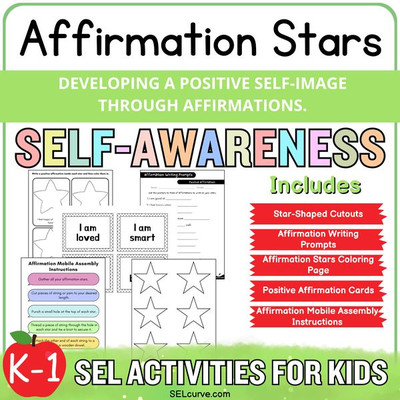
For one area in depth, try Feelings and Emotions Worksheets or Positive Self-Talk Worksheets. To keep it free, add Free Self-Awareness What Would You Do? Cards.
Questions teachers ask
Is there an answer key?
There is no separate key. The teacher pages explain what makes the best answer (the one that uses self-knowledge most fully), and the why line shows you each student’s thinking.
Do students need accounts for the digital version?
No. You share one link, and students open it on any device without logging in.
More for Self-Awareness
See all in the library →

Every resource, one library.
572 SEL resources for elementary classrooms — printables, digital activities and answer sheets, and every new one we add.

