
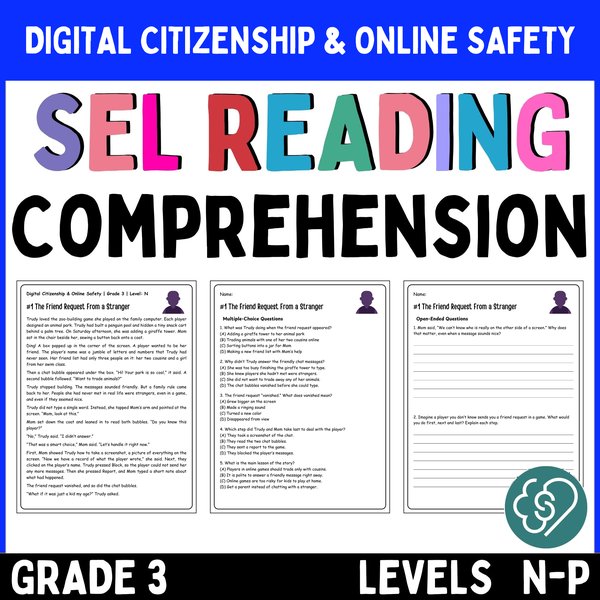
Digital Citizenship Reading Comprehension Passages — Grade 3
Third graders want the reasons behind online rules, not just the rules.
This resource is in the full SEL Resource Library. See what’s included or start with 10 free resources. Have an account? Log in.
About this resource
Third graders want the reasons behind online rules, not just the rules. These digital citizenship reading comprehension passages give Grade 3 readers ten passages at F&P levels N–P that explain why: why a username leaves out your town, why games are hard to put down, why a silly rhyme can travel further than its writer meant. It’s a Responsible Decision-Making set with the reasoning built in.
What students practice
- Not replying to players they don’t know, and telling a grown-up
- Making a safe username
- Choosing apps with a family checklist
- Leaving specific, kind comments
- Asking a grown-up before buying anything online
- Checking surprising claims with trusted sources
What’s inside
- 10 passages at F&P levels N–P, from a message that tells its own story to a concept piece on ads and in-app purchases
- Each passage ends by stating its lesson plainly
- 5 multiple-choice questions per passage, several on vocabulary in context or the way the passage is organized
- 2 open-ended prompts per passage for written replies
- MCQ answer key on the last page
- 44 pages
A look inside
- The Friend Request From a Stranger: Trudy doesn’t reply, tells her mom, and they take a screenshot, then block and report the player.
- The Message That Traveled Everywhere: a boy’s rhyme about his stuffed walrus is copied from screen to screen until it reaches his baseball coach.
- The Shared Password Problem: a classmate changes Vesna’s game avatar as a joke, and she and her teacher reset the password.
- Meet Yaretzi: The Fact-Check Corner Captain: classmates bring surprising things they read online to her “Is It True?” table.
How to use these digital citizenship reading passages in Grade 3
- Guided reading groups at levels N–P, beginning with How to Make a Safe Username
- Morning work, one passage at a time
- SEL lessons, such as Why Games Are Hard to Stop and the brain’s reward system
- A quick talk before students log on to a class computer, using Ads, Pop-Ups and In-App Purchases
Grade fit
Levels run from N to P, and the topics fit kids who are starting to play online games, comment on class pages and choose new apps with their families. The book review blog story and the app-choosing comparison show third graders the questions grown-ups ask, which makes these reading passages with questions useful beyond reading time.
Digital version
With the interactive digital version, you share one link and students read each passage and answer the questions on any device, with no student logins. At the end they download an answer sheet to hand in.
Pairs well with
Digital citizenship activities that pair well: Digital Citizenship Task Cards for written follow-ups and, for more online situations, Digital Citizenship Scenario Cards.
Questions teachers ask
Is there an answer key?
Yes. The multiple-choice answers are on the last page of the PDF. The open-ended questions have no fixed answer.
What do students do when a stranger contacts them in a passage?
In The Friend Request From a Stranger, Trudy doesn’t reply and tells her mom, and together they take a screenshot, then block and report the player.
Do students need accounts for the digital version?
No. You share one link, and students open it on any device without logging in.
More for Responsible Decision‑Making
See all in the library →


Every resource, one library.
572 SEL resources for elementary classrooms — printables, digital activities and answer sheets, and every new one we add.

