
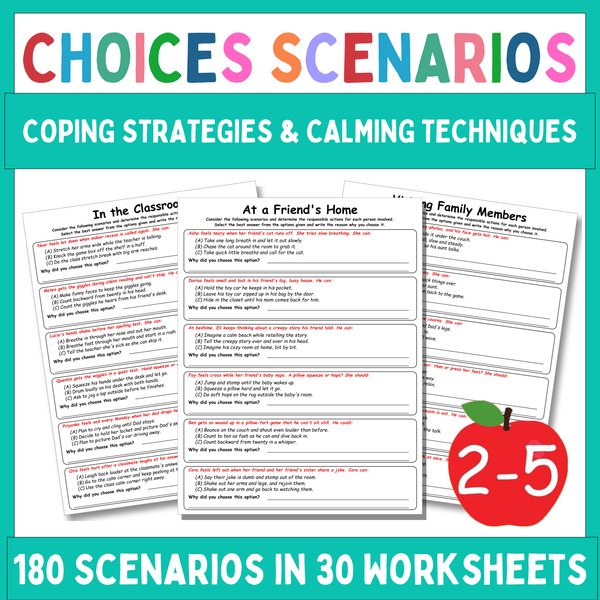
Coping Skills Worksheets — Multiple-Choice Scenarios
Knowing five calming tools is one thing; picking the right one when the bus brakes hard is another.
This resource is in the full SEL Resource Library. See what’s included or start with 10 free resources. Have an account? Log in.
About this resource
Knowing five calming tools is one thing; picking the right one when the bus brakes hard is another. These coping skills worksheets give Grades 2–5 180 short moments where a big feeling shows up, from a popped balloon to beeping registers at checkout, and three ways to respond. Students choose A, B or C and write why it fits, building Self-Management one calming choice at a time.
What students practice
- Using slow breathing
- Counting to settle
- Moving the body to calm down
- Using a calm spot, object or comfort
- Picturing a calm place or making a plan
- Choosing the right tool for the moment
What’s inside
- 30 printable worksheets, one setting each, including On the School Bus, Public Libraries and In the Garden
- 180 multiple choice scenarios in sets of 6, each with a “Why did you choose this option?” line
- Six themes: five calming tools (breathing, counting, moving, a calm spot or comfort object, picturing or planning) plus choosing the tool that fits
- 4 teacher pages
- 35 pages
A look inside
- In the Garden: “A wasp lands on Wes’s sleeve. Run inside or stand still and breathe? He should:” (A) Breathe slowly and flap his arm a little. (B) Swat at it and yell at it to fly away right now. (C) Keep still and breathe slowly as it flies off.
- School Responsibilities: Yael forgot her homework, and her face gets hot. “Take two slow breaths, then tell her teacher” sits next to “a gulp of air” and blurting it out.
- At the Grocery Store: beeping registers make Pablo’s head buzz, so he plans ahead for checkout.
How to use these coping skills worksheets
- Morning meeting: read the wasp scenario and ask why A and C both use breathing, but only one fits
- Small groups: dig into the in-between answers, where a tool is used too fast, too briefly or in the wrong place
- Before a field trip, use the On the School Bus page, where Zuri feels jumpy and excited on the way
Grade fit
The tools are concrete, and many scenarios show the feeling in the body: a tight chest, a hot face, a tummy that flips. That keeps it readable for Grade 2 and gives Grades 4–5 room to argue which tool fits best.
Digital version
The interactive digital version shares as one link: students pick A, B or C and type their reason, or just pick if you choose the choices-only format, on any device with no student logins. At the end they download an answer sheet to hand in.
Good to know
Many options use a real calming tool, just not well. Per the scoring note, in-between answers use a tool too quickly, too briefly, too late or in the wrong place. Expect good SEL debate.
Pairs well with
Coping Skills What Would You Do? Cards put the same calming choices on action cards, and the Coping Skills Task Cards add short written practice.
Questions teachers ask
Do students need to know the calming tools first?
It helps to introduce them, but the calming options name the tool in plain words (slow breaths, counting, a calm spot), so students can work it out from the scenario.
Why do two answers both look calm?
On purpose. The in-between answer uses a tool, but not well, and the why line is where students explain the difference.
Do students need accounts for the digital version?
No. One link works on any device without student logins.
More for Self-Management
See all in the library →
Every resource, one library.
572 SEL resources for elementary classrooms — printables, digital activities and answer sheets, and every new one we add.

