
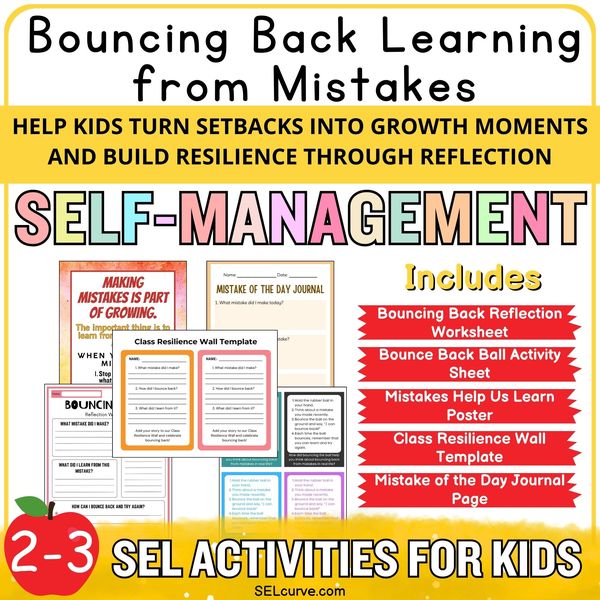
Bouncing Back — Resilience Activity Kit
Some students freeze after a mistake, crumpling the paper or going quiet instead of trying again.
This resource is in the full SEL Resource Library. See what’s included or start with 10 free resources. Have an account? Log in.
About this resource
Some students freeze after a mistake, crumpling the paper or going quiet instead of trying again. This learning-from-mistakes lesson, Bouncing Back, teaches what usually goes untaught: what to do in the moment right after something goes wrong. Pitched at Grades 2–4, it builds resilience and a growth mindset as part of Self-Management, in SEL activities that use a real rubber ball.
What students practice
- Seeing a mistake as something that can be learned from
- Naming how a mistake felt
- Planning how to try again
- Sharing setbacks with the class
What’s inside
- A teacher guide with a detailed script and a flexible outline: four steps, about 30 minutes
- A Reflection Worksheet with four boxes for the mistake, the feeling, the lesson and how to try again
- Bounce Back Ball Activity Sheet: four ball-bounce steps and one reflection question, 4 per page
- Mistakes Help Us Learn Poster, a Class Resilience Wall Template (2 versions) and a Mistake of the Day Journal (2 versions); 18 pages
A look inside
- From the teacher script: “Think of a rubber ball. When it falls, does it stay on the ground?”
- Bounce Back Ball Activity Sheet: “How did bouncing the ball help you think about bouncing back from mistakes in real life?”
- Mistakes Help Us Learn Poster: “1. Stop and think about what happened. 2. Learn from it.”
How to use this bouncing back kit
- Talk about resilience using the fall-off-a-bike-and-get-back-on example, then drop a rubber ball and let it bounce
- Have students fill in the reflection worksheet about a mistake they made
- Give each student a turn to bounce the ball and tell themselves they can bounce back
- Close with a sharing circle, then add to the Class Resilience Wall and keep the journal going
Grade fit
The ball, the wall and the worksheet give physical and visual anchors, which makes reflection reachable for Grades 2–4. It also works as a reset after a hard test or a tough week.
Good to know
You will need a rubber ball for the bounce.
Pairs well with
For practice beyond the lesson, Owning Mistakes Stop Think Act Cards apply the same habit to real situations, and The Power of Yet extends the growth mindset side.
Questions teachers ask
How long does it take?
About 30 minutes in four steps.
What do I need besides the printables?
A rubber ball.
More for Self-Management
See all in the library →

Every resource, one library.
572 SEL resources for elementary classrooms — printables, digital activities and answer sheets, and every new one we add.

