
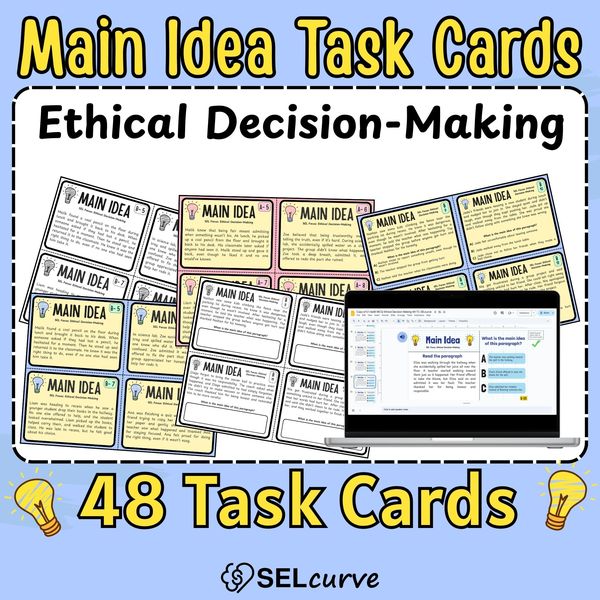
Ethical Decision-Making Task Cards
Main idea practice usually comes with paragraphs students forget by lunch.
This resource is in the full SEL Resource Library. See what’s included or start with 10 free resources. Have an account? Log in.
About this resource
Main idea practice usually comes with paragraphs students forget by lunch. These ethical decision making task cards use short paragraphs about choices that matter: telling the truth after a mistake, returning something that isn’t yours, refusing to laugh along when a classmate is teased. Students read for the main idea and end up talking about the right thing to do. Written for Grades 2–5, the set builds Responsible Decision-Making.
What students practice
- Finding the main idea of a short paragraph
- Making honest choices after a mistake
- Thinking about fairness and inclusion
- Standing up for someone
- Owning a mistake
What’s inside
- 24 supportive task cards (Set A): paragraphs with a clear topic sentence, in paragraph-only, multiple-choice and open-ended formats
- 24 challenging task cards (Set B): the same situations with the main idea left for students to infer, in all three formats
- Color and black-and-white versions of every card
- Multiple-choice answer sheet (2 pages) and an open-ended response sheet
- Answer key for the multiple-choice cards; 83 pages in all
A look inside
- Set A: “Jordan knew he had to take responsibility when he made a mistake.”
- Set A: “Tara believed that stopping a rumor was better than spreading it.”
- Set B: “Leo spotted a wallet lying near the swings on the playground.”
How to use these ethical decision making task cards
- Paragraph-only cards for group reads, think-pair-share or modeling under a document camera
- Multiple-choice cards, where students pick the best of three main ideas
- Open-ended cards, where students write the main idea in their own words
- A literacy center, small reading group, early-finisher work or exit ticket
- An SEL conversation about doing the right thing when it is hard
- Task cards for students to use at a literacy center, with making good choices activities as the follow-up conversation
Grade fit
Set A states the main idea in a topic sentence, so students who need support can find it and check their thinking. Set B tells the same 24 stories without it, so students infer the main idea from the details. Both levels suit Grades 2–5; give different levels to different groups.
Pairs well with
For a calm follow-up, Ethical Decision-Making Coloring Pages carry the same theme into quiet time, and Making Good Choices Task Cards add decision prompts.
Questions teachers ask
What is the difference between Set A and Set B?
Set A states the main idea in a clear topic sentence. Set B tells the same 24 stories without it, so students infer the main idea.
Is there an answer key?
Yes, for the multiple-choice cards. The open-ended cards use a response sheet.
More for Responsible Decision‑Making
See all in the library →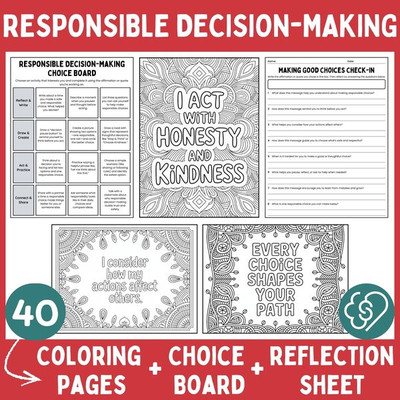
Every resource, one library.
572 SEL resources for elementary classrooms — printables, digital activities and answer sheets, and every new one we add.

