
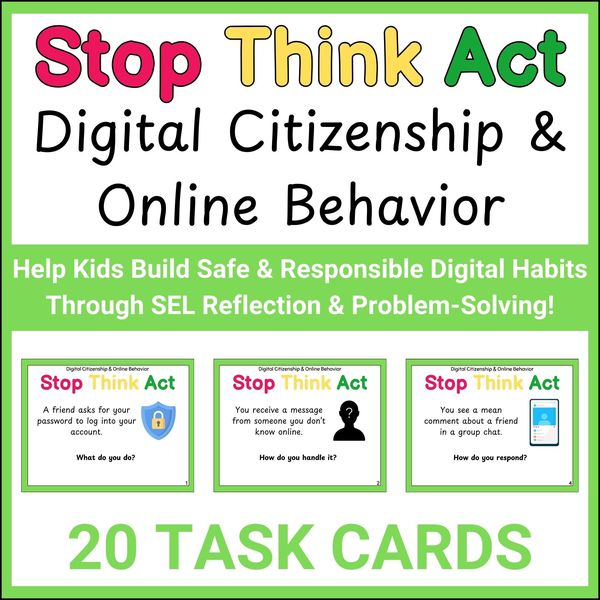
Digital Citizenship Stop Think Act Cards — Printable & Digital
Online, the urge to click comes fast and the consequences arrive later.
This resource is in the full SEL Resource Library. See what’s included or start with 10 free resources. Have an account? Log in.
About this resource
Online, the urge to click comes fast and the consequences arrive later. These digital citizenship stop think act cards give students a routine for that gap: stop before sharing a password or opening a link, think about who could be affected, then act on the safest choice. There are 20 scenarios for Grades 2–5, built around Responsible Decision-Making.
What students practice
- Keeping passwords and personal details private
- Pausing before opening links or messages from strangers
- Asking permission before posting a picture of someone
- Checking whether information online is true
- Treating people kindly in group chats and online messages
What’s inside
- 20 Stop Think Act cards in a full-page format for whole-class discussion or the projector
- The same 20 cards in a 4-per-page format for small groups and centers
- 20 reflection sheets, one per scenario, each with five open-ended prompts
- 52 pages: 30 in the card file and 22 in the reflection sheet file
A look inside
- “You’re playing an online game, and a stranger asks for personal details. What’s the safest response?”
- “You want to share a funny picture of a friend, but they haven’t given permission. What do you do?”
- “You find a website with inappropriate content while doing research. What’s the best thing to do?”
How to use these digital citizenship stop think act cards
- Project one card before computer time and talk it through together
- Small groups: each group takes a card, decides what to do and shares back
- Reflection sheets as think before you act worksheets after an SEL or digital citizenship lesson
- Revisit a card whenever a real online issue comes up in class
Grade fit
The scenarios use situations elementary students meet early: online games, class research, messages and group chats. They fit Grades 2–5, and the five-question reflection sheets add depth for older students.
Digital version
The digital version shares as one link: students answer each card on any device, in the one-question or five-question format you pick, with no student logins. At the end they download an answer sheet to hand in.
Pairs well with
For more digital citizenship activities that keep the stop and think habit going, add Digital Citizenship Task Cards, or read Digital Citizenship Reading Comprehension Passages — Grade 4.
Questions teachers ask
What is the difference between the two digital formats?
The task card format asks one question per card. The reflection format asks the same five questions on every card, so students think it through more fully.
Do students need accounts for the digital version?
No. You share one link, and students open it on any device without logging in.
More for Responsible Decision‑Making
See all in the library →
Every resource, one library.
572 SEL resources for elementary classrooms — printables, digital activities and answer sheets, and every new one we add.

