
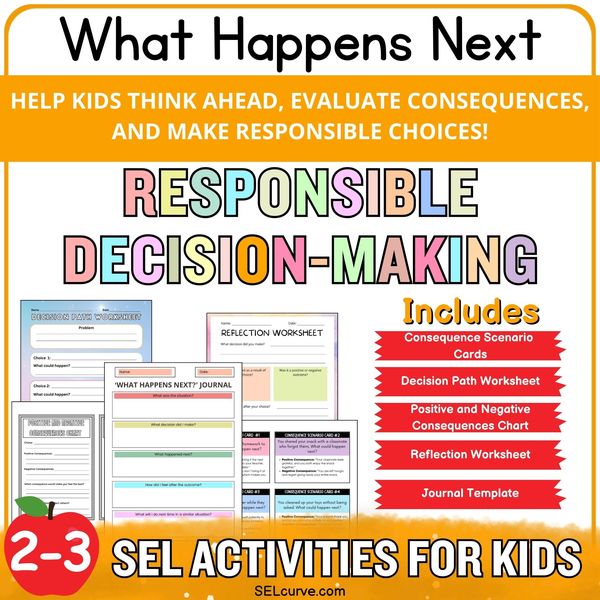
What Happens Next? — Choices and Consequences Activity Kit
Teaching consequences can sound like a discipline talk. What Happens Next?
This resource is in the full SEL Resource Library. See what’s included or start with 10 free resources. Have an account? Log in.
About this resource
Teaching consequences can sound like a discipline talk. What Happens Next? turns it into an investigation instead: students in Grades 1–3 trace where two different choices lead, compare the paths and build the habit of thinking one step ahead. It is a Responsible Decision-Making lesson and one of the SEL activities that makes a choice and its consequences visible on paper.
What students practice
- Connecting choices to likely outcomes
- Thinking of two choices for one situation
- Comparing which outcome is kinder for everyone
- Applying the pattern to real decisions
What’s inside
- A teacher guide with a detailed script and a flexible outline: three steps, about 25 minutes
- Consequence Scenario Cards: 12 everyday choices, each showing one positive and one negative consequence
- Decision Path Worksheet: two choices, what could happen after each, and which is better and why, in 2 versions
- A chart for weighing a choice, two per page
- Reflection Worksheet (five questions, 2 versions) and a repeatable What Happens Next? Journal page (2 versions); 19 pages
A look inside
- From the teacher script: “Every decision we make leads to something else happening. That’s called a consequence.”
- Consequence Scenario Card #8: “You accidentally bump into someone while walking. What could happen next?”
- Decision Path Worksheet: “How did thinking about the consequences help you make your decision?”
How to use this what happens next? kit
- Ask what choices students have already made today, then introduce the word consequence with the forgotten-homework example
- Walk through the worked example: a friend knocks over your blocks, and you either shout or take a breath and say how you feel
- Have students draw a scenario card, come up with two choices and write or draw what might happen after each
- Finish with a sharing circle, then use the reflection worksheet and journal for real decisions
Grade fit
The two-choice format, short written answers and everyday scenarios suit Grades 1–3. Younger students can draw their outcomes, and third graders can write them.
Pairs well with
Younger students can build the same habit through play with the Think Before You Act Game, or try the Cause and Effect kit, more making good choices activities.
Questions teachers ask
How long does the lesson take?
About 25 minutes across three steps.
How many scenario cards are there?
12 Consequence Scenario Cards, each showing one positive and one negative consequence.
More for Responsible Decision‑Making
See all in the library →



Every resource, one library.
572 SEL resources for elementary classrooms — printables, digital activities and answer sheets, and every new one we add.

