
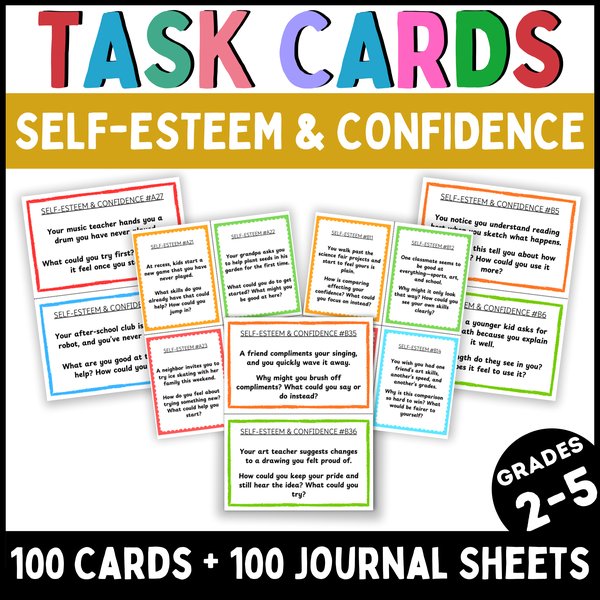
Self-Esteem Task Cards — Printable & Digital
Ask a second grader what they’re good at and you might get a shrug or one quick answer.
This resource is in the full SEL Resource Library. See what’s included or start with 10 free resources. Have an account? Log in.
About this resource
Ask a second grader what they’re good at and you might get a shrug or one quick answer. These self-esteem task cards help students find real evidence: a friend asking for help drawing a horse, a chapter book read alone, 20 math facts where there used to be 5. Written for Grades 2–5, the 100 cards build Self-Awareness, the CASEL competency of knowing your own strengths.
What students practice
- Naming everyday strengths at home and at school
- Seeing how far a skill has come since last year
- Bringing skills they already have to something new
- Keeping their confidence when someone else does better
- Taking healthy risks, like running for class representative
- Hearing praise and criticism without losing confidence
What’s inside
- Set A, Grades 2–3 (A1–A50): Things I am good at; Things I can do now that I couldn’t before; Trying new things with confidence; When others do better than me; Being proud of my effort
- Set B, Grades 4–5 (B1–B50): Knowing my strengths; Comparing myself to others; Confidence to take healthy risks; Handling praise and criticism; Building confidence from effort
- 100 cards in all, 10 per theme, in a 2-per-page or 4-per-page layout
- A 103-page journal file with a reflection sheet for each card, alongside the 81-page task card file
A look inside
- Set A: “At the start of the year, you knew 5 math facts. Now you know 20. How did you grow? How does seeing this change make you feel?”
- Set B: “Your friend is two swim levels ahead but started lessons years before you. How does knowing this change the comparison? What could you measure instead?”
- Set B: “A friend compliments your singing, and you quickly wave it away. Why might you brush off compliments? What could you say or do instead?”
How to use these self-esteem task cards
- Morning meeting: read one Things I am good at card and let a few students answer
- An SEL lesson, small group or counseling session on comparing, with B11–B20
- Writing prompts on the reflection sheets, especially the effort cards (A41–A50, B41–B50)
- Personal journaling about feedback with the praise-and-criticism cards (B31–B40)
Grade fit
Set A, for Grades 2–3, keeps confidence concrete: cracking eggs for the first time, sewing on a button, a snowman smaller than your sister’s. Set B, for Grades 4–5, takes on comparison, healthy risk and mixed feedback, which older students meet more often in school, sports and clubs.
Digital version
The interactive digital task cards share as one link: you choose Set A or Set B, and students type their answers on any device with no student logins. At the end they download an answer sheet to hand in.
Good to know
The cards stay with each student’s own confidence. Classmates, siblings and coaches show up as someone to compare with or someone giving praise or feedback, so the talk keeps coming back to the student’s own growth.
Pairs well with
For more self-esteem activities, add Self-Esteem Scenario Cards or Self-Esteem What Would You Do? Cards.
Questions teachers ask
Is this just about feeling good no matter what?
No. The cards point students to real evidence, such as skills they have practiced, effort they gave and progress they can see, so their confidence rests on something true.
Which set fits a mixed Grade 3–4 class?
Set A is labeled Grades 2–3 and Set B Grades 4–5. Many classes in between can start with Set A’s strengths cards and move to Set B’s comparison cards.
More for Self-Awareness
See all in the library →

Every resource, one library.
572 SEL resources for elementary classrooms — printables, digital activities and answer sheets, and every new one we add.

