
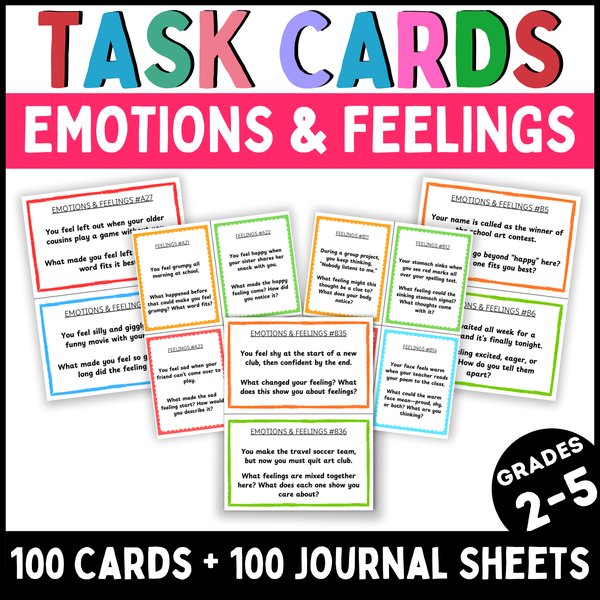
Feelings and Emotions Task Cards — Printable & Digital
A child who says “I’m fine” may really be disappointed, embarrassed or a bit of both.
This resource is in the full SEL Resource Library. See what’s included or start with 10 free resources. Have an account? Log in.
About this resource
A child who says “I’m fine” may really be disappointed, embarrassed or a bit of both. These feelings and emotions task cards give students 100 everyday moments to put words to, from a kite that rips on its first flight to a song that makes a camper homesick, most with two short questions about naming the feeling and what is behind it. They are written for Grades 2–5 and build Self-Awareness, the CASEL competency of knowing what is going on inside you.
What students practice
- Building a feeling vocabulary beyond happy and sad
- Reading clues like hot cheeks or slumped shoulders
- Tracing a feeling back to its cause, even hunger or tiredness
- Noticing two feelings at once, like relief and sadness
- Hearing what a feeling says about what they care about
What’s inside
- 100 task cards: Set A (A1–A50) for Grades 2–3 and Set B (B1–B50) for Grades 4–5
- Set A themes: feeling words; feeling clues in my face and body; what made me feel this way?; two feelings at once; all feelings are OK to have
- Set B themes: precise feeling words (upset vs. disappointed vs. embarrassed); body and thought clues; causes behind a feeling; mixed and changing feelings; feelings as messages
- Ten cards per theme, mapped on a Card Themes at a Glance page, in 2-per-page and 4-per-page layouts
- A second file with a reflection sheet for each card: 81 pages of task cards and 103 journal pages
A look inside
- Set A: “Your eyes fill with tears when your balloon floats away. What are your tears telling you? What word fits the feeling?”
- Set B: “Your science project didn’t win a ribbon, even though you worked for weeks. Which word fits best: upset, disappointed, or discouraged? Why?”
- Set B: “You feel disappointed when the seeds you planted in the class garden don’t grow. What does disappointment tell you about what mattered to you?”
How to use these feelings and emotions task cards
- Morning meeting: read a feeling-words card such as the new puppy (A10) and collect the words your class comes up with
- Small groups or counseling sessions: pull the ten mixed-and-changing-feelings cards (B31–B40) from the themes page
- SEL writing prompts: a feelings-as-messages card from Set B plus its reflection sheet makes a quiet journal entry
Grade fit
Set A (labeled Grades 2–3) stays with clear, single moments: thunder in the night, a loose tooth that comes out at lunch. Set B (Grades 4–5) asks for finer choices, such as excited, eager or restless, and why sadness can show up at the end of a great birthday party.
Digital version
The interactive digital task cards share as one link: you choose Set A or Set B, and students type their answers on any device with no student logins. At the end they download an answer sheet to hand in.
Good to know
The cards keep to the student’s own feelings; calming strategies and reading other people’s feelings are not the focus here. A few cards touch on missing someone, such as a grandma who moved far away (A47) or a brother leaving for college (B33).
Pairs well with
Beyond these task cards for students, add Feelings and Emotions Conversation Cards for whole-class talk, or Feelings and Emotions Scenario Cards for longer situations.
Questions teachers ask
Does Set B repeat Set A?
No. Set B has its own 50 cards (B1–B50) and five themes of its own, moving from precise feeling words to feelings as messages.
Do students need accounts for the digital version?
No. You share one link, and students open it on any device without logging in.
More for Self-Awareness
See all in the library →
Every resource, one library.
572 SEL resources for elementary classrooms — printables, digital activities and answer sheets, and every new one we add.

