
Teamwork Worksheets — Multiple-Choice Scenarios
Kai pours and his partner writes. If he pours too fast, the experiment falls apart.
This resource is in the full SEL Resource Library. See what’s included or start with 10 free resources. Have an account? Log in.
About this resource
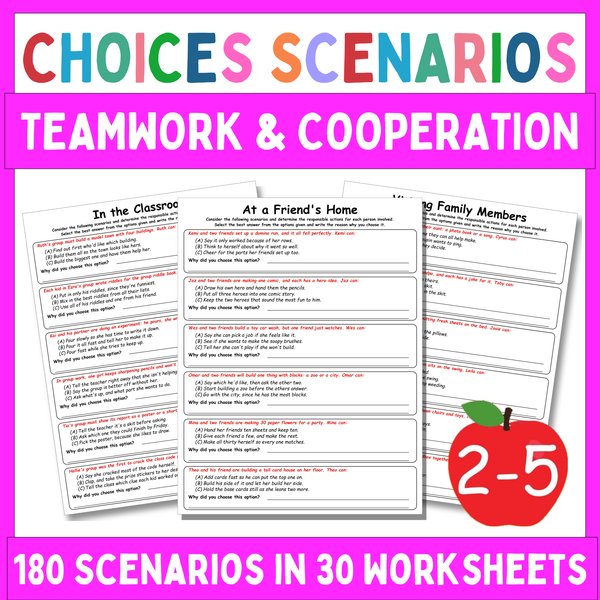
Kai pours and his partner writes. If he pours too fast, the experiment falls apart. These teamwork worksheets give Grades 2–5 180 jobs that only work when people do them together: a partner task, a group project, a family meal, a team practice. Students pick A, B or C for each and write why, practicing the everyday Relationship Skills of sharing a job.
What students practice
- Working well with a partner
- Sharing the job fairly
- Using everyone’s ideas
- Making a group decision
- Handling a teammate who isn’t helping
- Giving credit and celebrating as a team
What’s inside
- 30 printable worksheets, each set in one place, including In the Classroom, At Museums and On Walks
- 180 multiple choice scenarios, 6 per page, each followed by a “Why did you choose this option?” line
- Partner jobs, group decisions, a brother who wanders off mid-task and team wins to celebrate
- 4 teacher pages
- 35 pages
A look inside
- In the Classroom: “Kai and his partner are doing an experiment: he pours, she writes. Kai can:” (A) Pour slowly so she has time to write it down. (B) Pour it all fast and tell her to make it up. (C) Pour fast while she tries to keep up.
- On Walks: Mom wants the river, Dad the woods and Hamza the market. The strongest answer is to “Plan a loop past the river, woods and market.”
- At Museums: one girl found most of the facts for the group’s guide. Does Hugo claim them, praise everyone, or give her the credit?
How to use these teamwork worksheets
- Before a group project: read Kai’s scenario and agree as a class on what a fair split looks like
- Small groups: do the Hamza scenario, then make a real group decision using the same idea
- Pick a setting that matches what’s coming, such as Sports Teams before field day
Grade fit
Each team job is small and clear (wash the paint brushes, fold 50 papers, plant radish seeds), so Grade 2 can follow it. Grades 4–5 can write about credit and the teammate who just watches.
Digital version
The interactive digital version shares as one link: students pick A, B or C and type their reason, or just pick if you choose the choices-only format, on any device with no student logins. At the end they download an answer sheet to hand in.
Good to know
Per the scoring note, bringing the whole group into the job is strongest; taking over, quitting or blaming is poorest. A fair vote works, but combining everyone’s ideas is stronger when possible, as in Hamza’s walk.
Pairs well with
For SEL practice in another format, try the Teamwork What Would You Do? Cards or the Teamwork Task Cards.
Questions teachers ask
Can students do these in pairs?
Yes. The how-to page suggests small group work, and partners choosing together fits the topic well.
Is there an answer key?
No. The discussion page includes a scoring note on stronger and weaker teamwork choices.
Does the digital version need student accounts?
No. Share one link; students open it on any device.
More for Relationship Skills
See all in the library →

Every resource, one library.
572 SEL resources for elementary classrooms — printables, digital activities and answer sheets, and every new one we add.

