
Problem Solving What Would You Do? Cards — Think, Choose, Act
A glue stick that won’t hold, a bike that wobbles, a picnic with no spoons.
This resource is in the full SEL Resource Library. See what’s included or start with 10 free resources. Have an account? Log in.
About this resource
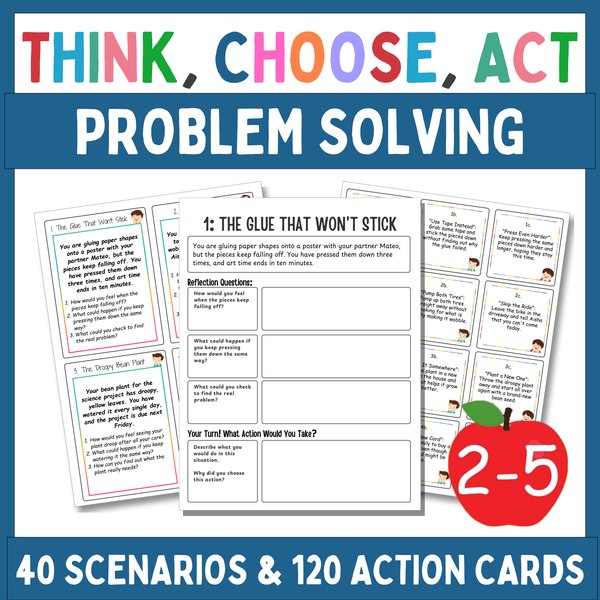
A glue stick that won’t hold, a bike that wobbles, a picnic with no spoons. These problem solving what would you do scenarios give Grades 2–5 forty small, practical problems like those, and each one comes with three action cards. Your students stop and think, name the real problem, then pick the fix they would actually try. It’s Responsible Decision-Making practice in the Think, Choose, Act format.
What students practice
- Naming the real problem before fixing it
- Thinking of more than one fix
- Choosing a fix that will really work
- Making do with what they already have
- Checking whether a fix worked and trying again
What’s inside
- 40 scenario cards, eight in each subtopic: Naming the Real Problem, Coming Up With More Than One Fix, Picking a Fix That Will Work, Making Do With What I Have and Checking If the Fix Worked
- 120 action cards, three per scenario: one best choice, one partial fix and one impulsive reaction
- 40 full-page reflection sheets, each ending with “Your Turn! What Action Would You Take?”
- A teacher guide with five ways to use the set; 77 pages in all
A look inside
- The Glue That Won’t Stick: the paper shapes keep falling off a poster, and art time ends in ten minutes. Action cards: Find the Real Problem, Use Tape Instead, Press Even Harder.
- No Ruler for Math: the pencil case holds only a pencil, an eraser and an index card. The best card reads, “Use the straight edge of the index card to draw a neat line.”
- The Squirrel-Proof Feeder: the feeder went up higher two days ago. Did it work?
How to use these problem solving what would you do cards
- Run Think-Pair-Share on The Wobbly Bike before any action card appears
- Post the three cards for The Ripping Grocery Bag and have students sort them into “Best Choice,” “Okay Choice” and “Not the Best Choice”
- Act out each fix for The Picnic With No Spoons, then ask students to improvise one more
- Hand out reflection sheets to early finishers, or file them in SEL journals to revisit the problem solving scenarios later
- Set up Problem Solving Learning Stations, where the last station has students write a new problem and its three action choices
Grade fit
Problems happen at school (15), at home (14) and in the community (11), and the fixes use ordinary things like tape or juice box straws. Second graders can talk a card through; fifth graders can argue why one fix beats another. That makes them problem solving activities that stretch across Grades 2–5.
Digital version
The interactive digital version shares as one link: students answer the think questions (or just read them in the quick format), choose an action card and say why, on any device with no student logins. At the end they download an answer sheet to hand in.
Pairs well with
For open-ended practice, try Problem Solving Scenario Cards, or add written choices with Problem Solving Worksheets.
Questions teachers ask
Are these about arguments between friends?
No. Every scenario is a practical problem: something missing, broken or not enough, or a fix that didn’t work, like a lost library book or a jump rope that’s too short for two.
Do students need accounts for the digital version?
No. You share one link, and students open it on any device without logging in.
More for Responsible Decision‑Making
See all in the library →
Every resource, one library.
572 SEL resources for elementary classrooms — printables, digital activities and answer sheets, and every new one we add.

