
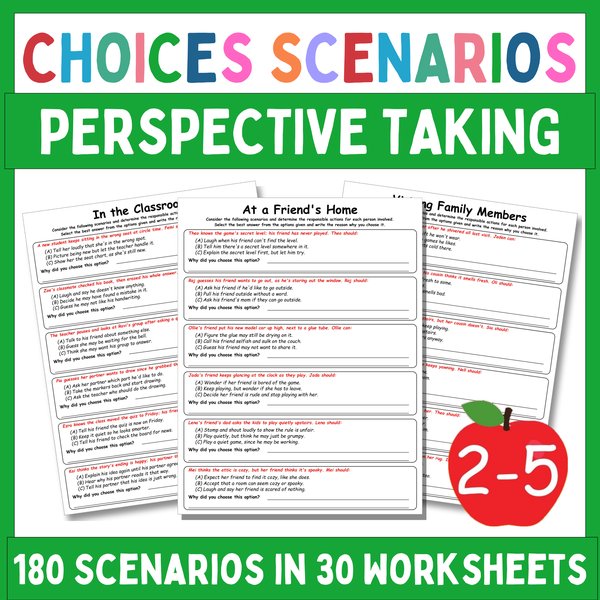
Perspective Taking Worksheets — Multiple-Choice Scenarios
Arlo sees a dragon in the painting; his friend sees a cloud. Moments like that are the heart of these perspective taking worksheets for Grades 2–5.
This resource is in the full SEL Resource Library. See what’s included or start with 10 free resources. Have an account? Log in.
About this resource
Arlo sees a dragon in the painting; his friend sees a cloud. Moments like that are the heart of these perspective taking worksheets for Grades 2–5. Your students read 180 short scenes, choose A, B or C and write why, practicing the Social Awareness skill of working out what someone else thinks, knows or wants.
What students practice
- Wondering what another person is thinking
- Working out why someone acted that way
- Accepting that two people can see one thing differently
- Checking a guess by asking
- Seeing an adult’s, a younger child’s or a new student’s side
- Remembering that others may not know what they know
What’s inside
- 30 printable worksheets, one everyday setting per page
- 180 perspective taking scenarios, six per worksheet, each with three answer choices and a line for the reason
- 4 teacher pages with a discussion guide and differentiation tips
- 35 pages
A look inside
- At a Friend’s Home: “Theo knows the game’s secret level; his friend has never played. Theo should:” (A) Laugh when his friend can’t find the level. (B) Tell him there’s a secret level somewhere in it. (C) Explain the secret level first, but let him try.
- Using Electronics: “Grandpa asks Talia again how to send a photo. Talia should:” The choices run from “Tell him he should know it by now” to “Show him slowly, as phones are new to him.”
- Clue-reading items ask what a look means, like a mom who “keeps looking at Caleb’s muddy shoes by the door.”
How to use these perspective taking worksheets
- Morning meeting: after one scenario, ask the teacher page’s question, “What might the other person be thinking or knowing that you didn’t at first? How could you find out?”
- Small groups or an SEL lesson: compare reasons on the two-views items (the spicy soup, the cold bus, the ref’s call)
- Before a new student joins or a field trip: In the Classroom and At Museums include a new classmate and a friend’s first visit
- Role-play: act out guessing without checking next to asking first
Grade fit
Second graders can follow the plain two-line scenes, especially read aloud, and they meet the idea that someone may not know what you know every day. Fourth and fifth graders can write about the trickier clue-reading items, so the set spans Grades 2–5.
Digital version
The interactive digital version shares as one link: students pick A, B or C and type their reason, or just pick if you choose the choices-only format, on any device with no student logins. At the end they download an answer sheet to hand in.
Pairs well with
Pair it with Walking in Someone Else’s Shoes — Perspective Taking Kit for a hands-on lesson, or Perspective Taking What Would You Do? Cards — Think, Choose, Act.
Questions teachers ask
Is there a best answer for each scenario?
Usually. The scoring note says a guess that fits the clues in the story, or an action that shows the other person’s side, is a strong step; acting on a guess without checking, or assuming the worst, is weaker.
Can I skip the writing for younger students?
Yes. Read the scenarios aloud and discuss them as a class, or use the choices-only format in the digital version.
More for Social Awareness
See all in the library →

Every resource, one library.
572 SEL resources for elementary classrooms — printables, digital activities and answer sheets, and every new one we add.

