
Impulse Control Worksheets — Multiple-Choice Scenarios
Whipped cream sitting out before dessert. A remote car zooming past. A fresh leaf pile the park worker just raked.
This resource is in the full SEL Resource Library. See what’s included or start with 10 free resources. Have an account? Log in.
About this resource
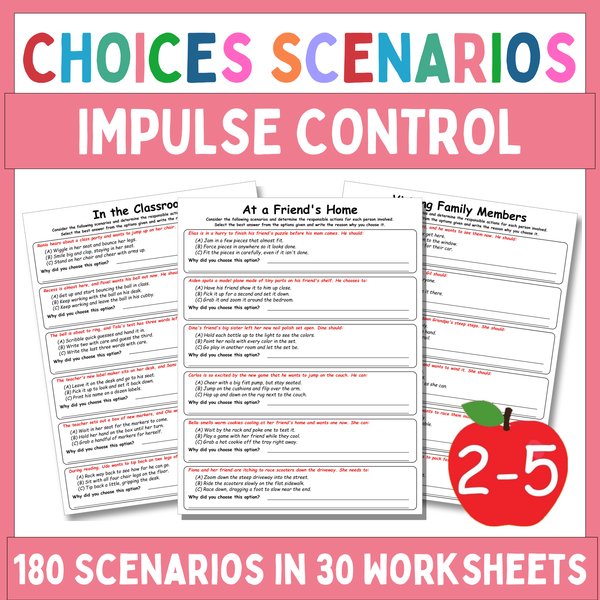
Whipped cream sitting out before dessert. A remote car zooming past. A fresh leaf pile the park worker just raked. These impulse control worksheets catch Grades 2–5 right when the urge hits and ask what to do with their hands and feet: pick A, B or C, then write why. The 180 scenarios build Self-Management one pause at a time.
What students practice
- Stopping a grab or a touch
- Waiting for something they want right now
- Holding back a wild act when they’re excited
- Leaving a tempting thing alone
- Slowing down when they’re rushing
- Choosing the slower, safer move
What’s inside
- 30 printable worksheets, one setting each, from At the Beach to While Watching Movies
- 180 multiple choice scenarios (A, B, C), each with a why line
- 4 teacher pages, including a discussion guide with a scoring note
- 35 pages
A look inside
- At the Dinner Table: “A bowl of whipped cream sits out for dessert, and Jace wants a fingerful. He should:” (A) Leave the whipped cream for dessert time. (B) Scoop a big fingerful when no one is looking. (C) Hold his hand over the bowl and pull back.
- Sports Teams: “Kat scores a goal and wants to slide on her knees across the gym floor.”
- Visiting Family Members: Jia is carrying a pie and wants to hurry down Grandpa’s steep steps.
How to use these impulse control worksheets
- Morning meeting: read Jace’s scenario, then follow the guide and talk about what students can do with their hands, feet and bodies to stop an urge
- Act it out in an SEL lesson: practice stepping back or taking a breath, as the discussion page suggests, right after reading Kat’s goal celebration
- Before a field trip or busy day, use the On the School Bus page, where Fritz wants to be first onto the bus
- Independent reflection, early finishers or sub plans
Grade fit
The urges are physical and familiar (nail polish left open, juice pops not frozen yet, a pizza still being cut), so even second graders recognize them in a read-aloud. Older students can use these impulse control scenarios to explain why “hovering close” isn’t quite the same as stepping away.
Digital version
The interactive digital version shares as one link: students pick A, B or C and type their reason, or just pick if you choose the choices-only format, on any device with no student logins. At the end they download an answer sheet to hand in.
Good to know
Watch the in-between answers. The scoring note says they are safe and kind but still half-act on the urge, like touching lightly or hovering close, while moving away from a temptation or calming the body first counts as a strong answer.
Pairs well with
Pair with Pause and Think — Impulse Control Activity Kit or the Impulse Control What Would You Do? Cards.
Questions teachers ask
Are there anger scenarios in this set?
No. The urges here come from excitement, temptation or rushing: grabbing, touching, running or acting wild.
Is there an answer key?
No. The scoring note in the teacher pages explains which choices count as strong and why the in-between ones fall short.
More for Self-Management
See all in the library →


Every resource, one library.
572 SEL resources for elementary classrooms — printables, digital activities and answer sheets, and every new one we add.

