
Identifying Triggers Worksheets — Multiple-Choice Scenarios
Ines was cranky at dinner on Monday and Thursday, her piano lesson nights. Was it dinner, or something else?
This resource is in the full SEL Resource Library. See what’s included or start with 10 free resources. Have an account? Log in.
About this resource
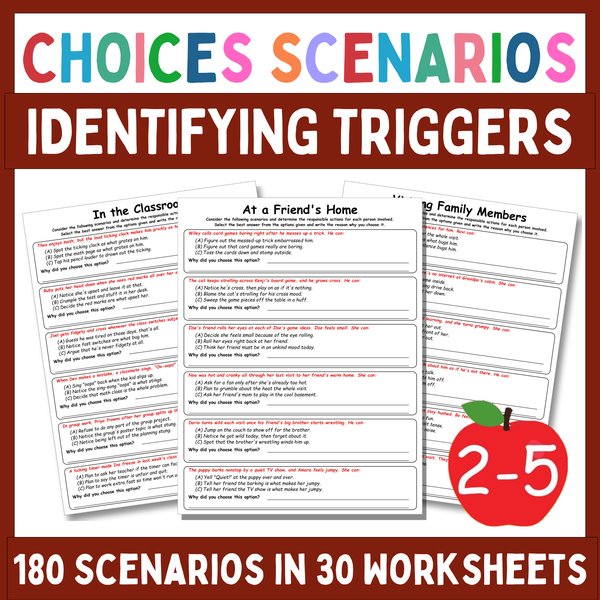
Ines was cranky at dinner on Monday and Thursday, her piano lesson nights. Was it dinner, or something else? These identifying triggers worksheets help Grades 2–5 find what really sets off a big feeling: a sharp word, a noisy room, a long wait, being left out. Students read 180 scenarios, choose A, B or C, and write why, building the Self-Awareness that has to come before any calming plan.
What students practice
- Noticing what sets me off
- Spotting triggers in places: noise, hurry, waiting
- Spotting triggers in people: words, tone, actions
- Finding hidden triggers like feeling left out
- Seeing patterns over time
- Planning ahead for tricky times
What’s inside
- 30 printable worksheets, each in one setting, such as Sports Teams, Birthday Parties and Using Electronics
- 180 multiple choice scenarios, 6 per page, with a “Why did you choose this option?” line under each
- Pattern and plan-ahead scenarios, where a hard moment is coming up again
- 4 teacher pages
- 35 pages
A look inside
- At the Grocery Store: “Thea’s big brother laughs when she picks a bruised apple. Her face gets hot. She can:” (A) Decide his laughing is what stings. (B) Decide picking fruit isn’t for her. (C) Throw the apple back and quit helping.
- While Shopping: scratchy sweaters made Lulu cry at the store last winter, and now she needs a coat.
- Sports Teams: trash talk made Yara miss passes last game, and Saturday’s team trash-talks too.
How to use these identifying triggers worksheets
- Morning meeting: read Thea’s apple scenario and ask, “What really made her face hot?”
- Small groups: sort out the in-between answers, the ones that blame the whole place or notice only the feeling
- Before a tricky event, pick the matching setting, like Birthday Parties before a class celebration
Grade fit
Every story carries its clue (a ticking timer, a blaring radio, an aunt who asks about grades every holiday), so younger students can find the trigger in a read-aloud. Older students can write fuller reasons for the pattern scenarios that connect two or three days, or write their own scenarios.
Digital version
The interactive digital version shares as one link: students pick A, B or C and type their reason, or just pick if you choose the choices-only format, on any device with no student logins. At the end they download an answer sheet to hand in.
Good to know
Per the scoring note, the strongest choice names the real trigger the story points to, or plans around it; in-between choices blame a cause the story doesn’t support or notice only the feeling. That distinction is the heart of this social-emotional learning topic.
Pairs well with
Pair it with the Identifying Triggers What Would You Do? Cards, or read about triggers in the Identifying Triggers Reading Comprehension Passages — Grade 3.
Questions teachers ask
Is this a calming-strategies set?
Not mainly. The focus is finding the trigger and spotting patterns; some scenarios end with a plan for next time.
Is there an answer key?
No. The discussion page has a scoring note on what makes a choice stronger, in-between or poorest.
Do students need accounts for the digital version?
No. You share one link, with no student logins.
More for Self-Awareness
See all in the library →

Every resource, one library.
572 SEL resources for elementary classrooms — printables, digital activities and answer sheets, and every new one we add.

