
Decision-Making Worksheets — Multiple-Choice Scenarios
The cashier hands back change for a twenty, but Ayla paid with a ten.
Free with a free account — no credit card. Create a free account or log in.
About this resource
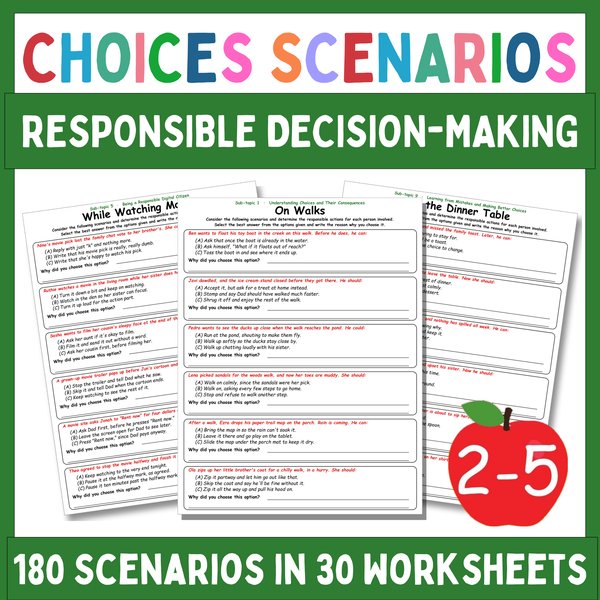
The cashier hands back change for a twenty, but Ayla paid with a ten. Moments like that fill these free decision-making worksheets for Grades 2–5: 180 multiple choice scenarios where students choose A, B or C and write why. The full set is free with a free account (no card needed) and spans all ten areas of Responsible Decision-Making.
What students practice
- Thinking through what could happen next
- Solving a problem one step at a time
- Being honest when it costs them
- Asking for help at the right time
- Choosing what helps others and their community
What’s inside
- 30 worksheets, each set in one everyday place with six scenarios and a why line under each
- Ten sub-topics with three worksheets each, such as Problem-Solving Step by Step, Being a Responsible Digital Citizen and Making Choices That Help Your Community
- 4 teacher pages with uses, tips and a discussion flow; 35 pages
A look inside
- While Shopping: “Ayla paid with a ten, but the cashier gave her change for a twenty. She should:” (A) Put the extra money into her pocket. (B) Tell the cashier she got too much change back. (C) Show Mom the extra money out in the parking lot.
- At the Grocery Store: “The store’s kids’ hunt rule is look, don’t touch. Bella spots the last item.”
- At a Restaurant: “A giant shake once left Mateus too full for dinner. His brother wants one.”
How to use these decision-making worksheets
- Morning meeting: read Ayla’s change scenario and vote with fingers before anyone explains
- Small groups: try the guide’s prompt, “Think of a choice you made this week. What happened because of it, and what might you choose next time?”
- Independent writing, early finishers or sub plans
- Before a class device lesson, use the three digital citizenship pages
Grade fit
The choices are concrete (a forgotten deli number, a dog following Esi to the front door as she leaves for the bus, an angry message in the family chat) and the sentences short, so they fit Grades 2–5. Second graders can work through them as a class SEL activity; fifth graders can argue for a choice in writing.
Digital version
The interactive digital version shares as one link: students pick A, B or C and type their reason, or just pick if you choose the choices-only format, on any device with no student logins. At the end they download an answer sheet to hand in.
Good to know
When something on a screen is upsetting, costs money, or breaks in a public place, the best answer brings in a grown-up or staff member.
Pairs well with
Try Making Good Choices Worksheets or Honesty Worksheets for one topic in depth, or Free Decision-Making Task Cards for a free card set.
Questions teachers ask
Is there an answer key?
Not a separate one. The teacher pages include a scoring note on when the best answer brings in a grown-up, and the why line shows each student’s reasoning.
Do students need accounts for the digital version?
No. You share one link, and students open it on any device without logging in.
More for Responsible Decision‑Making
See all in the library →
Every resource, one library.
572 SEL resources for elementary classrooms — printables, digital activities and answer sheets, and every new one we add.

