Stop, Think, Act for Kids: How to Teach the Strategy (+ 10 Free Cards)
Stop, Think, Act is a three-step strategy that helps kids pause before they react, think about their choices, and then do the best one. Here's how to teach it in grades 2–5, with 8 quick games and 10 free cards to practice with.
Stop, Think, Act is a three-step strategy for the moment right before a reaction: stop what you’re doing, think about your choices, then act on the best one. It works because it’s short enough to remember when feelings are big. It’s also one of the easiest social-emotional learning (SEL) routines to make a habit, since the same three words fit a playground argument, a hurt friend or a tricky online moment. Below is how to teach Stop, Think, Act to kids in grades 2–5: what each step means, a simple 4-lesson plan, 8 quick games and 10 free cards to practice with.
What is the Stop, Think, Act strategy?
Stop, Think, Act puts a short pause between a feeling and an action. Each step has one job:
- Stop. Freeze your body for a moment. Take one slow breath. Don’t grab, shout or walk away yet.
- Think. What’s happening? How do I feel, and how might the other person feel? What are two or three things I could do, and what would happen after each one?
- Act. Choose the kind, fair or safe option, and do it.
Many teachers pair it with traffic-light colors: red for stop, yellow for think, green for act. A simple Stop, Think, Act visual on the wall (three circles with one word each) gives younger students something to point to even before they have the words.
Why Stop, Think, Act works in grades 2–5
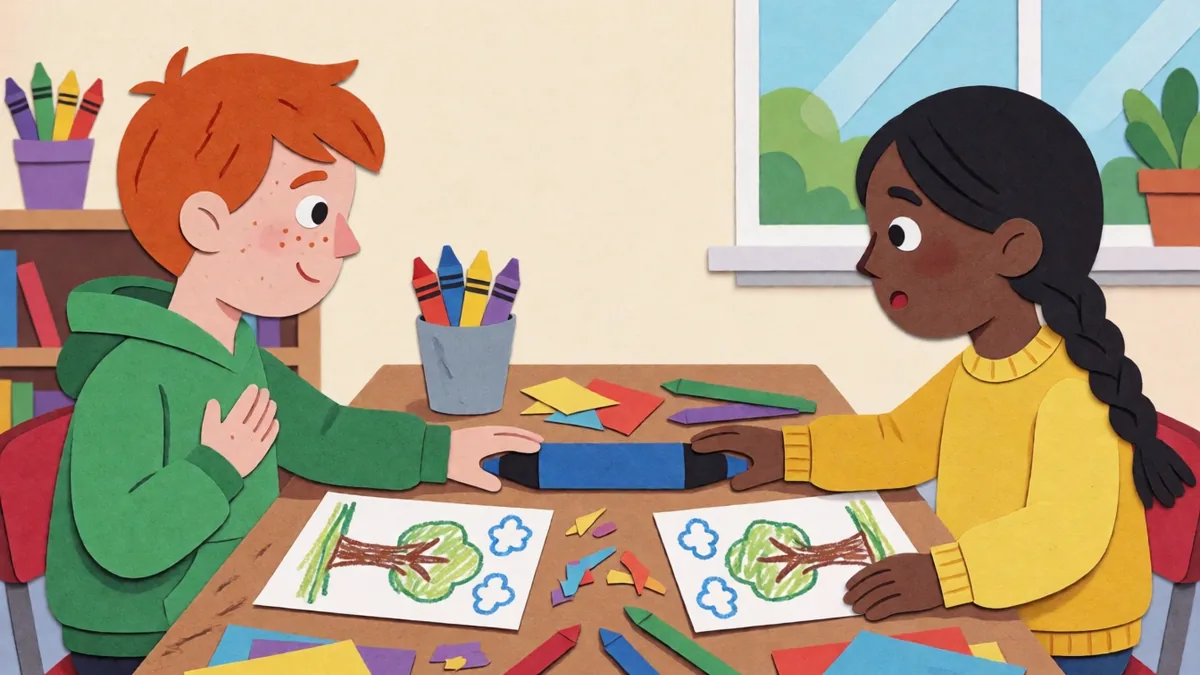
Elementary students often know the right thing to do. What’s hard is doing it in the moment, when someone grabs the last blue marker or a joke goes wrong. Stop, Think, Act gives them a few seconds back, and a few seconds is often all it takes.
- It’s short. Three words are easy to remember under stress.
- It works everywhere. Conflicts, friendships, big feelings, peer pressure, mistakes, online choices: the same steps fit them all.
- It’s a shared language. When the whole class knows it, a quiet “Stop, think” from a teacher or a friend is enough of a reminder.
- It builds decision-making. The “think” step is where students learn to weigh choices and consequences, the heart of responsible decision-making.
How to teach Stop, Think, Act in 4 lessons
Spread the teaching over about a week, then keep it alive with short practice:
- Learn the words. Teach the three steps with a gesture for each: a flat hand for stop, a finger to the temple for think, a thumbs-up for act. Practice until students can do it without looking. self-management
- Watch a model. Read one card aloud and think out loud: “Stop: I want to grab the marker, so I freeze and breathe. Think: we both want it. I could grab it, I could take turns, or I could use another color. Act: I’ll say, ‘You go first, then can I have it?'” decision-making
- Practice together. Use a new card each day. Students work through the three steps with a partner, then share their “act” choice with the class. communication
- Use it for real. When a real moment comes up, cue it quietly: “Stop, think.” Afterward, ask how it went, and celebrate the pause, not just the outcome. reflection
8 Stop, Think, Act games and activities
Each game lists how long it takes and the grades it suits. The first four work with the free cards; the rest work with any situation.
1. Stop-and-breathe walk
Students walk slowly around the room. When you call “Stop!”, everyone freezes and takes one slow breath. Then call “Think!” and read a situation, and on “Act!” partners whisper their best choice to each other before the walk starts again. It practices the physical pause, which is the hardest part to remember in a real moment. Takes 5 minutes, grades 2–4.
2. Traffic-light choices
Give each student a red, a yellow and a green card. Read a situation and three possible reactions. For each one, students hold up red (unsafe or unkind), yellow (okay, but could be better) or green (kind, fair and safe). Ask a few students to explain their color. Takes 10 minutes, grades 2–5.
3. Two choices, two endings
Read a card and ask for two very different reactions. Students draw or tell what happens next for each one: “If I grab the marker… If I offer to take turns…” Seeing both endings side by side makes the “think” step concrete. Takes 10 to 15 minutes, grades 2–5.
4. Scoot around the room
Post the ten free cards around the room. Students rotate in pairs, spend two minutes at each card, and write their “act” choice on a recording sheet. Finish by sharing the hardest card and why. Takes 20 to 25 minutes, grades 3–5.
5. Hot seat advice
One student sits in the “hot seat” and reads a card as if it just happened to them. Three classmates each offer one “think” idea: a different thing the student could do. The student in the hot seat picks one, says why, and acts it out in one sentence. Rotate the seat so everyone gets a turn over the week. Takes 10 minutes, grades 3–5.
6. Rewind button
After a real conflict has cooled down, invite the students involved to “rewind” it with you privately: “Where could you have stopped? What were your choices? What would you do now?” Keep it calm and curious, not a punishment. Mistakes are information. Takes 5 minutes, grades 2–5.
7. Reflection sheet journal
After a card discussion, students answer the matching reflection sheet on their own. Writing slows the “think” step down and gives you a window into how each student is reasoning. Takes 10 minutes, grades 2–5.
8. Class cue word
Agree on a quiet class signal, like the word “pause” or the flat-hand gesture. Anyone, teacher or student, can use it kindly when things start to heat up. Review once a week: “When did someone use our cue this week? What happened next?” Takes 5 minutes a week, any grade.
A look inside the 10 free Stop Think Act cards
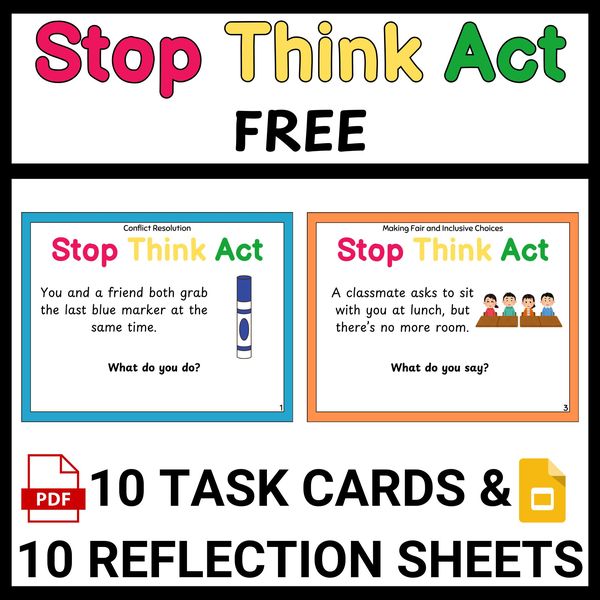
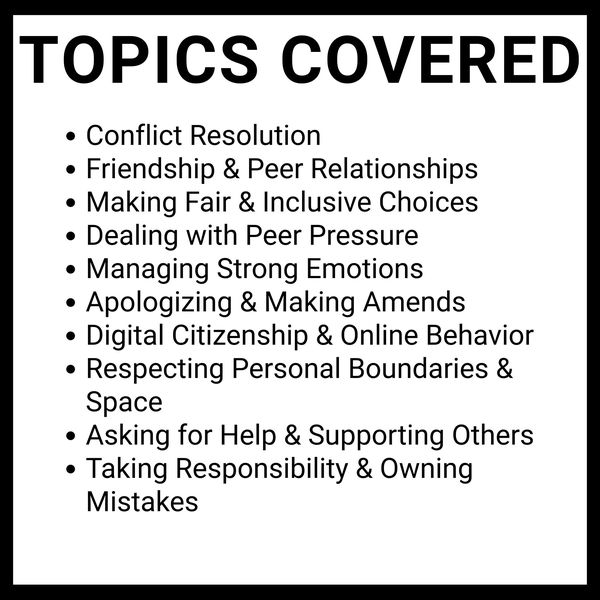
The free Stop Think Act Cards give you one full-page card for each of ten everyday situations, each with its own question:
What do you do?
How do you handle it?
What do you say?
How do you handle it?
How do you calm yourself?
How do you apologize?
What do you do?
How do you respond?
How can you help without making them feel bad?
How do you fix the situation?
The cards come full-page for whole-class talks and four to a page for small groups. Each one has a matching reflection sheet, a short Stop Think Act worksheet students can fill in on their own. The Managing Strong Emotions sheet, for example, asks: “What strong emotion might someone feel here? What’s a helpful or calming choice you could make? How might your choice affect others in the situation?”
Use them on screens, too
The free cards also work as a digital activity. You share one link, choose a one-question or five-question format, and students answer on any device with no student logins. At the end, each student downloads an answer sheet to hand in. It’s a quick way to run a Stop, Think, Act center or a calm-down-corner reflection without printing.
Want to go deeper on one topic? The library has a full Stop Think Act set for each of the ten situations, from conflict resolution to owning mistakes: see all ten topic sets.
Stop Think Act resources for your classroom
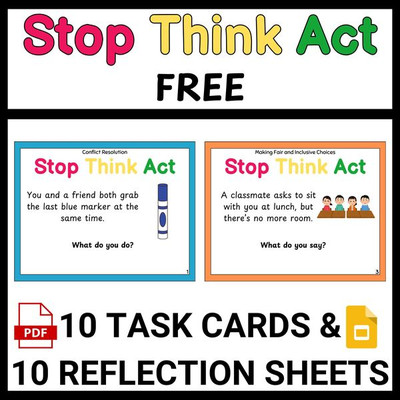 Stop Think Act Cards — Free Printable & Digital SampleGrades 2–5 · Print + digitalFREE
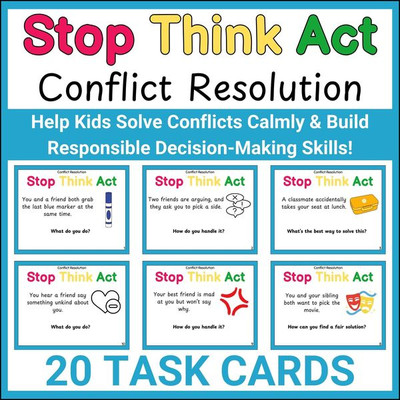 Conflict Resolution Stop Think Act Cards — Printable & DigitalGrades 2–5 · Print + digitalFULL LIBRARY
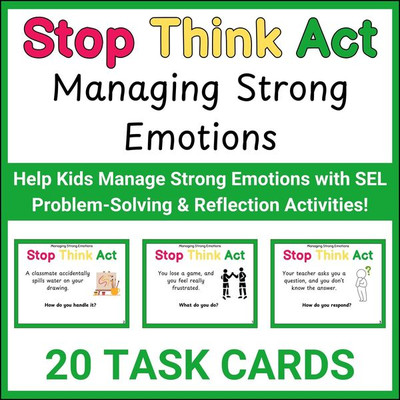 Managing Strong Emotions Stop Think Act Cards — Printable & DigitalGrades 2–5 · Print + digitalFULL LIBRARY
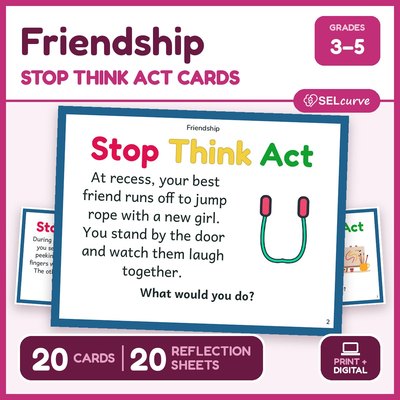 Friendship Stop Think Act Cards — Printable & DigitalGrades 2–5 · Print + digitalFULL LIBRARY
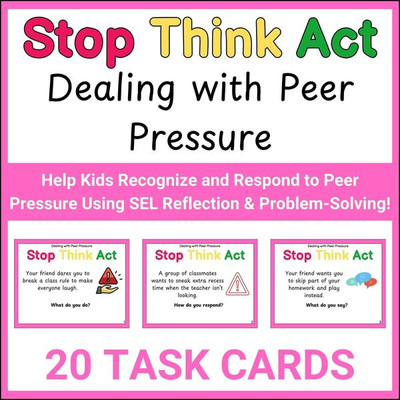 Peer Pressure Stop Think Act Cards — Printable & DigitalGrades 2–5 · Print + digitalFULL LIBRARY
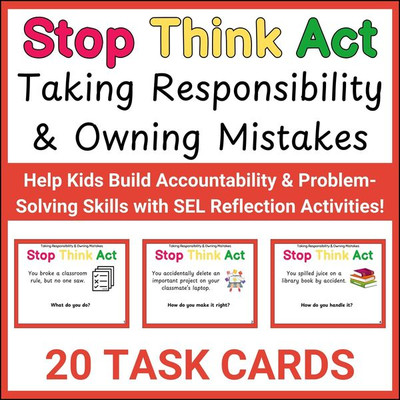 Owning Mistakes Stop Think Act Cards — Printable & DigitalGrades 2–5 · Print + digitalFULL LIBRARY
See everything on the Conflict Resolution resources page or browse all free SEL resources.
Frequently asked questions
How do you teach the Stop, Think, Act strategy?
Teach the three words with a gesture for each, model the steps out loud with a real-life situation, then practice with a new situation every day. Once students know it, use a quiet cue in real moments and talk about how it went afterward.
What does Stop, Think, Act mean for kids?
Stop: freeze and take a breath before reacting. Think: notice what’s happening, how everyone feels, and what your choices are. Act: pick the kind, fair or safe choice and do it.
Is there a free Stop Think Act worksheet?
Yes. Each of the 10 free cards has a matching reflection sheet with questions like “What’s happening in the situation?” and “What’s a helpful or calming choice you could make?” They work as a printable worksheet or in the digital version.
What age is Stop, Think, Act for?
The strategy works from kindergarten up, with simpler language for younger students. The free cards are written for grades 2–5, and older students can use the reflection sheets to go deeper.
Is Stop, Think, Act the same as the traffic light strategy?
They’re closely related. Many teachers use traffic-light colors as a visual for the same three steps: red for stop, yellow for think, green for act.
Are the Stop Think Act cards really free?
Yes. The 10 cards and 10 reflection sheets are free with a free SELcurve account. No card needed. They include a digital version you can share as one link.
More SEL ideas
 Relationship SkillsTeasing vs. Bullying: How to Teach Kids the Difference (+ 4 Upstander Steps and Free Scenario Cards)
 Relationship SkillsHow to Say No to Peer Pressure: A 4-Step Plan to Teach Kids, 10 Practice Games + Free Scenario Cards
 Relationship SkillsHow to Teach Conflict Resolution to Kids: A 5-Step Talk-It-Out Routine, 10 Games + Free Scenario Cards