
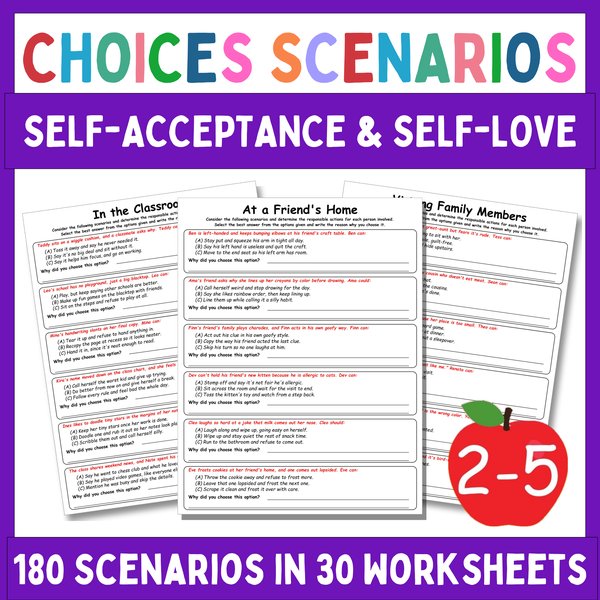
Self-Acceptance Worksheets — Multiple-Choice Scenarios
Oscar brings his own cupcake to a party because he can’t eat gluten, and Mina’s handwriting slants on her final copy.
This resource is in the full SEL Resource Library. See what’s included or start with 10 free resources. Have an account? Log in.
About this resource
Oscar brings his own cupcake to a party because he can’t eat gluten, and Mina’s handwriting slants on her final copy. These self-acceptance worksheets give Grades 2–5 180 moments like these, each with three choices and a line to explain the pick, so students practice staying themselves and going easy on themselves. Together they build Self-Awareness.
What students practice
- Liking who you are
- Accepting what makes you different
- Treating yourself like a good friend
- Accepting what you can’t change
- Handling mistakes without needing to be perfect
- Being your true self with others
What’s inside
- 30 printable worksheets, each set in one everyday place
- 180 multiple choice scenarios, six per worksheet, one for each theme
- A why line for every scenario
- 4 teacher pages, among them a guide to running the discussion
- 35 pages
A look inside
- At Birthday Parties, Oscar can eat his cupcake fast before anyone asks questions, hide it in his bag and sit apart, or eat it at the table with everyone.
- In the Classroom, Mina can tear up her page, recopy it at recess so it looks neater, or hand it in “since it’s neat enough to read.” The recopy option is the in-between kind the scoring note describes: redoing work only because it isn’t perfect.
- Differences show up in many forms: Hiro’s family keeps chickens as pets, Basil calls the sidewalk “the pavement,” like his family from England, and Kofi is colorblind during a color game.
How to use these self-acceptance worksheets
- Morning meeting: ask the guide’s question, “Which choice showed the child treating themselves the way they would treat a good friend?”
- SEL lessons or small groups: talk through the hiding and toning-down answers, and why they feel safer in the moment
- Independent reflection: the why line gives quieter students room to think in private
- Sub plans or early finishers: each page is self-contained
Grade fit
The stems are short and the situations are familiar (a lopsided cookie, plain raisins as a favorite candy, a quirky way of dusting), so the self-acceptance scenarios suit Grades 2–5. Read them aloud for younger students, and invite older ones to write their own.
Digital version
The interactive digital version shares as one link: students pick A, B or C and type their reason, or just pick if you choose the choices-only format, on any device with no student logins. At the end they download an answer sheet to hand in.
Pairs well with
Next, try the Self-Acceptance What Would You Do? Cards or the Self-Acceptance Conversation Cards.
Questions teachers ask
What kinds of differences come up?
Food needs, a family’s home language or way of speaking, being colorblind, unusual pets and hobbies like bird-watching or folding paper frogs. The focus is on staying yourself, not on standing out.
Is there an answer key?
No. A scoring note on the discussion page explains that staying yourself and going easy on yourself is the strongest choice, and hiding part of yourself is weaker.
More for Self-Awareness
See all in the library →


Every resource, one library.
572 SEL resources for elementary classrooms — printables, digital activities and answer sheets, and every new one we add.

