

Boundaries and Personal Safety Reading Comprehension Passages — Grade 5
Never a kid’s fault, never too late to tell: fifth graders need to hear both often.
This resource is in the full SEL Resource Library. See what’s included or start with 10 free resources. Have an account? Log in.
About this resource
Never a kid’s fault, never too late to tell: fifth graders need to hear both often. These boundaries and personal safety reading comprehension passages give Grade 5 readers ten passages at F&P levels S–V that pair new independence with the know-how to match, from ten minutes at home alone to a ride that doesn’t come. Building on earlier body-safety lessons, the set grows Relationship Skills such as speaking up and keeping telling until someone helps.
What students practice
- Helping a younger child say stop and tell
- Following home and family safety plans
- Explaining clearly what happened and what they need
- Pausing to check a gut feeling with a trusted adult
- Building a safety hand of five trusted adults
What’s inside
- 10 passages at F&P levels S–V, mixing narratives, a how-to guide, a comparison, a profile and concept nonfiction
- A plain-spoken takeaway after each reading
- 5 multiple-choice questions plus 2 open-ended questions to answer in writing for each passage
- MCQ answer key on the last page
- 44 pages
A look inside
- Helping My Brother Say Stop: Xavier stands at the edge of the court while his seven-year-old brother tells a teammate, “Stop. I don’t like that.”
- Zawadi Keeps the Door Locked: when a delivery driver rings, Zawadi keeps the door shut and calls her mom, who is next door.
- When the Ride Doesn’t Come: Thorsten stays with the club leader and won’t take a ride that isn’t in the plan, even from someone he knows.
- Your Gut Feelings Have a Reason: the brain notices clues faster than we can think them through, so it pays to pause and check.
How to use these boundaries and personal safety reading passages in Grade 5
- Guided SEL reading comprehension lessons, moving from Xavier’s reflection at level S to Why It’s Never a Kid’s Fault at level V
- Counselor visits, especially with How to Speak Up When Something Feels Wrong
- Family conversations that start from Safety Rules for Little Kids and Big Kids
Grade fit
One passage compares the rules for a six-year-old with those for an eleven-year-old, which is right where fifth graders are: old enough for new privileges, still leaning on trusted adults. Levels run from S to V, and these reading passages with questions also model what to do when the first grown-up doesn’t help.
Digital version
With the interactive digital version, you share one link and students read each passage and answer the questions on any device, with no student logins. At the end they download an answer sheet to hand in.
Good to know
Why It’s Never a Kid’s Fault speaks to worries a child may carry, such as not saying no or keeping a secret at first, and says they can still tell. It names tricky moves like special gifts and requests for secrecy without describing any harm. In Helping My Brother Say Stop, an older teammate keeps roughhousing with Xavier’s seven-year-old brother, with bear hugs and hard knuckle rubs he doesn’t want; the boys tell their mom and the coach, and the coach stays close while the younger boy says stop.
Pairs well with
More personal safety activities for this age: Boundaries and Personal Safety Scenario Cards or Boundaries and Personal Safety Conversation Cards.
Questions teachers ask
Is there an answer key?
Yes. The multiple-choice answers are on the last page of the PDF. The open-ended questions have no fixed answer.
Is the topic handled in an age-appropriate way?
Yes. The wording is calm and reassuring, and no abuse is described; the most physical moment is an older teammate’s unwanted roughhousing, which the brothers report to their mom and the coach. The stories show children getting help from trusted adults. The PDF suggests the set for guided lessons, counselor visits and family conversations.
Do students need accounts for the digital version?
No. You share one link, and students open it on any device without logging in.
More for Relationship Skills
See all in the library →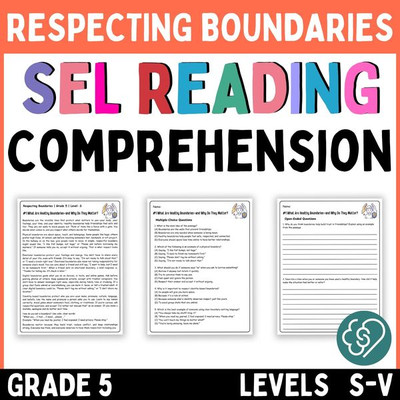

Every resource, one library.
572 SEL resources for elementary classrooms — printables, digital activities and answer sheets, and every new one we add.

