Full library·Grades 2–5·Social Awareness·Task Cards · Stop Think Act Cards
Empathy Stop Think Act Cards
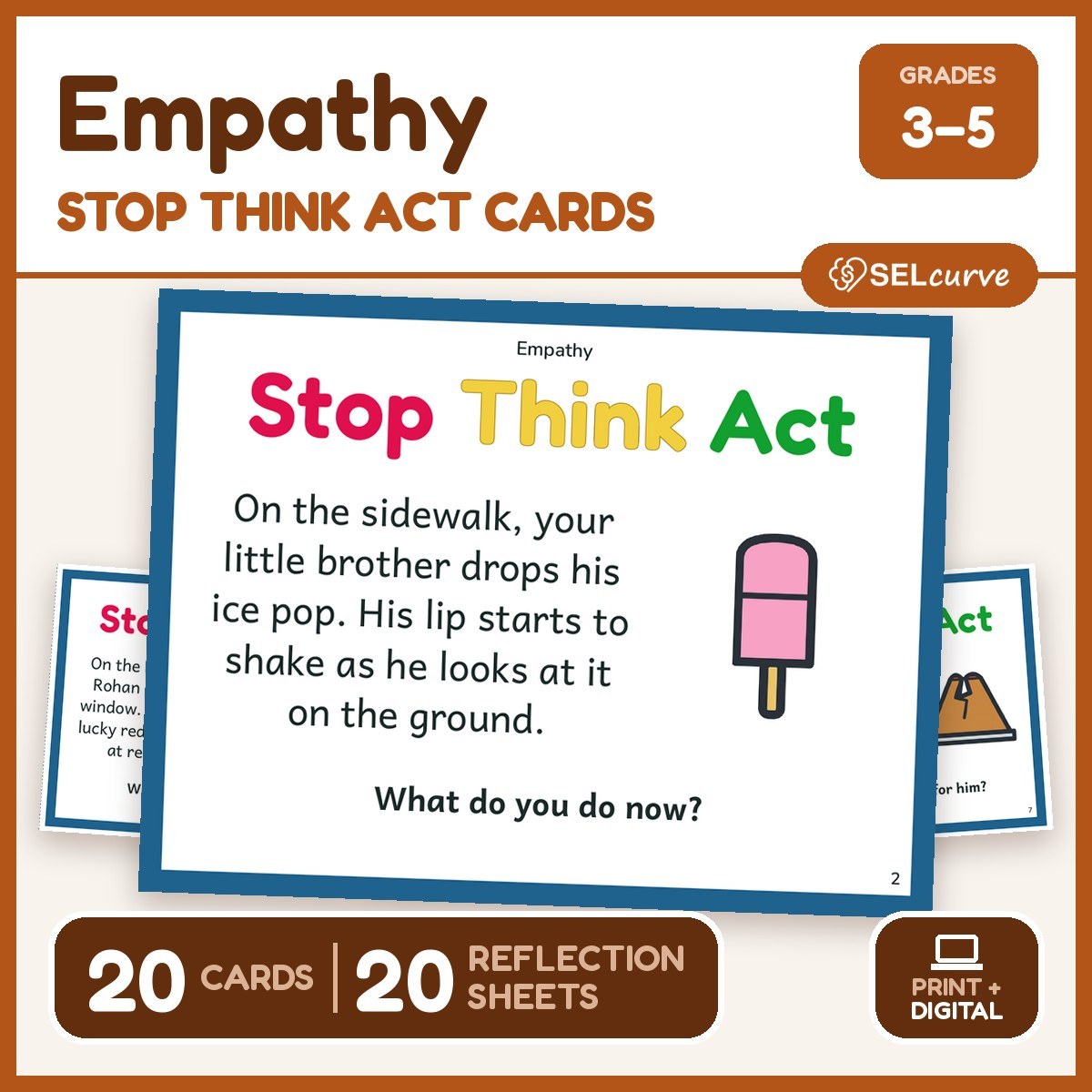
Our empathy stop think act cards put Grades 3–5 next to twenty people with a strong feeling: a little brother whose lip shakes over a dropped ice pop, a table partner who erases so hard the paper tears, a little sister bursting in the door…
- 20 Stop Think Act cards
- 20 reflection sheets
- Print + digital
In the full library, with 34 more on Empathy
Scenario cards, worksheets, role play and more (grades K–8).
Get the free Social Awareness Stop Think Act CardsFree account · school email works · See the full library
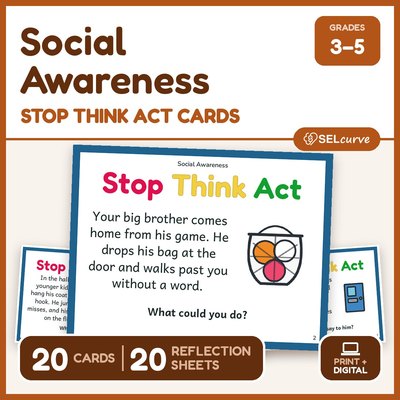
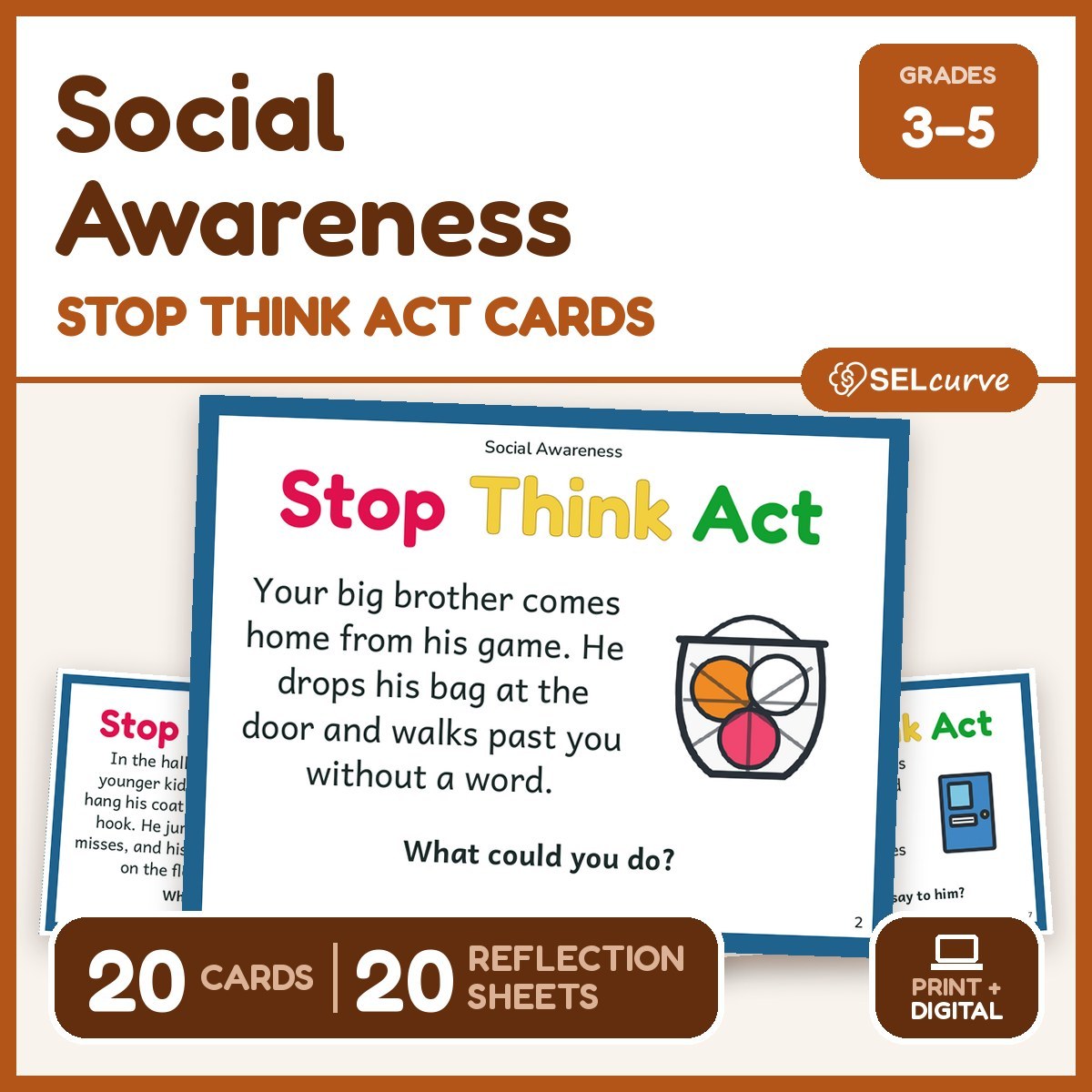 Same format, free with a free account: Social Awareness Stop Think Act CardsOpen it →
- Grades
- 2–5
- What you get
- 20 Stop Think Act cards
- Type
- Task Cards
- Use it
- Print + digitaldigital = any device, no student logins
- Competency
- Social Awareness
- Topic
- Empathy
About this resource
Our empathy stop think act cards put Grades 3–5 next to twenty people with a strong feeling: a little brother whose lip shakes over a dropped ice pop, a table partner who erases so hard the paper tears, a little sister bursting in the door with her first lost tooth. Students look for the clues in a face, a body or a few words, then choose a caring thing to say or do, in hard moments and happy ones. It is a Social Awareness resource. Find more in our empathy activities and worksheets.
What students practice
- Notice the clues that show how someone feels
- Stay with someone who is having a hard moment
- Offer kind words that fit the moment
- Share in someone’s joy, even when they wanted the same thing
What’s inside these think before you act empathy cards
- Two print sizes: a full-page card for the whole class or a group, and four cards per page for small groups, partner talks and stations
- A 4-page teacher guide with discussion steps, ideas like a class list of kind words, and differentiation, plus Cards at a Glance and a printing guide
- A Family Connection page with a name-the-feeling game for home, and a digital activity on any device, with no student logins
A look inside
Card 4: “At the library story time, your little cousin Lily hugs her knees. She watches the door after her dad waves goodbye.”
Card 15: “Your group is excited to hold the class snake. Imani steps back and puts her hands behind her.” Then: “What do you say to her?”
How to use these empathy discussion cards
Grade fit
Grades 3–5 work with feelings they see every day. Younger students use the starter “You look… Do you want…” and work through a card with you. Older students name two clues on a card and explain how each one shows a feeling. The guide reminds students that quiet care, like sitting nearby or offering a smile, can help as much as words.
Printing
- Full-page cards: cardstock or plain paper, one-sided; each card is printed sideways to fill the page.
- Four-per-page cards: one-sided on cardstock or plain paper, cut along the dashed lines, and laminated if you want to reuse them.
- Reflection sheets: plain paper, one-sided, one per student once the card has been discussed.
- Family Connection: plain paper, one-sided, two take-home notes per page.
Good to know
Any student may pass, and the class talks about situations, not people, so no classmates are named. Students share a time someone was kind to them only if they want to.
Questions teachers ask
Do all the cards show sad moments?
No. Many cards show someone who is sad, worried or embarrassed, and the last few show good news, like a drawing picked for the front office, so students practice sharing someone’s joy too.
Which grades are these empathy stop think act cards for?
Grades 3–5. The guide gives sentence starters for younger students and asks older students to explain the clues behind a feeling.
Is there a routine students can say on their own?
Yes. The guide suggests posting three questions by the door: “What do I notice? How might they feel? How can I help?”
Can students use it on devices?
Yes. Post it in Google Classroom or Teams, or show a QR code. Students work on any device with no student logins and send you their answer sheet.
More for Social Awareness
See all in the library →


Every resource, one library.
775 SEL resources for elementary classrooms — printables, digital activities and answer sheets, and every new one we add.