Full library·Grades 2–5·Responsible Decision‑Making·Task Cards
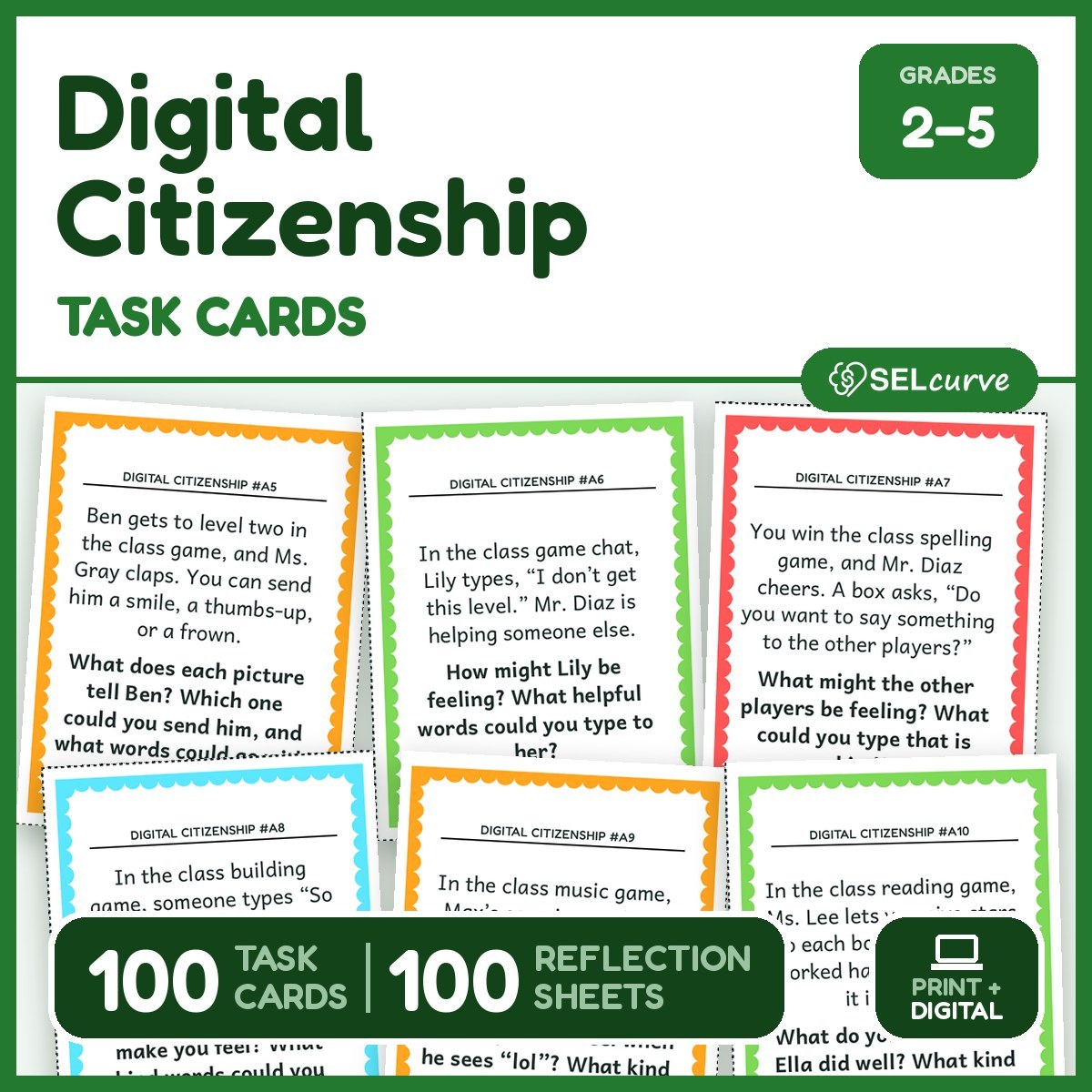
Digital Citizenship Task Cards
A game asks for a player name, and a second grader starts typing their real one.
- 103 journal pages
- Print + digital
In the full library, with 13 more on Digital Citizenship & Online Safety
Scenario cards, reading passages, conversation cards and more (grades K–8).
Get the free Self-Awareness Task CardsFree account · school email works · See the full library
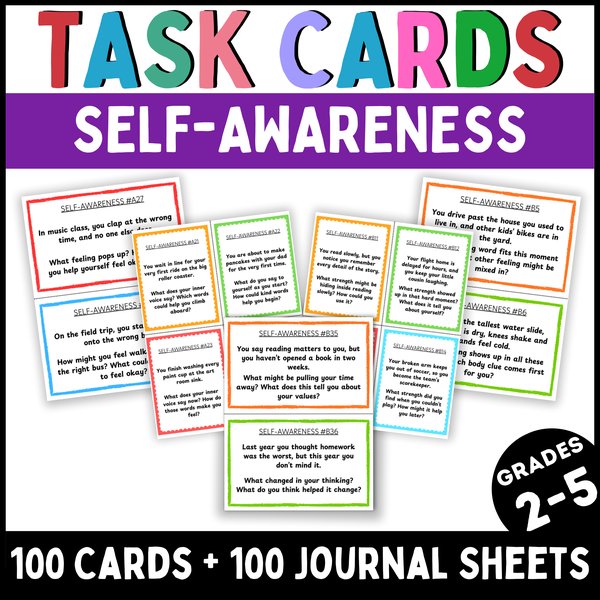 Same format, free with a free account: Self-Awareness Task CardsOpen it →
- Grades
- 2–5
- What you get
- 103 journal pages in a separate PDF
- Type
- Task Cards
- Use it
- Print + digitaldigital = any device, no student logins
- Competency
- Responsible Decision‑Making
About this resource
A game asks for a player name, and a second grader starts typing their real one. These digital citizenship task cards set 100 prompts in real online and device moments, from game chats and pop-ups to a chatbot’s homework answer, and ask what a safe, kind and smart choice would look like. They’re written for Grades 2–5 and build Responsible Decision-Making.
What students practice
- Keeping a real name, street or birthday private
- Writing kind words in game chats and class apps
- Making strong passwords and logging out
- Spotting scam and stranger red flags
- Checking whether a video, ad or chatbot answer is true
What’s inside
- Set A (Grades 2–3, A1–A50), five themes: Keeping my information private; Kind words online; Asking a grown-up first; Smart choices with apps and games; Something online upset me
- Set B (Grades 4–5, B1–B50), five themes: Privacy and passwords; Online kindness and cyberbullying; Stranger and scam safety; Checking if information is true; Digital footprint
- Ten cards per theme in two printable sizes, 2 or 4 cards per page
- 103 journal pages in a separate PDF, each a reflection sheet for one card, plus 81 pages of task cards
A look inside
Set A: “You record a video for your class at home, and your house number shows behind you. What could that number tell people? What could you change before you record?”
Set B: “A player you’ve gamed with for weeks asks to video chat with you. What do you really know about this player? Who could you talk to first?”
Set B: “A chatbot gives you an answer for your homework, but you’re not sure it’s right. How could you check the answer? What else could help you learn it?”
How to use these digital citizenship task cards
Grade fit
Set A, for Grades 2–3, stays with apps and games younger students meet first: a drawing app asking for a full name, a cartoon that autoplays into something unknown, a smart speaker. Set B, for Grades 4–5, adds accounts, group chats and the wider internet, from fake game accounts to websites with no author.
Digital version
In the interactive digital task cards, you choose Set A or Set B, and students type their answers on any device with no student logins. At the end they download an answer sheet to hand in.
Good to know
Some Set B cards deal with serious situations, such as a stranger asking for a photo (B24) or a player who wants chats kept secret from parents (B26). These cards ask who students could tell, so read them ahead and plan your follow-up.
Pairs well with

Questions teachers ask
Do students need to be online to use the printable cards?
No. Each card describes an online or device moment for students to think through on paper or out loud. The digital version is optional.
Does the set cover cyberbullying?
Yes. Set B has a theme on online kindness and cyberbullying (B11–B20), including a fake account, an edited class photo and a mean online poll. Offline bullying is outside this set.
More for Responsible Decision‑Making
See all in the library →
Every resource, one library.
698 SEL resources for elementary classrooms — printables, digital activities and answer sheets, and every new one we add.