Paid·Grades K–2·Responsible Decision‑Making·Brain Breaks
Making Good Choices Brain Breaks
- 60 game cards
- 24 Open Practice Cards
- 6 Round Cards
- Printable
 Free with a free accountDecision-Making Brain Breaks24 Open Practice Cards · 60 game cards · Printable
What a free account gives you
- 81 free resources across all five SEL areas, ready to print
- Digital activities: post them in Google Classroom or Teams. Any device · No student logins
- A planner and collections to keep your SEL week organized
- Grades
- K–2
- What you get
- 60 game cards, six rounds of ten
- Type
- Brain Breaks
- Use it
- PrintView & Print in your browser
- Competency
- Responsible Decision‑Making
About this resource
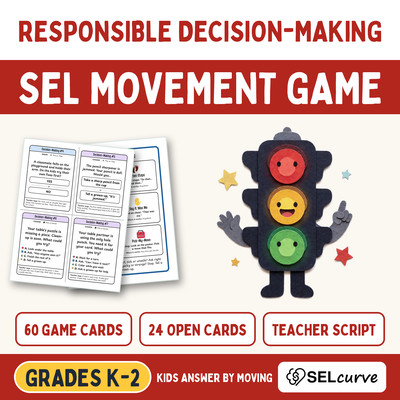
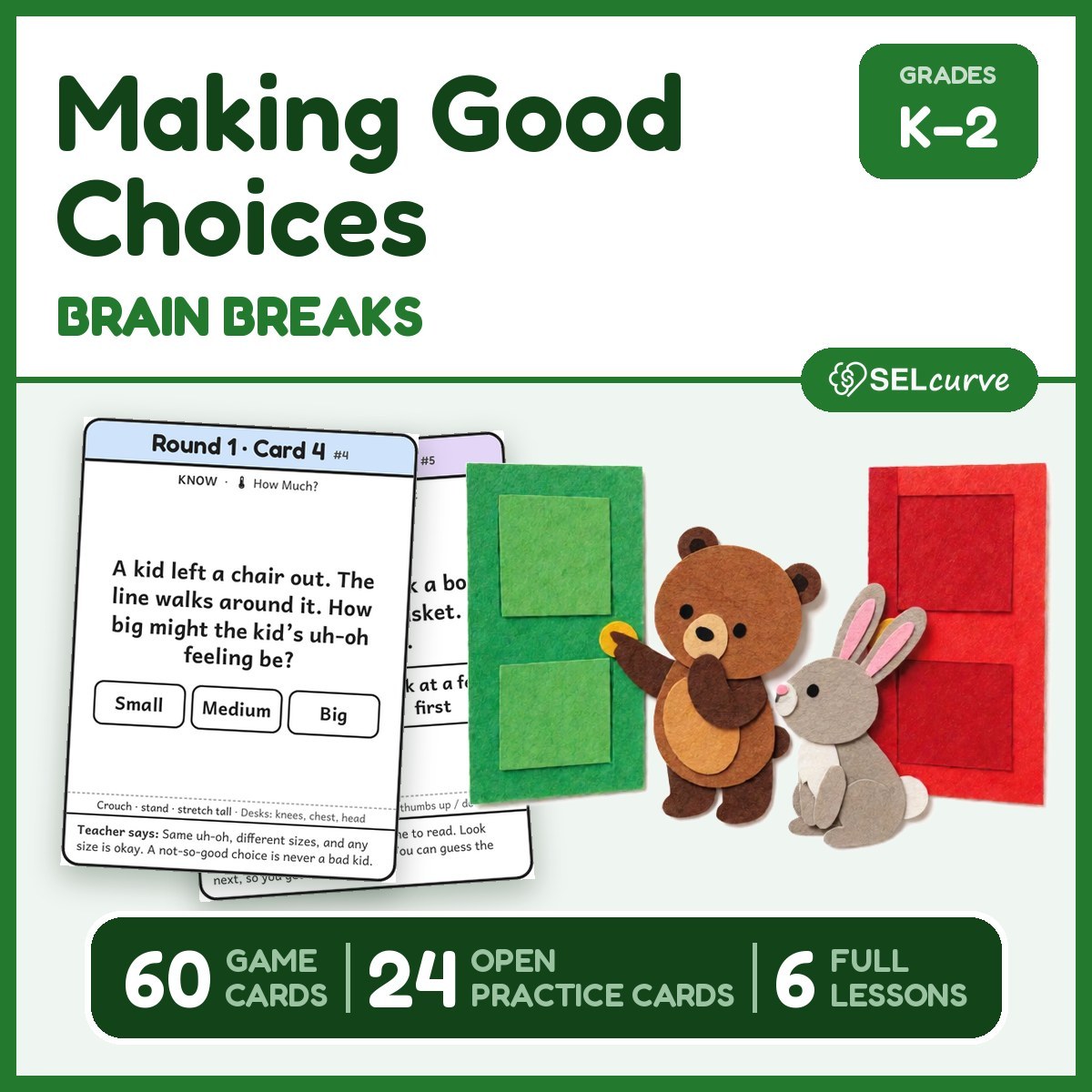
Every choice has a next, and these making good choices brain breaks help Grades K–2 guess it before they pick, with 60 game cards across six 15–20 minute lessons and 24 Open Practice Cards for a 3-minute movement break. Children clap 3 times if they have ever seen a smile after saying good morning, and when a big hole is left in the sandbox at the end of play, they walk to one side to fill it back in or the other to tell a grown-up it is there. It is a Responsible Decision-Making resource. Find more in our making good choices activities.
What students practice
The six rounds think one step further each time:
- What happens next?
- So then…
- Who does it reach?
- Later on
- More than one okay choice
- Choice Trail
Right for your grade
Grades K–2
Cards are short and read aloud, and the moments come from a K–2 day: the sandbox, the art center, lining up, indoor recess and the hallway. Answers are simple movements with color-and-shape corner signs, and the focus stays on the basics: what happens next, so then, who a choice reaches, later on and picking what fits.
Everything included
What’s inside these movement activities
- 60 game cards, six rounds of ten, four per printed page and in playing order, with two Choice Move cards in every round
- 24 Open Practice Cards: Move If and True or False cards that work alone, in any order
- 6 Round Cards that set up each lesson, each paired with a blank Make Your Own card
- A Detailed Script for Teachers with the words to say and the questions to ask, plus a Movement Menu
- The Choice Moves Poster of six moves to practice, with 17 Movement Cards to keep handy, six Room Signs and a Family Connection page


A look inside
Real pages, real moments
In the classroom
How to use these choice games
- 1Any spare 3 minutes: read 3–5 Open Practice Cards word for word and let everyone move before the teaching line.
- 2A full lesson: the Round Card lists the setup and the stopping points; read each card and use the Quick Start moves for every kind of card.
- 3When the class splits: on a Know card, read Teacher says and then let anyone switch sides.
- 4At recess or after: replay any round, or pull a single card when a real choice comes up.
Printing and prep
Ready to print
- Print the US Letter pages single-sided with Actual size selected, or choose Fit to page when using A4.
- Grayscale prints are fine; for year-long use, print on cardstock or laminate.
- Keep each cut-apart round together in an envelope or on a binder ring, with the Round Card on top.
Questions teachers ask
FAQ
Do these making good choices brain breaks ask children about their own mistakes?
No. The guide keeps next time for pretend kids and asks you not to ask children about a choice they wish they hadn’t made. If one shares, thank them and move on.
What does consequence mean in this game?
It means what happens next. Round 1 teaches that every choice has a next, and that a not-so-good choice isn’t a bad kid.
Can more than one answer be okay?
Yes. Round 5 is all about more than one okay choice, and on Choose cards every corner is okay; children pick the one that fits right now.
What changes in the Grades 3–5 version?
It builds on these ideas with the good and not-so-good consequences of one choice, a two-path Crossroads Plan, and choices that fit the time, the people and what’s happening.
More for Responsible Decision‑Making
See all in the library →

Try it in class this week
Start with the free Decision-Making Brain Breaks, or unlock it with Monthly.