
Paid·Grades 3–5·Responsible Decision‑Making·Brain Breaks
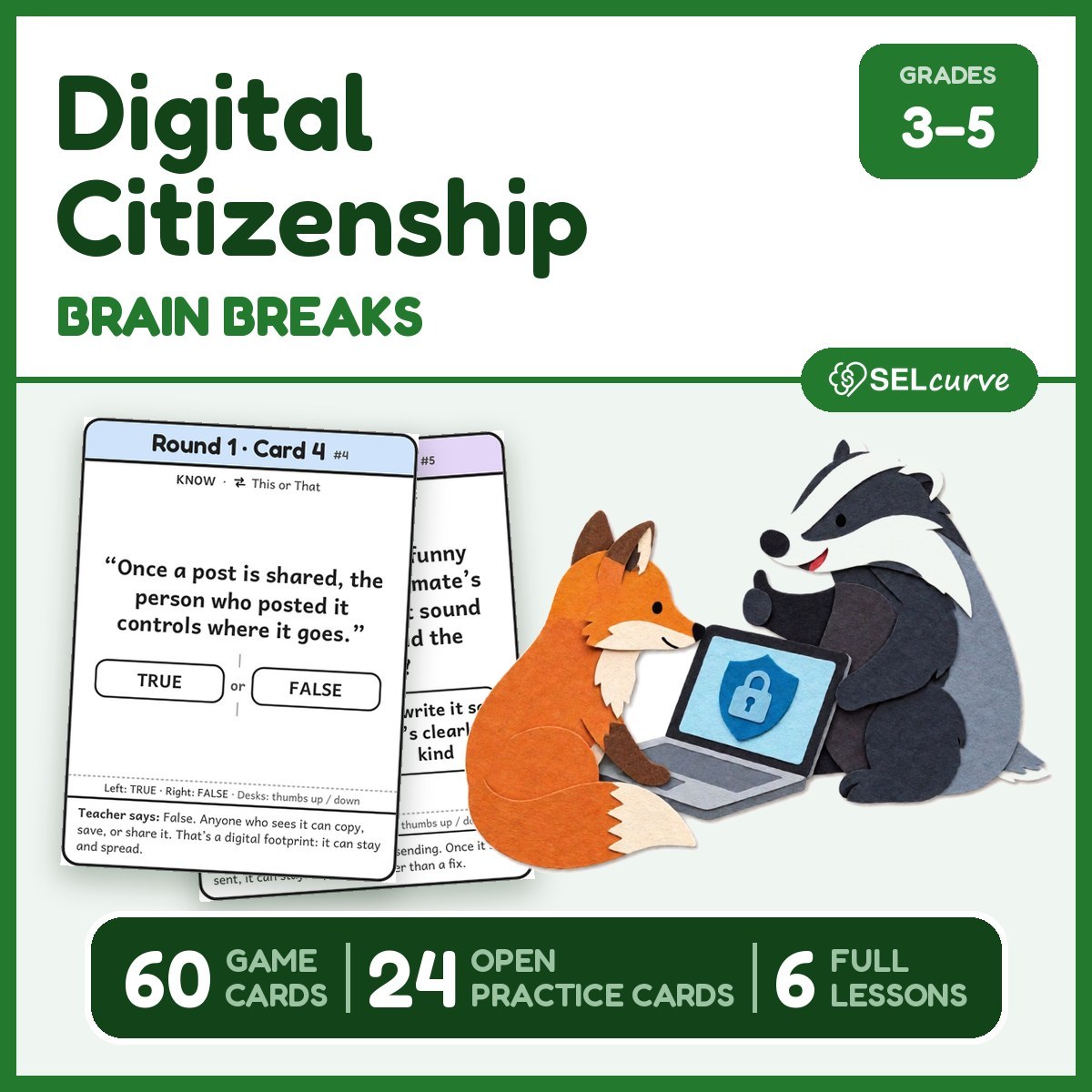
Digital Citizenship Brain Breaks
- 60 game cards
- 1 Reflect card
- 24 Open Practice Cards
- Printable
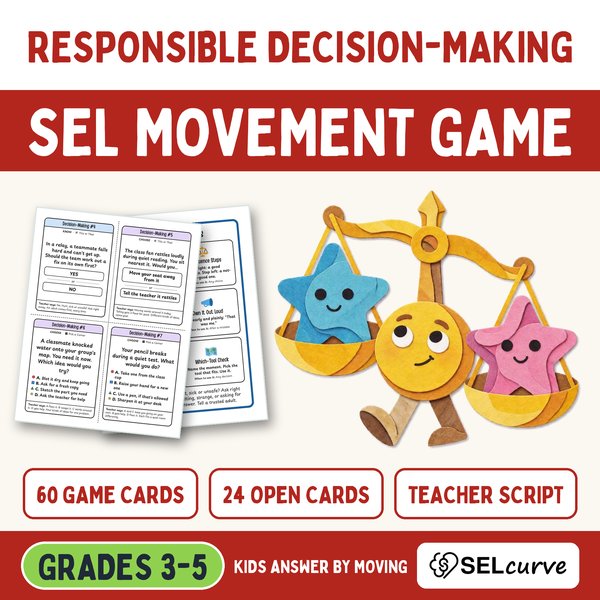 Free with a free accountDecision-Making Brain Breaks60 game cards · 24 Open Practice Cards · 6 Round Cards · Printable
What a free account gives you
- 81 free resources across all five SEL areas, ready to print
- Digital activities: post them in Google Classroom or Teams. Any device · No student logins
- A planner and collections to keep your SEL week organized
- Grades
- 3–5
- What you get
- 60 game cards for 6 rounds
- Type
- Brain Breaks
- Use it
- PrintView & Print in your browser
- Competency
- Responsible Decision‑Making
About this resource
Footprints, passwords and pop-up ads all get a whole-body answer in these digital citizenship brain breaks for Grades 3–5, which hold 60 game cards for six 15–20 minute lessons and 24 Open Practice Cards for a 3-minute break. Students step in on the line if a song has ever stuck in their head for days, take a side on whether typed words hurt less, and press one foot down to picture who could read a slideshow comment next year. It is a Responsible Decision-Making resource. Find more in our digital citizenship activities.
What students practice
Six rounds, from footprints to a clue hunt:
- Real people, lasting footprints
- Unexpected? Hands off
- Private info and passwords
- Stop, don’t answer, tell
- Who made it, and why?
- Clue hunt
Right for your grade
Grades 3–5
The situations belong to upper elementary: a class e-book, report research, a class typing game, the class blog and a class email to an author. Cards push students past quick reactions to ask who could see a post later, what makes a link unexpected and who may know a password, and student leaders can take over after Round 1. Every movement also works from a seat.
Everything included
What’s inside these SEL games
- 60 game cards for 6 rounds, printed 4 per page; each round moves through 2 Connect, 2 Know, 3 Choose, 2 Do and 1 Reflect card
- 24 Open Practice Cards that work on their own: Move If, True or False, This or That and Say It & Move cards
- A Round Card for each of the 6 rounds with the time, materials, Do cards and an early stopping point, plus a blank Make Your Own card per round
- A Detailed Script for Teachers that ties each round to the last, with discussion questions and a Movement Menu
- The Digital Citizen Tools Poster with six tools, 20 Movement Cards, 6 Room Signs (corners A–D and the 1 and 5 line ends) and a Family Connection page


A look inside
Real pages, real moments
In the classroom
How to use these digital citizenship brain breaks
- 1Between lessons: pick 3–5 Open Practice Cards (pages 40–45), read them as written, and end each with its Teacher says line once the class has moved.
- 2As a lesson: open with the Round Card, read the cards with the Quick Start default moves, and ask one or two students why they chose a side or corner.
- 3Pacing: plan on roughly a minute a card; read the four corner options twice and point to each sign as you go.
- 4Hand it over: student leaders can read Rounds 2, 3, 5 and 6. You lead Round 4 and read its flagged cards ahead of time.
Printing and prep
Ready to print
- Game cards for Rounds 1–6 are on pages 22–39, 4 per page, and the Open Practice Cards follow on pages 40–45.
- US Letter at Actual size, one side only (A4 users pick Fit to page), in color or black and white.
- Print the Movement Cards and Room Signs once; cardstock or lamination keeps every card going all year.
Questions teachers ask
FAQ
Do these digital citizenship brain breaks teach students to spot fakes?
No. Because computer-made pictures can look real, the guide teaches source questions instead: who made it, why, and where else can I check.
How is the round on upsetting things online handled?
You lead Round 4 yourself and read its flagged cards ahead of time. The guide asks you to tell your counselor before the round, and it explains which cards to skip if a student has had something upsetting happen online.
Do students need devices?
No. The pack uses no screens. Pencils are optional, for students who want to write their Reflect answers.
Can I use it with younger grades?
There is a separate Grades K–2 version that focuses on real people, asking first, private info, telling and real or made up.
More for Responsible Decision‑Making
See all in the library →
Try it in class this week
Start with the free Decision-Making Brain Breaks, or unlock it with Monthly.

