Full library·Grades 2–5·Social Awareness·Task Cards · Stop Think Act Cards
Bullying Prevention Stop Think Act Cards
Theo bumps your elbow by accident and says sorry, your friend Ruby grins and high-fives you after a missed shot, a kid on the bus says your shoes look like baby shoes for the second day: these bullying prevention stop think act cards ask Gr…
- 20 Stop Think Act cards
- 20 reflection sheets
- Print + digital
In the full library, with 17 more on Bullying Prevention
Scenario cards, worksheets, role play and more (grades K–8).
Get the free Stop Think Act CardsFree account · school email works · See the full library
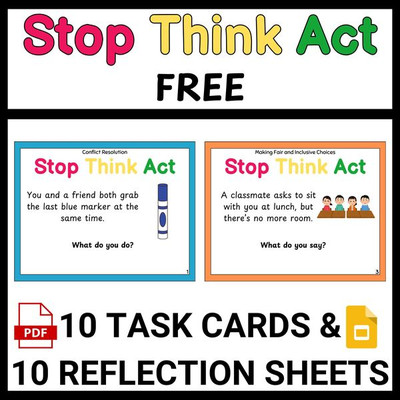
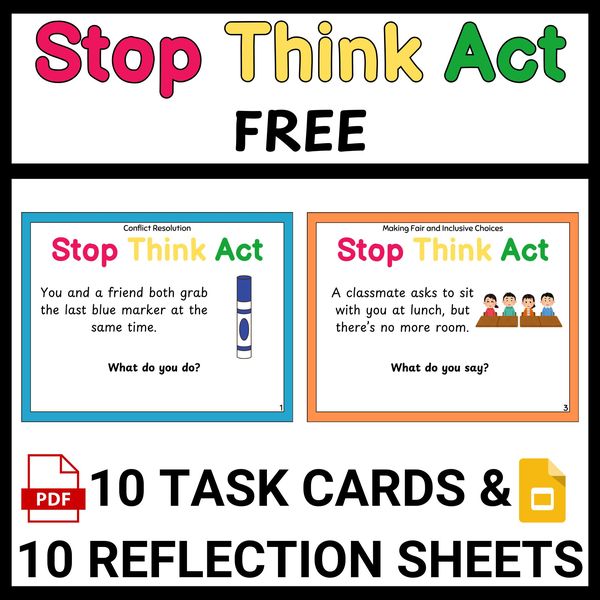 Same format, free with a free account: Stop Think Act CardsOpen it →
- Grades
- 2–5
- What you get
- 20 Stop Think Act cards
- Type
- Task Cards
- Use it
- Print + digitaldigital = any device, no student logins
- Competency
- Social Awareness
- Topic
- Bullying Prevention
About this resource
Theo bumps your elbow by accident and says sorry, your friend Ruby grins and high-fives you after a missed shot, a kid on the bus says your shoes look like baby shoes for the second day: these bullying prevention stop think act cards ask Grades 3–5 to tell meanness that happens again and again apart from a one-time accident or a friendly joke. Across 20 moments, most with a grown-up close by, students practice what to say, how to be an upstander and which grown-up to tell. It is a Relationship Skills resource. Find more in our bullying prevention activities.
What students practice
- Telling bullying apart from an accident or a friendly joke
- What to say and do when it happens to you
- Being an upstander for someone else
- Telling a trusted grown-up and supporting someone afterward
What’s inside these stop and think cards on bullying prevention
- Two printable sizes, one card per page for class talks or display and four per page for small groups, partner talks or stations
- A 4-page teacher guide with talking-safely rules, a teacher note, a five-step routine, differentiation and Cards at a Glance
- A Family Connection page with an upstander story game, and a digital activity that opens on any device with no student logins
A look inside
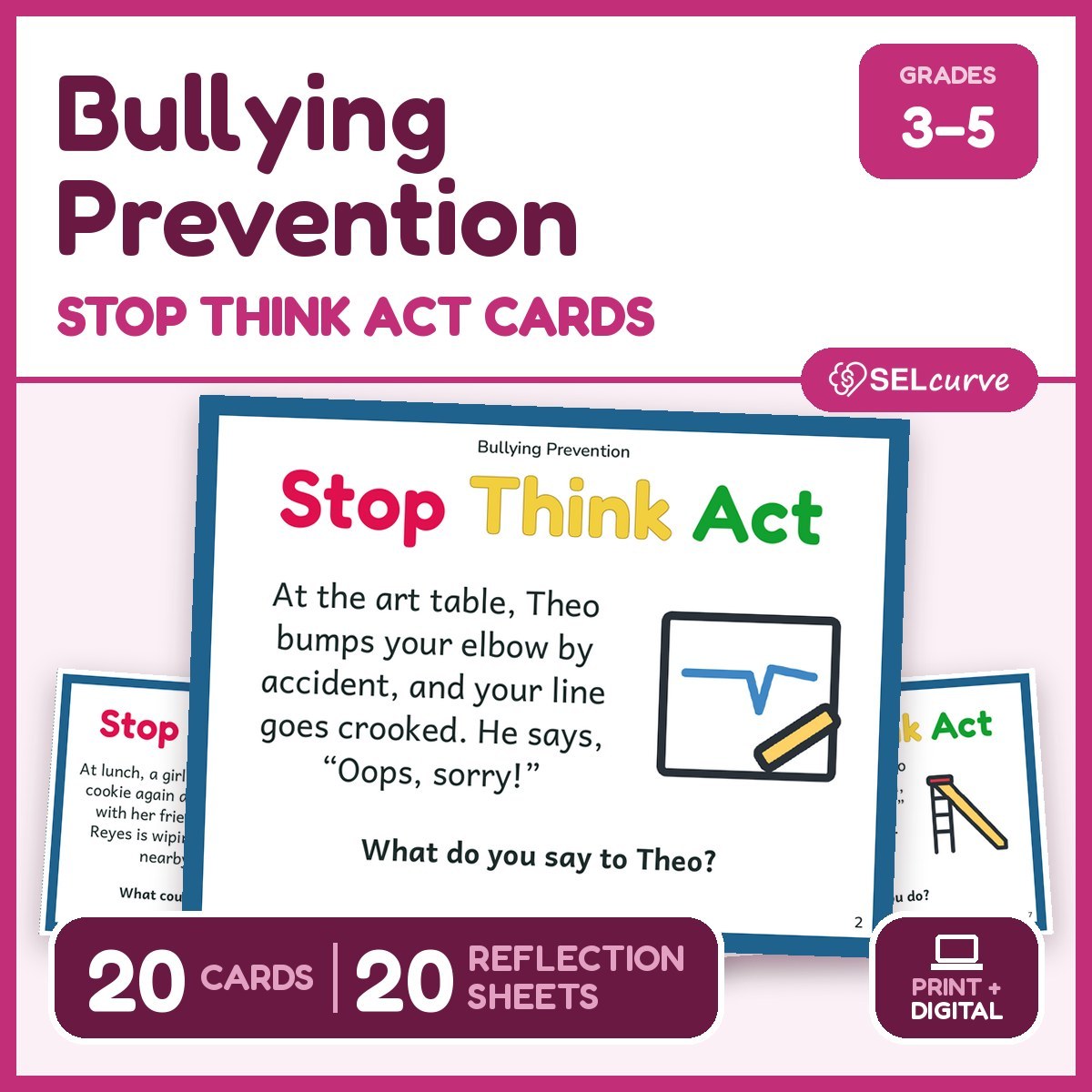
Card 2: “At the art table, Theo bumps your elbow by accident, and your line goes crooked.” He says sorry right away. Students decide what to say to Theo.
Card 15: you tell the recess teacher that kids keep leaving your friend out of the game on purpose, and she is too busy to listen. The question: “What could you do?”
Card 18: “On the walk home, your neighbor Ivy says kids at school made fun of her new haircut again today. Her dad is on the porch.”
How to lead a bullying prevention talk
- Read and picture: choose a card, read it aloud and let students imagine they are there.
- Ask the key question: “Is this bullying, a one-time accident or a friendly joke? How do you know?” Then ask what students could say, and which grown-up on the card could help.
- Practice speaking up: brainstorm two or three responses, pick the one that keeps everyone safest, and role-play short, calm words and walking to a grown-up to tell.
- Follow up: give out the sheet that goes with the card, or post the digital activity in Google Classroom or Teams, or show a QR code. Students answer on any device and send you their answer sheet.
Grade fit
In Grades 3–5, younger students get starters such as “That’s not okay because… I could tell…” and work through a card with you. Older students explain the difference between telling to get someone in trouble and telling to keep someone safe. Mixed-ability groups can act out the target, the upstander and the grown-up.
Printing
- Full-page cards: plain paper or cardstock, single-sided, for class talks, display or one card per group.
- Four-per-page cards: single-sided, cut apart on the dashed lines and laminated if you want to reuse them.
- Reflection sheets: one per student on plain paper; the matching card prints at the top.
Good to know
Read the cards yourself before you use the set and skip any card a student may be living right now. Students may always pass, the talk is about situations, not people, and if a student shares something that worries you, the guide asks you to thank them, follow up privately and follow your school’s reporting steps.
Questions teachers ask
Is every card about bullying?
No. Most cards show meanness that happens again and again to the same person, but a few show a one-time accident or a friendly joke, so students practice telling the difference.
What grades are these bullying prevention stop think act cards for?
Grades 3–5. Use them with the whole class, in small groups or one on one; the guide gives younger students sentence starters and asks older students why telling keeps people safe.
What should students say in the moment?
The guide suggests practicing short, calm words such as “Stop. That’s not okay,” then walking to a grown-up. Its three-step routine is “Is it again and again? Say stop. Tell a grown-up.”
What goes home to families?
A Family Connection page that explains what the class practiced, suggests making up a story together where a character is an upstander, and asks families to contact the school counselor if a child shares something unsafe.
More for Social Awareness
See all in the library →


Every resource, one library.
770 SEL resources for elementary classrooms — printables, digital activities and answer sheets, and every new one we add.