Fair vs Equal: How to Explain the Difference to Kids (With Classroom Scenarios)
"No fair! Why does he get one?" Every teacher hears it. Explaining fair vs equal gives students a better answer: fair doesn't mean everyone gets the same thing, it means everyone gets what they need.
“No fair! Why does he get one?” Every elementary teacher has heard it, usually about something a classmate needs: a wobble cushion, extra time, a different lap in gym. Talking about fair vs equal gives students a better way to think about those moments. Equal means everyone gets the same thing. Fair means everyone gets what they need. Once kids understand the difference, “no fair” turns into a real question they can answer for themselves. Below you’ll find a simple way to explain it, examples kids already know and four scenarios to discuss.
Fair vs equal: the difference in one sentence
For students: equal is everyone getting the same; fair is everyone getting what they need to do well.
The quickest way to make it stick is the bandage lesson. Ask every student to name a pretend scrape: a knee, an elbow, a finger. Then hand each of them a bandage for their elbow, no matter where the scrape is. Everyone got the same thing, so it was equal. Did it help? Ask students what would have been fair, and they’ll tell you right away: a bandage where each person is hurt.
Examples kids already know
- Glasses. Only students who need glasses wear them, and nobody thinks that’s unfair.
- Shoe sizes. Giving everyone a size 3 would be equal, and most of the class couldn’t walk.
- A step stool. A shorter kid uses it to reach the sink. A taller kid doesn’t need it.
- Help with reading. A brother who is learning to read gets more time with a parent at homework time.
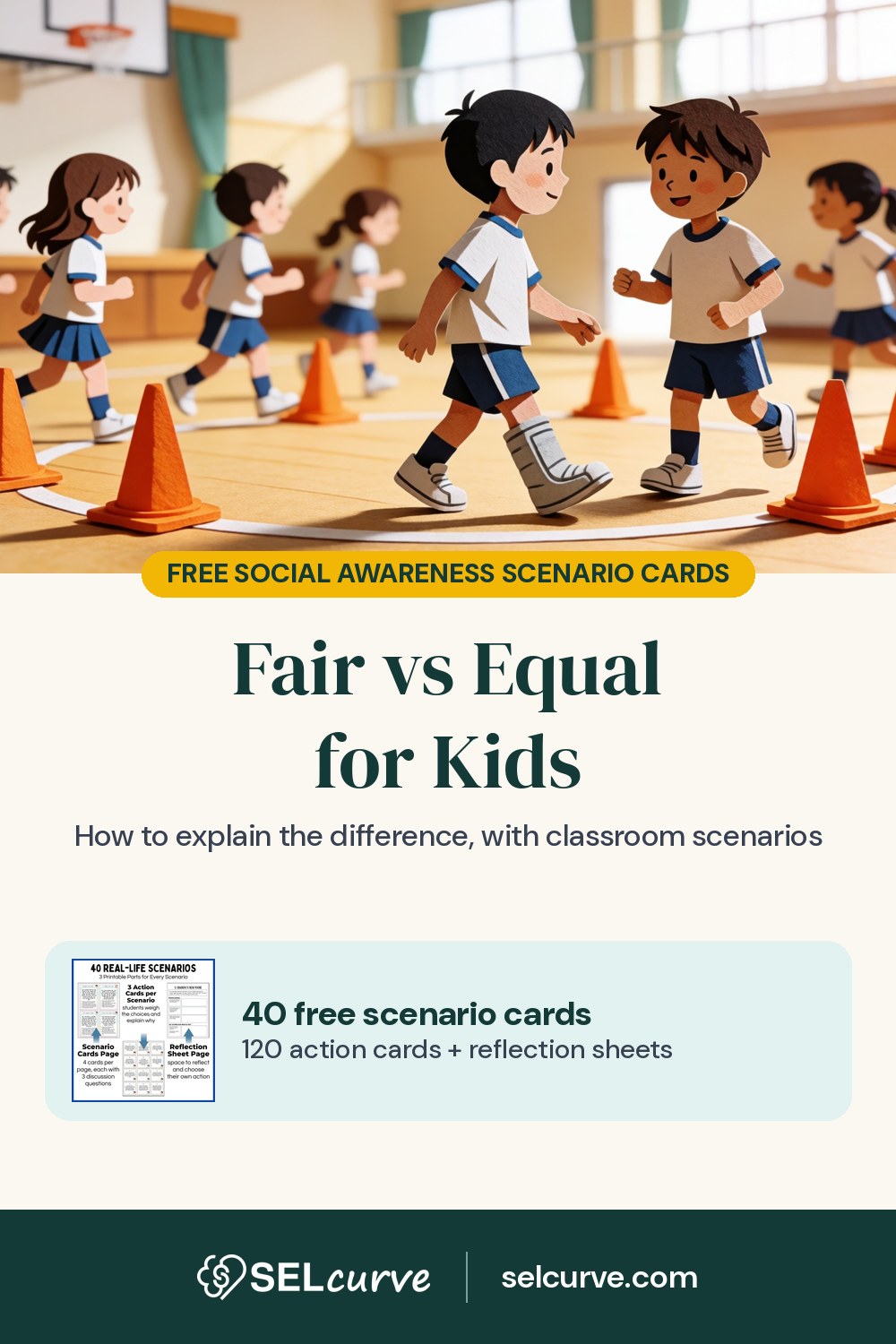
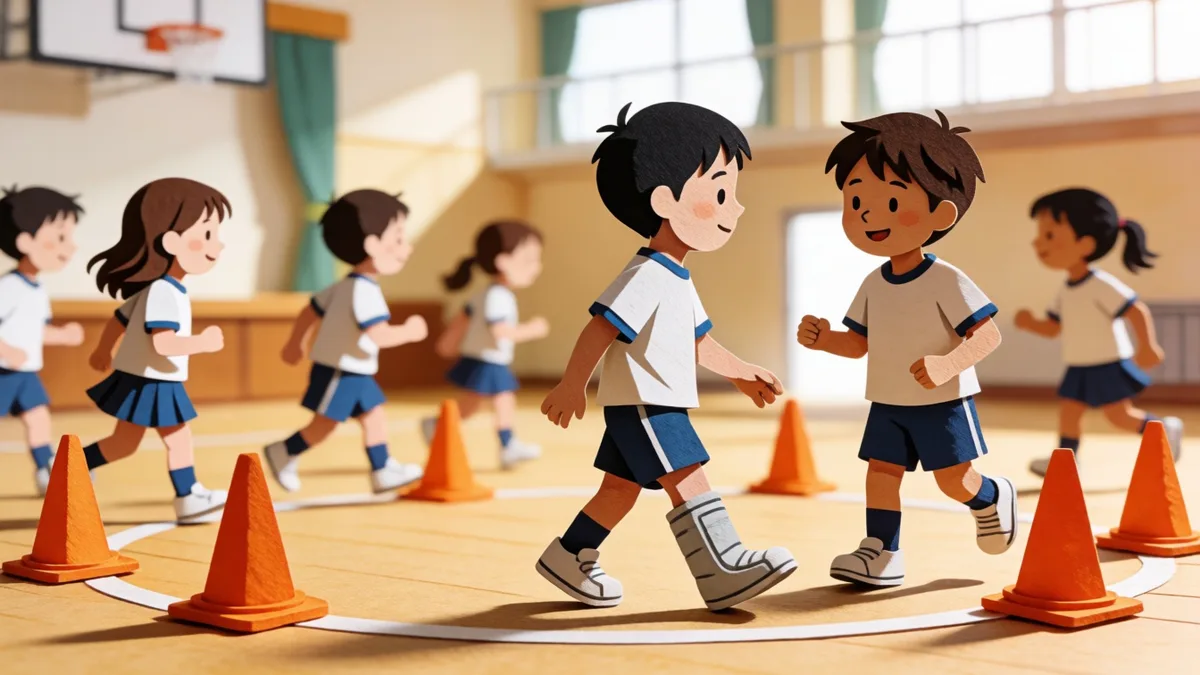
- A healing leg. A classmate just out of a cast walks a lap while others jog.
Each of these fair vs equal examples follows the same pattern. Someone needs something to have the same chance as everyone else, and giving it to them doesn’t take anything away from you.
Teaching fair vs equal in the classroom
- Name both words. Write “equal” and “fair” on the board with the one-sentence definitions. vocabulary
- Try the bandage lesson. Let students feel the difference before you explain it. experience
- Sort examples. Read short situations and ask: is this equal, fair, both or neither? thinking
- Talk through scenarios. Use real-life moments where a student feels “no fair” and decide what they could think or say. perspective
- Make it a class phrase. When “no fair” comes up for real, ask, “Is this about equal or about fair?” habit
4 fair vs equal scenarios
You’ll find all four in the free social awareness scenario cards, each with three possible actions for students to weigh.
What could you say about why Xavier has the cushion?
How can you explain to yourself why Hamish’s lap is different?
How can you think about why Kenta gets the extra time?
The fourth, “The Playground Gate,” is about a rule that might feel annoying, a gate you have to keep closing, until you think about the toddlers it protects from a busy street. For Walking the Last Lap, the action cards are “See the Difference,” “Keep Quiet and Jog” and “Walk Like Hamish.” Only the first one changes how the student thinks about it, and that’s the one worth talking about.
Questions to discuss
- What is the difference between equal and fair?
- When has something been equal but not helpful?
- What is something you need that a friend doesn’t?
- How might it feel to need help and hear someone say “no fair”?
- Can something be fair and equal at the same time? When?
- What could you say to yourself the next time you think “no fair”?
What you get in the free social awareness cards
The free Social Awareness What Would You Do? Cards stretch well beyond fairness: a grandpa sighing at his new phone, a tablemate who scoops stew with soft flatbread, a basketball team made of kids from three schools and a neighborhood lantern walk are a few of the 40. Students choose among three actions for each one, write on a matching page, or answer on a tablet or laptop.


For other social awareness skills and beyond, browse the free SEL library.
More free social awareness resources
 Free Social Awareness Conversation Cards — Morning Meeting QuestionsGrades 2–8 · Print + digitalFREE
 Free Social Awareness Reading Comprehension Passages — Grade 5Grade 5 · Print + digitalFREE
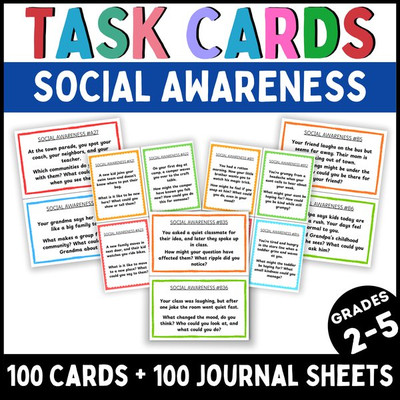 Free Social Awareness Task Cards — Printable & DigitalGrades 2–5 · Print + digitalFREE
Browse all free SEL resources.
Frequently asked questions
How do you explain fair vs equal to a child?
Equal means everyone gets the same thing. Fair means everyone gets what they need. Glasses are a good example: only the kids who need them wear them, and that’s fair even though it isn’t equal.
What is a good fair vs equal activity?
The bandage lesson: give every student a bandage for the same spot, no matter where their pretend scrape is, then ask what would have been fair. Follow it with real-life scenarios to discuss.
What grade level are these scenarios written for?
Second through fifth grade. Second graders love the bandage lesson and can talk the cards through out loud; fourth and fifth graders can write their thinking down.
Are the fair vs equal cards free?
Yes. They are part of the free Social Awareness What Would You Do? Cards, which you can print or use on screens at no cost.
More SEL ideas