Paid·Grades 3–5·Self-Awareness·Brain Breaks
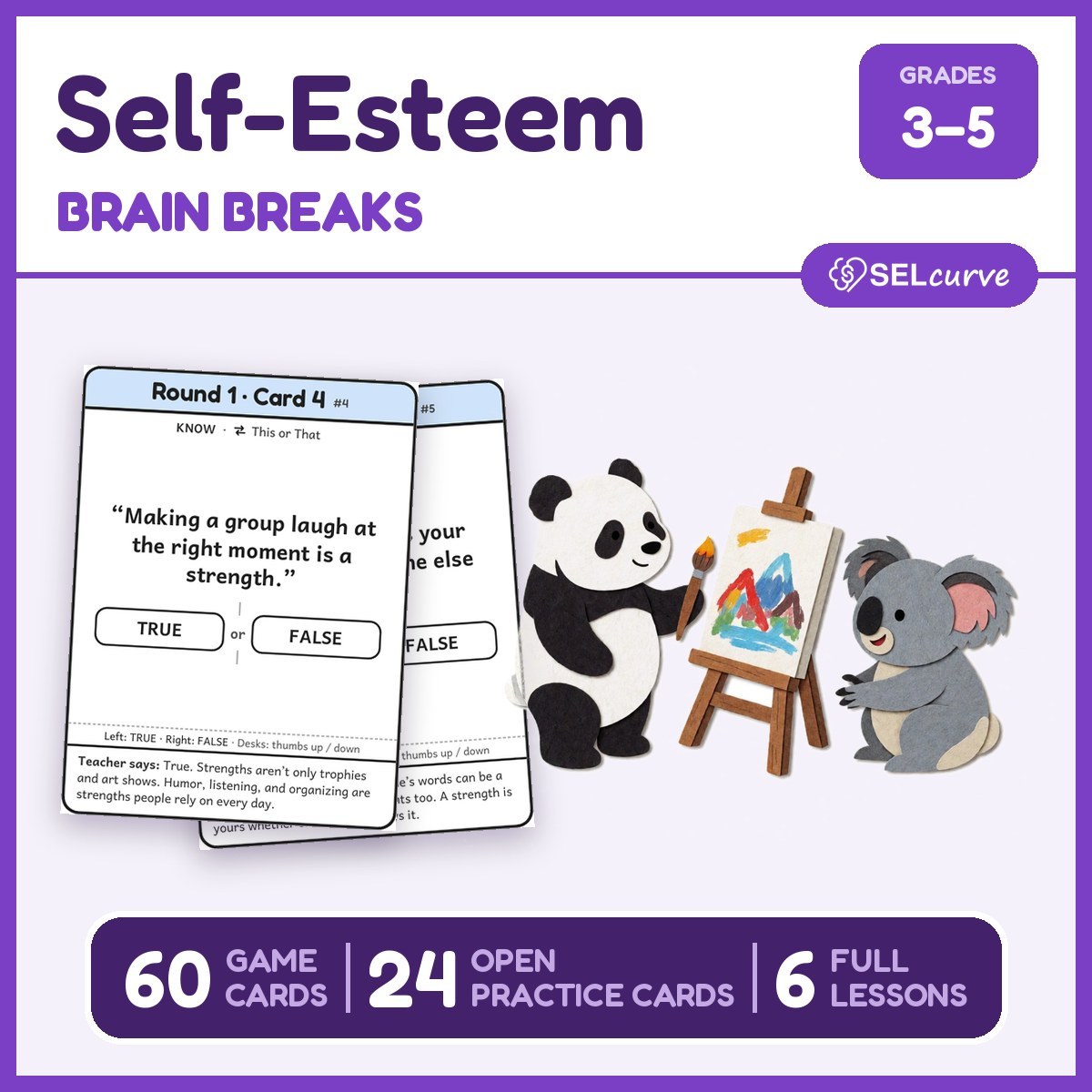
Self-Esteem Brain Breaks
- 60 game cards
- 6 Round Cards
- 24 Open Practice Cards
- Printable
 Free with a free accountSelf-Awareness Brain Breaks60 game cards · 6 Round Cards · 24 Open Practice Cards · Printable
What a free account gives you
- 81 free resources across all five SEL areas, ready to print
- Digital activities: post them in Google Classroom or Teams. Any device · No student logins
- A planner and collections to keep your SEL week organized
- Grades
- 3–5
- What you get
- 60 game cards in 6 rounds
- Type
- Brain Breaks
- Use it
- PrintView & Print in your browser
- Competency
- Self-Awareness
About this resource
Self-esteem brain breaks for Grades 3–5 put strengths, new groups and hard firsts on their feet, using 60 game cards that make up six 15–20 minute lessons, with 24 extra Open Practice Cards for days when you only have 3 minutes. Students stretch side to side if they have ever fixed something small, like a tangled jump rope, take a side on whether confident people feel unsure when they try something new, and pick a corner for who they would watch or ask first on the day the class starts coding. It is a Self-Awareness resource. Find more in our self-esteem worksheets and activities.
What students practice
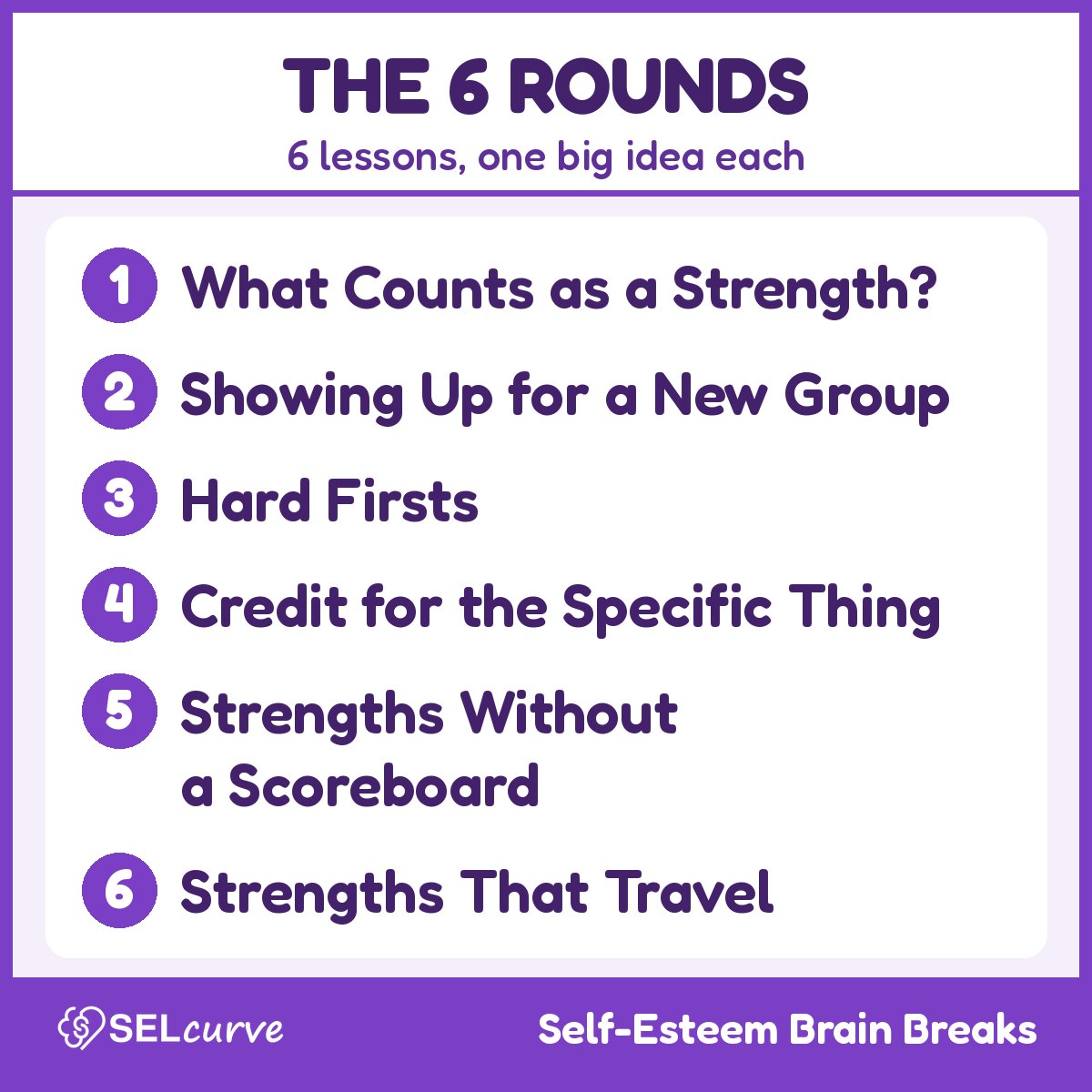
Six rounds, from naming a strength to carrying it somewhere new:
- What counts as a strength?
- Showing up for a new group
- Hard firsts
- Credit for the specific thing
- Strengths without a scoreboard
- Strengths that travel
Right for your grade
Grades 3–5
The guide notes that upper elementary students often measure themselves against classmates, so the scenes come from their world: new clubs and teams, group projects, class plays and praise that goes to someone else. Cards ask what counts as evidence, what a first small step looks like and why exact credit matters, and every movement has a seated version.
Everything included
What’s inside these self-esteem activities
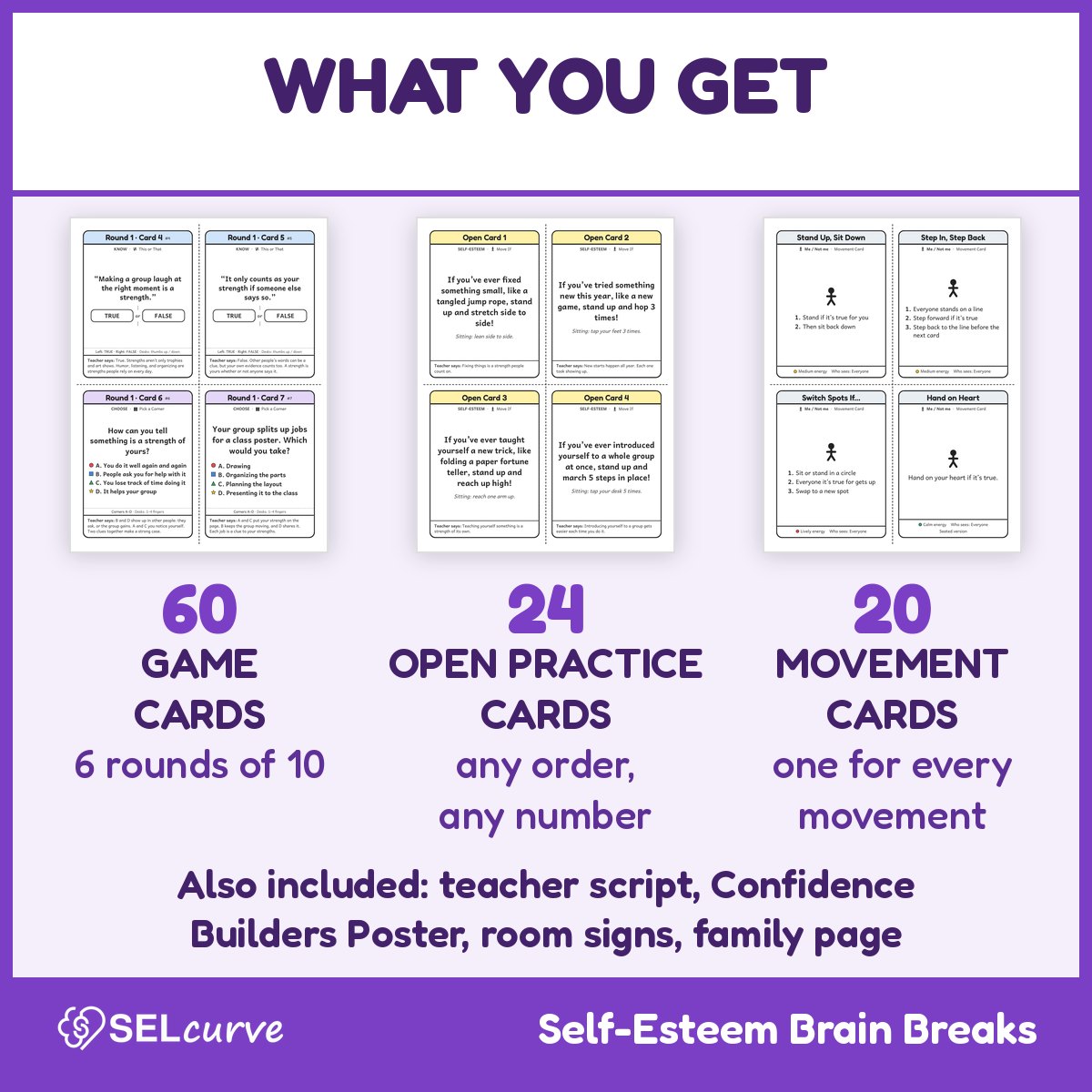
- 60 game cards in 6 rounds, four to a page, each round moving from three Connect cards through Know, Choose and Do to one Reflect card
- 6 Round Cards and 6 Make Your Own cards, each Round Card listing the big idea, what you need, the Do cards and where to stop early
- 24 Open Practice Cards that stand alone, a mix of Move If, True or False, This or That and Say It & Move prompts
- A Detailed Script for Teachers covering every round, with a Movement Menu of other ways to answer
- The Confidence Builders Poster of six tools, 20 Movement Cards, corner and line-end Room Signs, and a take-home Family Connection page
A look inside
Real pages, real moments
In the classroom
How to use these self-esteem brain breaks
- 1Between lessons: choose 3–5 Open Practice Cards and read them exactly as printed; everyone does the move, and you finish with the Teacher says line.
- 2For a full SEL lesson: start from the Round Card and read the ten cards in order; ask a student or two why, then read the teaching point.
- 3With the script: each round has a Before You Start list, an Introduction, notes for every group of cards and a Calm Finish.
- 4Hand it over: once Round 1 is done, students can take turns as the card reader and pick how the class moves, while you hold the Round Card.
Printing and prep
Ready to print
- Print on US Letter, single-sided and at Actual size; for A4 paper, pick Fit to page.
- A round needs just 3 pages: its Round Card, the ten game cards and one blank Make Your Own card.
- Cut along the dashed lines, then keep each round together, Round Card first, in an envelope or on a binder ring.
Questions teachers ask
FAQ
Do these self-esteem brain breaks rank students?
No. The guide asks you to skip “best in the class” and to swap general praise for the exact thing a student did. Round 5 is about measuring a strength by your own growth.
What if a student is nervous about new groups?
Round 2 gives every student a planned first sentence for a new group, and looking at faces during the Room Read card is optional.
Is eye contact required?
No. The guide says facing the room is enough, since some families teach lowered eyes as respect and some students find eye contact hard.
Does a Grades K–2 version exist?
Yes. The Grades K–2 version focuses on naming a strength, saying the exact thing you did, and saying hello to something new.
More for Self-Awareness
See all in the library →
Try it in class this week
Start with the free Self-Awareness Brain Breaks, or unlock it with Monthly.