Quick Brain Breaks: 2-Minute Games for Grades 3–5 (Free Honesty Game)
Sometimes you only have two minutes between lessons. These quick brain breaks for grades 3–5 fit that gap: no setup, one rule each, and a clear ending, with a free printable movement game on owning up to mistakes.
The bell is about to ring, the math lesson ran long, and the class is fading. You don’t have ten minutes for a game. You have two. Quick brain breaks are built for exactly that gap: no setup, one rule, a clear ending, and everyone back in their seat ready to work. The 10 below each take about two minutes and work in grades 3–5, with seated versions. Several also practice a skill that matters more than it seems in upper elementary: owning up to a mistake early and plainly. You can print the first five free, as part of a social-emotional learning (SEL) game.
Three rules for a brain break that stays quick
- No materials. If you need to hand something out, it’s not a two-minute break. no setup
- One rule you can say in one sentence. “Walk to TRUE or FALSE.” Done. simple
- A built-in ending. A count, a freeze or a still pose tells students it’s over. clear finish
10 quick brain breaks for grades 3–5
1. Own It Out Loud
Partners stand. You call a pretend “oops”: an extra turn, a wrong answer, a skipped step. Partner A steps in and says, “That was me. I ___.” Partner B answers, “Okay. Let’s fix it.” Step back and switch. Say it early and plain, then fix it together. About 2 minutes. Medium energy. Seated: turn and say it.
2. Truth Weight
Students sit tall with palms up and picture a pretend student hiding a fib. Their hands sink, heavy. Then they picture the student saying, “It was me,” and their hands float up. Hands in laps, be still. The truth often feels lighter, even before the fix. About 1 minute. Calm.
3. True or False: Owning Up
Label two sides TRUE and FALSE and read: “Correcting a wrong answer you told a classmate makes you look worse to them.” Students walk to a side. (False: most people trust you more.) Second round: “Telling your lab group you skipped a step helps the group’s results.” (True.) About 2 minutes. Medium energy. Seated: thumbs up or down.
4. How Tempted? 1 to 5
Put a 1 sign at one end of the room and a 5 at the other. Read: “A team’s quiz score was added wrong, in their favor. How tempted to stay quiet might a teammate feel?” Students stand on the line where they think. Any number is okay; feeling tempted is normal. What you do next is the honest part. About 2 minutes. Medium energy.
5. When Could They Say It?
Hang four corner signs and read: “A student told a classmate the warm-up answer was 24. It’s 42. When could they say so?” Right now, at the next break, before it’s handed in, or ask the teacher to tell the class. Every option sets it right; sooner is easier. About 2 minutes. Lively.
6. Desk Stretch Sequence
Standing beside desks: reach high for a count of five, twist gently left and right, reach down toward toes, then stand tall and still. Four moves, one minute. Great when there’s really no time. Calm. Seated: reach and twist from the chair.
7. 30-Second Shake
Shake out hands, arms, shoulders and legs while you count down from 30, getting slower and quieter as you go. At zero, everyone freezes. Under a minute. Lively, then still.
8. Air Write
Students stand and “write” a vocabulary word or their name in the air with a hand, then an elbow, then a foot. Classmates guess the word. Mixes movement with review. About 2 minutes. Medium energy.
9. Pass the Clap
Standing in a circle (or around the room), one student claps toward the next, who passes it on, faster each round. If two people clap at once, it starts over. About 2 minutes. Lively, and it ends with full focus.
10. Breathe and Count
Breathe in for four counts, out for six, three times. A long, slow breath out helps many students settle. They can count on their fingers. About 1 minute. Calm.
Inside the free owning-up round
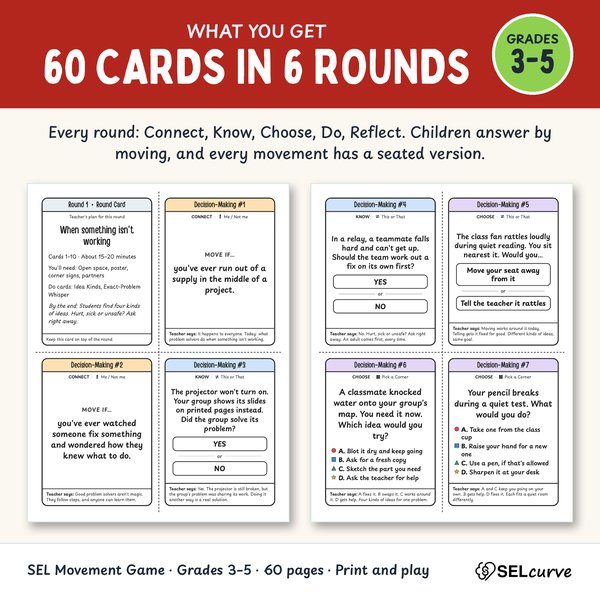
Breaks 1 to 5 come from Round 4 of the free Decision-Making Brain Breaks for grades 3–5, called “Owning up.” By the end, students own a mistake early and plainly, even when staying quiet is tempting. Every card stands alone as a quick break; together, the 10 cards make a 15- to 20-minute lesson. Three of them:
Teacher says: Honest words can be hard to say and to hear. Today: how to be the one who says them.
Say, “That was an extra turn,” and step out
or
Keep playing, then tell them after the point
Teacher says: Both own it. One fixes it now; one waits for a break. Fair either way.
Teacher says: A kind answer makes owning up easier for the next person.
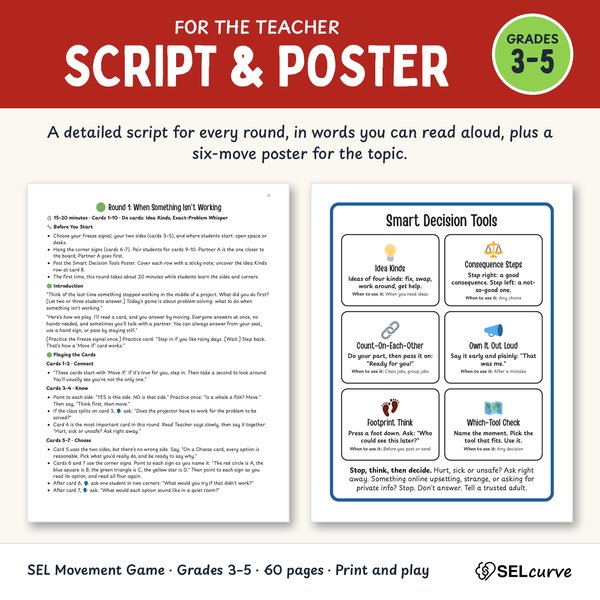
The rest of the free game covers when something isn’t working, thinking through consequences, doing your part and thinking before you post, plus a final step-by-step story round. Twenty-four open practice cards come with the set too.
Need a break for a different skill? The free SEL resources cover all five.
More free decision-making resources
 Free Decision-Making Reading Comprehension Passages — Grade 4Grade 4 · Print + digitalFREE
 Free Decision-Making Scenario Cards — Printable & DigitalGrades 2–6 · Print + digitalFREE
 Stop Think Act Cards — Free Printable & Digital SampleGrades 2–5 · Print + digitalFREE
Browse all free SEL resources.
Frequently asked questions
What is a quick brain break?
A movement or focus break of about two minutes with no materials, one simple rule and a clear ending. It fits between lessons, during transitions, or whenever attention fades.
Do 2-minute brain breaks really help?
A short reset helps students settle back into work, and it costs almost no teaching time. The key is ending on a still or calm move so the class comes back ready.
How do you teach honesty to upper elementary students?
Make owning up ordinary: practice short, plain phrases (“That was me. Let’s fix it.”), model them yourself, and answer kindly when a student owns up to you.
What if students are too old for movement breaks?
Offer seated versions, use real situations instead of silly ones, and let students lead once they know the game.
Is owning up the only honesty topic in the free game?
It’s the focus of Round 4. The other five rounds cover problem solving, consequences, doing your part, thinking before you post and a final story round, for 60 game cards in all.
More SEL ideas
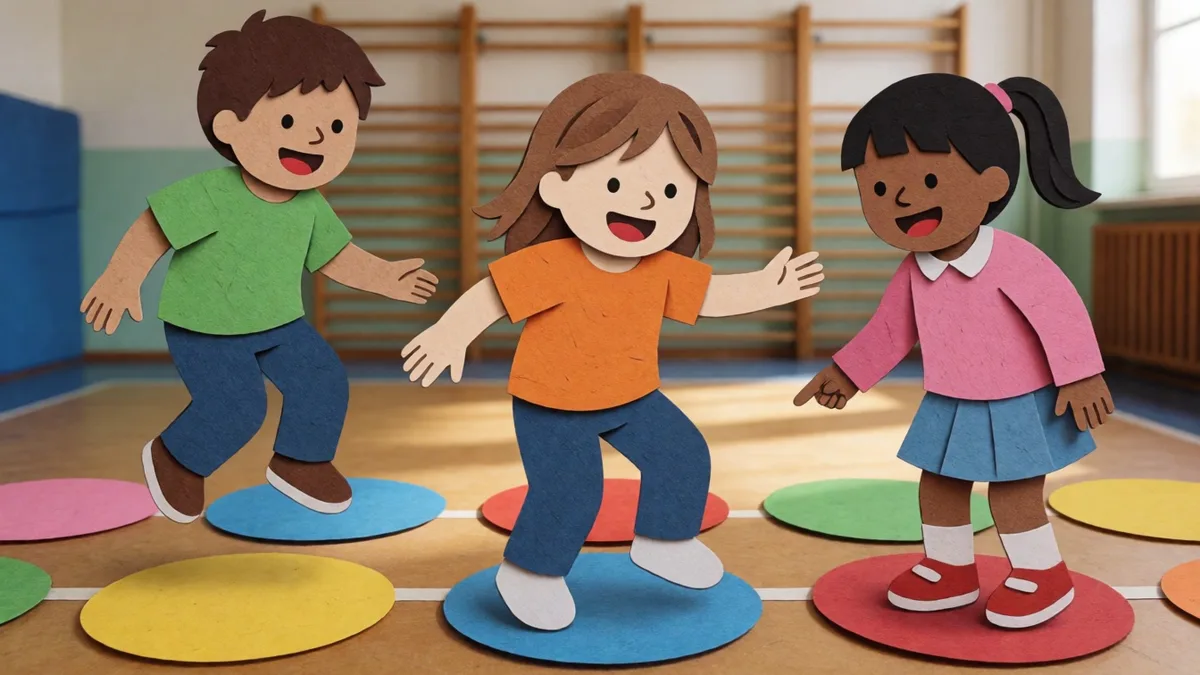 Responsible Decision-MakingBrain Break Games Where Kids Make Choices (Free K–2 Problem-Solving Game)
 Responsible Decision-MakingStop, Think, Act for Kids: How to Teach the Strategy (+ 10 Free Cards)
 Relationship SkillsFun Brain Breaks for Upper Elementary That Also Teach Students to Solve Conflicts (Free Game)