
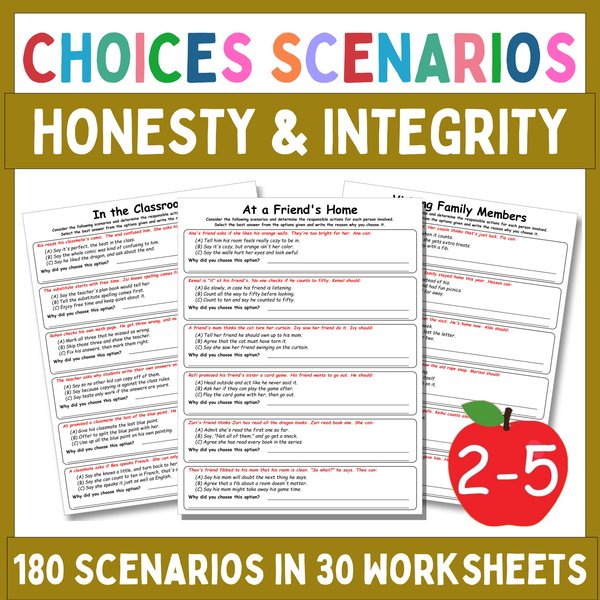
Full library·Grades 2–5·Responsible Decision‑Making·Worksheets · Choices Scenarios
Honesty Worksheets
Kaya’s little sister made pancakes and wants to know if they’re good. They’re burnt.
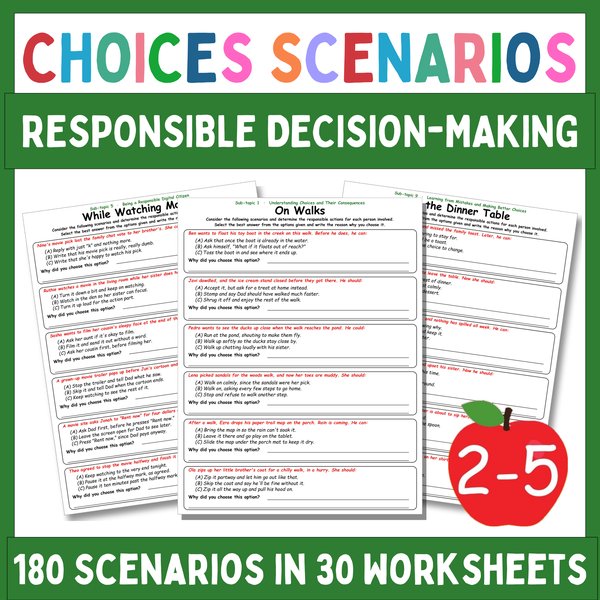
- 30 printable worksheets
- 180 multiple choice scenarios
- 4 teacher pages
- Print + digital
In the full library, with 16 more on Honesty & Integrity
Scenario cards, reading passages, What Would You Do? cards and more (grades K–8).
Get the free Decision-Making WorksheetsFree account · school email works · See the full library
 Same format, free with a free account: Decision-Making WorksheetsOpen it →
- Grades
- 2–5
- What you get
- 30 printable worksheets35 pages
- Type
- Worksheets
- Use it
- Print + digitaldigital = one link, no student logins
- Competency
- Responsible Decision‑Making
- Topic
- Honesty & Integrity
About this resource
Kaya’s little sister made pancakes and wants to know if they’re good. They’re burnt. These honesty worksheets are full of moments like that, where telling the truth, keeping a promise or playing fair when no one is looking takes a little courage. Grades 2–5 read 180 scenarios, choose A, B or C, and write why, working on Responsible Decision-Making and on honesty that is also kind.
What students practice
- Telling the truth about what I saw or know
- Skipping small fibs and stretched stories
- Keeping promises
- Doing right when no one is watching
- Being honest in a kind way
- Explaining why honesty matters
What’s inside
- Promise, no-one-is-watching and kind-truth scenarios alongside telling what they saw
A look inside
- ASay they taste burnt, and pass the syrup.
- BThank her, and say they’re a little dark.
- CMake a face and push the plate away from her.
In the Classroom: Rohan checks his own math page. He got three wrong, and no one will see. Best: “Mark all three that he missed as wrong.”
How to use these honesty worksheets
Grade fit
The situations are small and familiar (a toy moved to the sale bin, a sack race promise, a movie Dad never okayed), so they sit well in Grades 2–5. Older students can explain why a softer truth is still not a lie.
Digital version
The interactive digital version shares as one link: students pick A, B or C and type their reason, or just pick if you choose the choices-only format, on any device with no student logins. At the end they download an answer sheet to hand in.
Good to know
From the scoring note: the full truth or kept promise, said kindly, is strongest; a vague, partial or softer truth is weaker but never a lie; a fib, a broken promise or a cheat is poorest. That middle category is great SEL material.
Pairs well with

Questions teachers ask
What about a truth that might hurt someone’s feelings?
That’s one of the six themes. Scenarios like Kaya’s pancakes ask students to find the answer that is both true and kind.
Is there an answer key?
No. The discussion page has a scoring note that ranks the kinds of choices, and students defend theirs on the why line.
Do students need accounts for the digital version?
No. You share one link, and there are no student logins.
More for Responsible Decision‑Making
See all in the library →
Every resource, one library.
672 SEL resources for elementary classrooms — printables, digital activities and answer sheets, and every new one we add.

