Full library·Grades 2–5·Responsible Decision‑Making·Task Cards · Stop Think Act Cards
Problem Solving Stop Think Act Cards
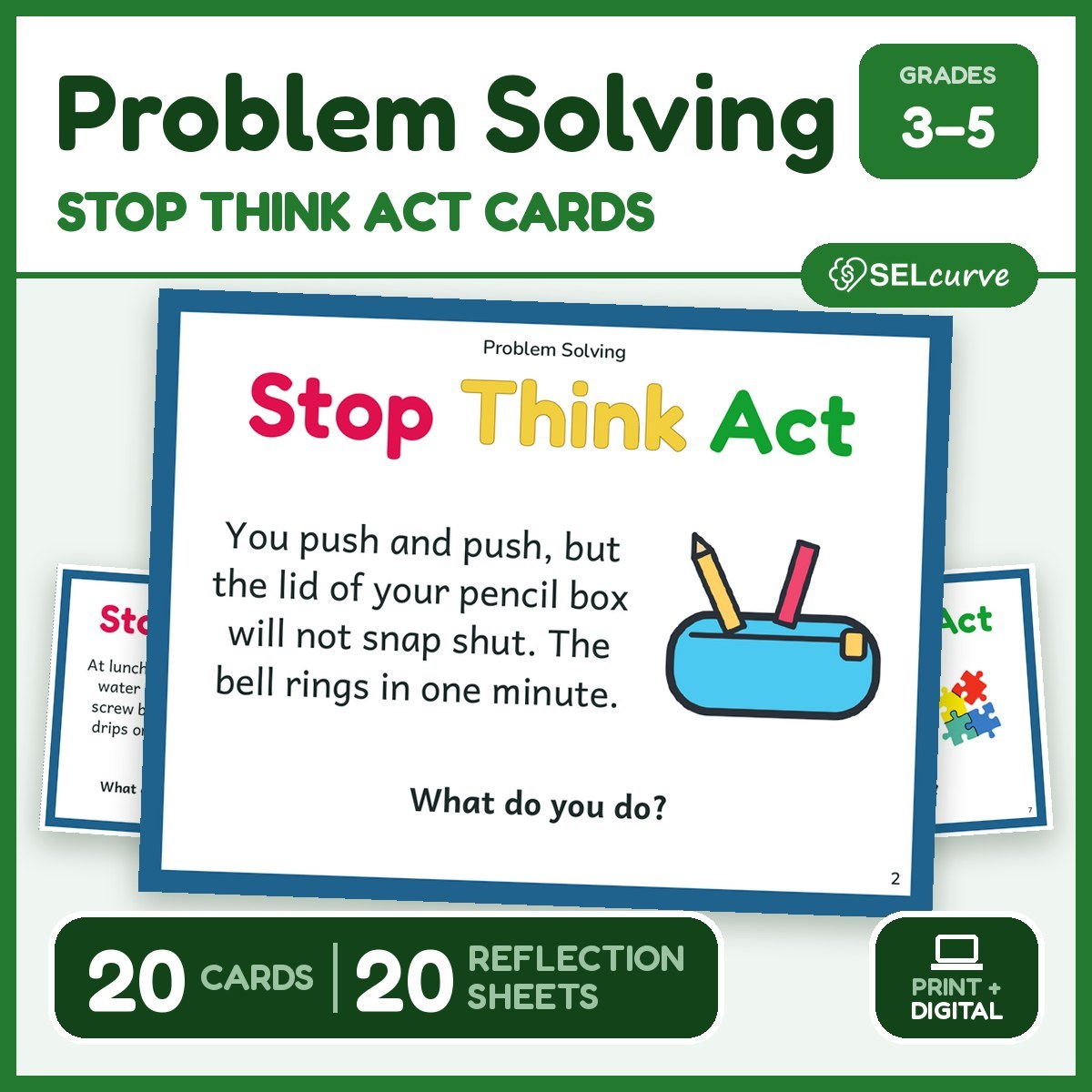
Something is broken, missing or not working on every one of these problem solving stop think act cards for Grades 3–5: headphones at the library listening station make no sound, the button jar is empty when your paper owl needs one more eye…
- 20 Stop Think Act cards
- 20 reflection sheets
- Print + digital
In the full library, with 23 more on Problem Solving
Scenario cards, worksheets, role play and more (grades K–8).
Get the free Stop Think Act CardsFree account · school email works · See the full library
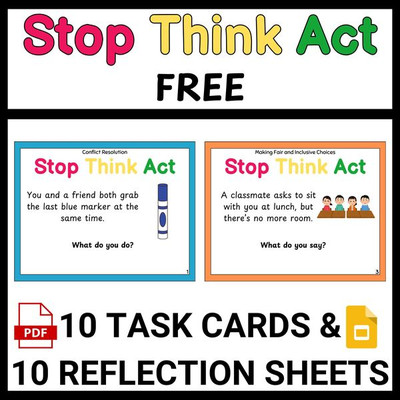
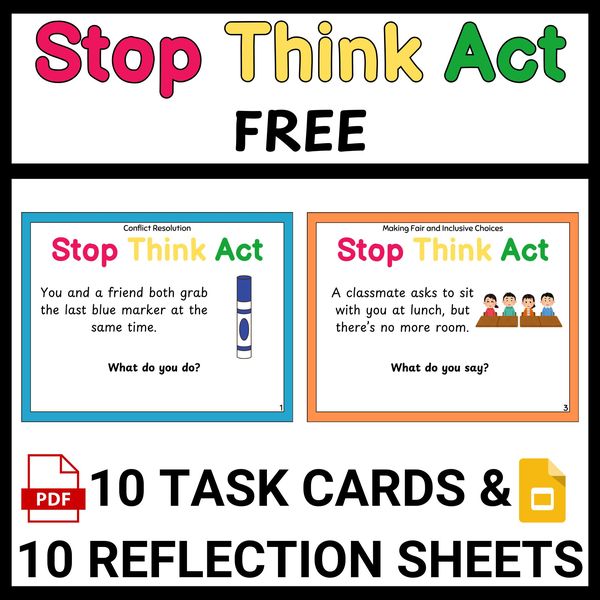 Same format, free with a free account: Stop Think Act CardsOpen it →
- Grades
- 2–5
- What you get
- 20 Stop Think Act cards at school
- Type
- Task Cards
- Use it
- Print + digitaldigital = any device, no student logins
- Competency
- Responsible Decision‑Making
- Topic
- Problem Solving
About this resource
Something is broken, missing or not working on every one of these problem solving stop think act cards for Grades 3–5: headphones at the library listening station make no sound, the button jar is empty when your paper owl needs one more eye, a glued clay mug handle still wobbles after it dries. Over 20 moments, students name the real problem, think of more than one fix that fits the time and things they have, and try again when the first fix doesn’t hold. It is a Responsible Decision-Making resource. Find more in our social problem solving activities.
What students practice
- Naming the real problem first
- Thinking of more than one idea
- Picking a fix that fits the time and things you have
- Trying again when a first fix doesn’t work
What’s inside these stop and think problem solving cards
- Full-page and 4-per-page formats of the same cards, for whole-class talks and for small groups and stations
- A 4-page teacher guide with tips like celebrate second tries, a five-step routine, differentiation and Cards at a Glance
- A Family Connection page on solving problems step by step, and a digital activity on any device, with no student logins
A look inside
Card 8: “Your sidewalk chalk snaps into tiny bits before your hopscotch board is done. Recess ends in ten minutes.” Then: “What are two ways you could finish it?”
Card 19: the snapped jump rope you tied back together now catches on the ground at the knot. The question: “What do you try next?”
How to run a problem solving talk
- Read the problem: share the card aloud and have students picture it.
- Look closely: “What is not working here? What clues on the card tell you?” Then ask how much time or what things students have to work with.
- Collect fixes: brainstorm two or three ways to solve it, choose the one that fits best, and act out trying it, plus what you would do if it didn’t work.
- Reflect: give out the reflection sheet, or post the digital activity in Google Classroom or Teams, or show a QR code. Students answer on any device and send you their answer sheet.
Grade fit
Younger students in Grades 3–5 get the starter “The problem is… I could try…” and solve a card with you. Older students compare two fixes and explain which one fits the time and things they have. At morning meeting, the class can collect as many fixes as it can find for one card.
Printing
- Full-page cards: single-sided, on plain paper or cardstock, for whole-class talks or display.
- Four-per-page cards: single-sided; cut on the dashed lines, then laminate for repeated use.
- Family Connection: plain paper, single-sided, two take-home notes per page.
Good to know
The guide treats a fix that doesn’t work as useful information, not a failure. Students may pass, and if they share a small problem they solved, they don’t name anyone.
Questions teachers ask
What if a student’s first fix wouldn’t work?
That is part of the practice. Several cards show a fix that didn’t hold, and the guide asks students to act out what they would do next.
What grades are these problem solving stop think act cards for?
Grades 3–5. Younger students use a sentence starter and solve a card with you, and older students weigh two fixes against the time and things they have.
What routine can students use?
“What’s wrong? What could I try? Did it work?” The guide suggests posting it near your class supplies.
Is there a digital problem solving activity?
Yes. Post it in Google Classroom or Teams, or show a QR code. Students work on any device with no student logins and send you their answer sheet.
More for Responsible Decision‑Making
See all in the library →

Every resource, one library.
770 SEL resources for elementary classrooms — printables, digital activities and answer sheets, and every new one we add.