
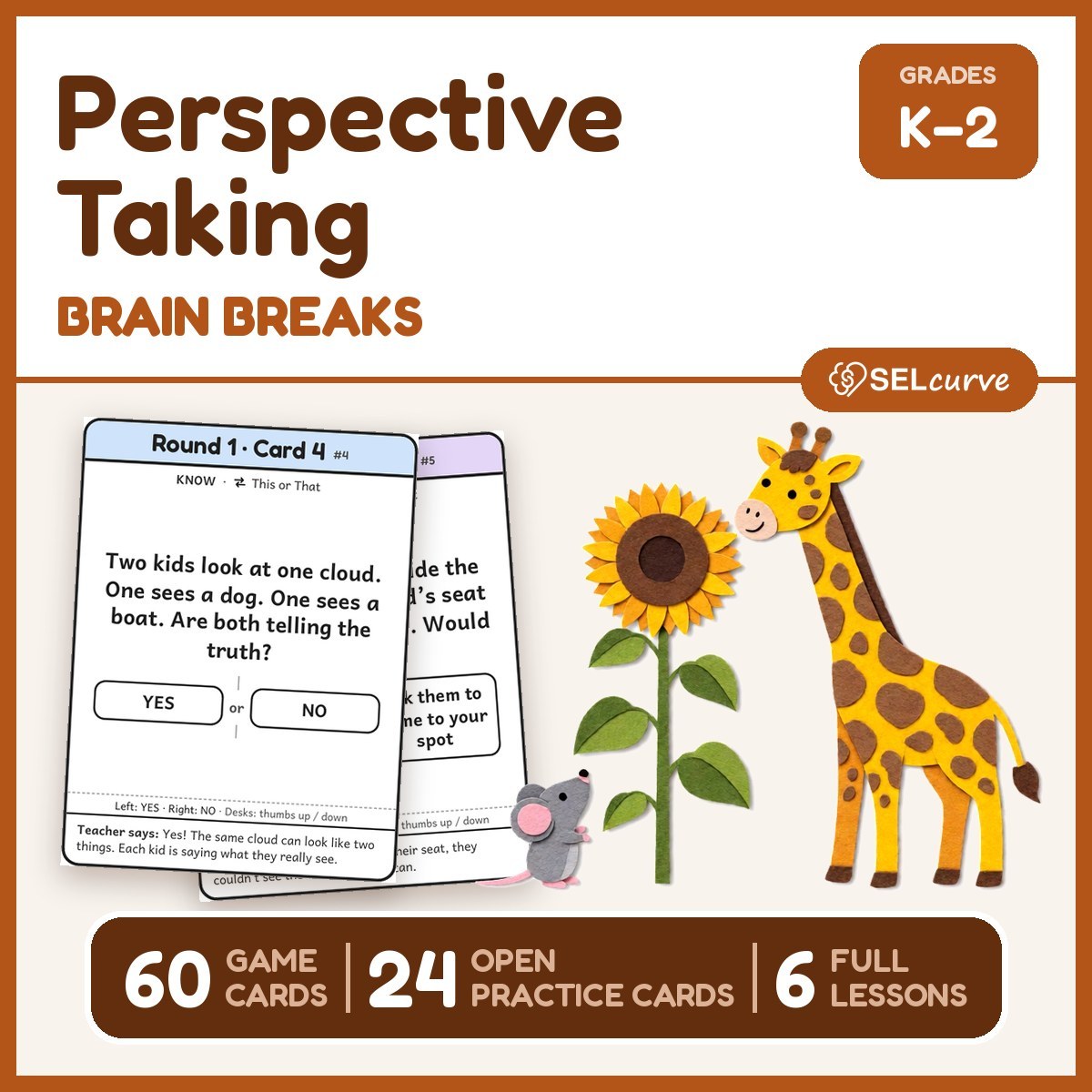
Paid·Grades K–2·Social Awareness·Brain Breaks
Perspective Taking Brain Breaks
- 60 game cards
- 24 Open Practice Cards
- 6 Round Cards
- Printable
 Free with a free accountSocial Awareness Brain Breaks60 game cards · 24 Open Practice Cards · Printable
What a free account gives you
- 71 free resources across all five SEL areas, ready to print
- Digital activities: post them in Google Classroom or Teams. Any device · No student logins
- A planner and collections to keep your SEL week organized
- Grades
- K–2
- What you get
- 60 game cards in 6 rounds
- Type
- Brain Breaks
- Use it
- PrintView & Print in your browser
- Competency
- Social Awareness
- Topic
- Perspective Taking
About this resource
From a drawing that faces the wrong way to a friend who names a meeting spot you don’t know, these perspective taking brain breaks for Grades K–2 turn everyday mix-ups into 60 game cards for six 15–20 minute lessons, plus 24 Open Practice Cards for a 3-minute break. Children decide whether the kid across the table can see a picture that faces you, choose between asking which spot and heading to the usual one, and take 3 steps to a new seat to guess what a kid there would see. It is a Social Awareness resource. Find more in our perspective taking activities.
What students practice
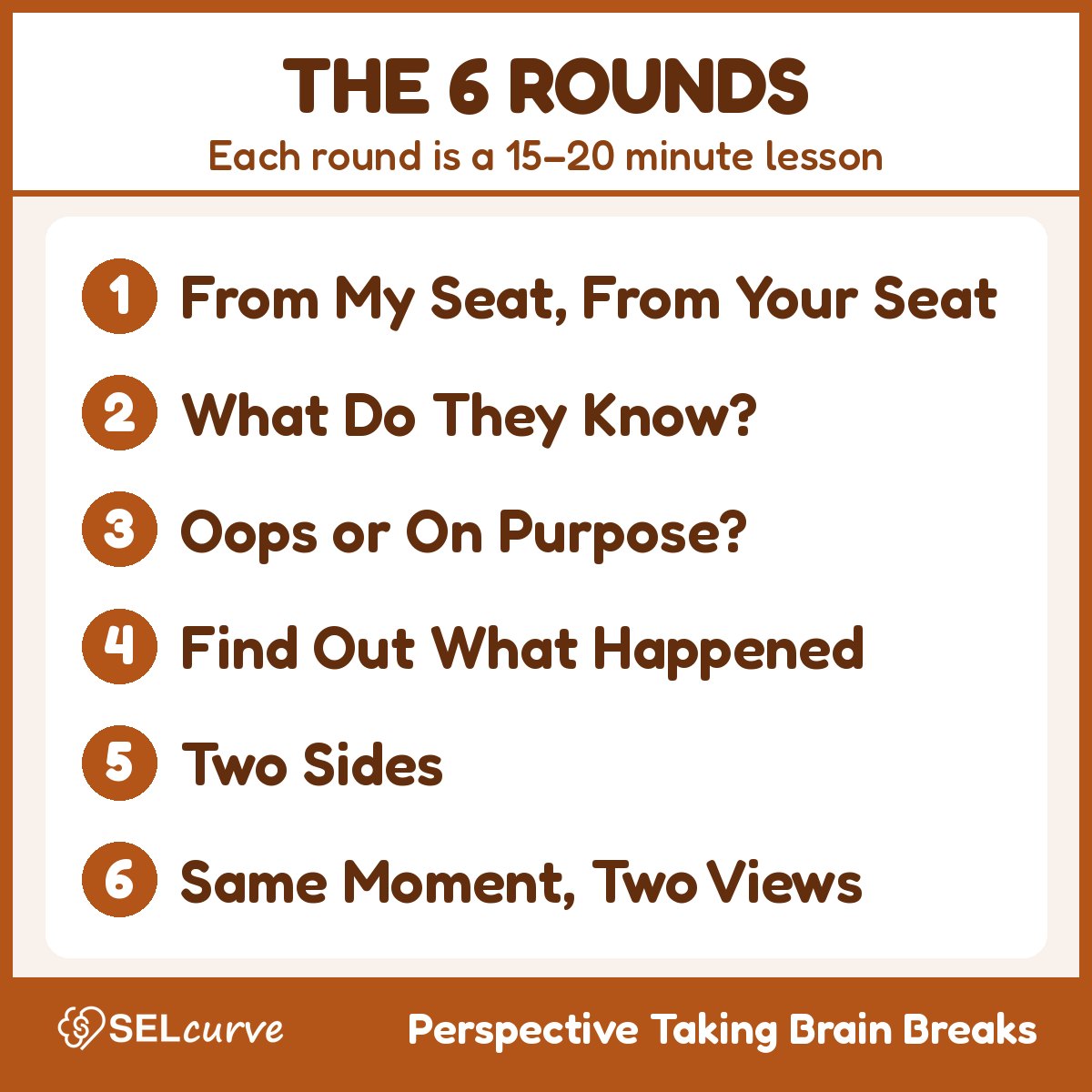
What each round looks at:
- From my seat, from your seat
- What do they know?
- Oops or on purpose?
- Find out what happened
- Two sides
- Same moment, two views
Right for your grade
Grades K–2
Situations come from a young child’s world, like recess, hopscotch, the class fish tank, a hula hoop and a cloud that looks like a dog. You read every short card aloud, answers are simple movements with sitting versions, and the guide suggests starting kindergartners with 4–5 cards and practicing each movement first.
Everything included
What’s inside these perspective taking activities
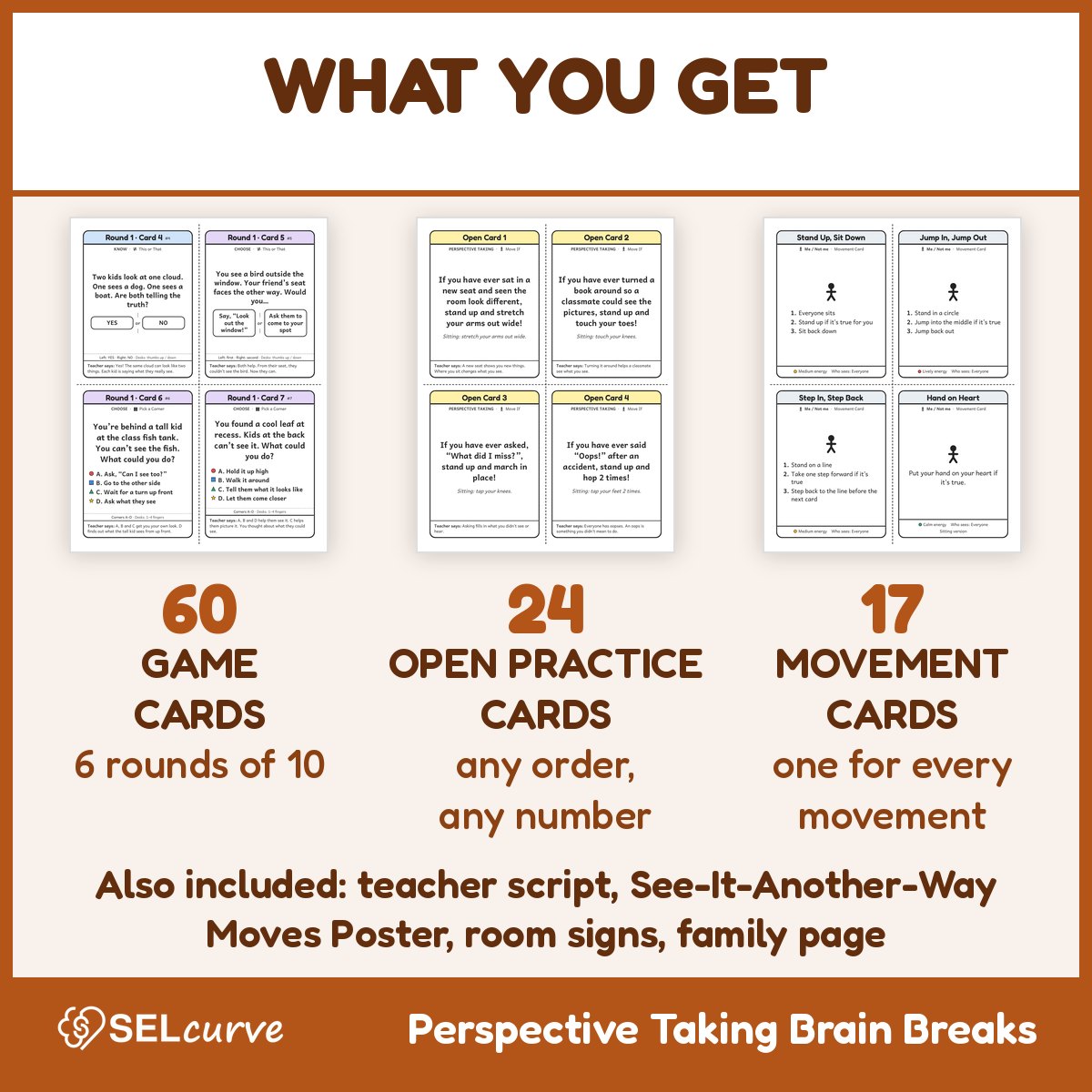
- 60 game cards in 6 rounds, with three Choose cards per round, so children try out what to do before the Do cards
- 24 Open Practice Cards with a move, a sitting version and a teaching line on every card
- 6 Round Cards and 6 Make Your Own cards showing the materials, the Do cards and two places to stop
- A Detailed Script for Teachers with questions for each group of cards, and a Movement Menu
- The See-It-Another-Way Moves Poster, 17 Movement Cards, 6 Room Signs and a Family Connection page with a Whose Shoes? game
A look inside
Real pages, real moments
In the classroom
How to use these perspective taking brain breaks
- 1Before recess: pull 3–5 Open Practice Cards and read each one exactly; everyone moves, sits and hears Teacher says.
- 2One round as a lesson: in Round 1, the Round Card asks for open space or desks, two sides, partners and corner signs, then children answer card by card.
- 3On a split: read Teacher says after a Know card splits the room, and anyone who changes their mind may cross over.
- 4Script support: the Detailed Script gives an introduction, card-by-card questions and a Calm Finish for all six rounds.
Printing and prep
Ready to print
- US Letter, one side, Actual size; pick Fit to page for A4 paper.
- Game cards are 4 per page and each round is 3 pages; cut on the dashed lines and keep the Round Card on top.
- Color or black and white both work, with cardstock or lamination for all-year cards.
Questions teachers ask
FAQ
Do these perspective taking brain breaks teach children to put up with being hurt?
No. The guide is clear that seeing another side never means putting up with being hurt, and that a classmate’s side doesn’t have to win.
What materials do I need?
Only the round’s cards and some open space or desks. Round 2 uses a crayon for each pair; a soft ball for Talking Ball, the poster and the room signs are optional.
Can pre-readers play?
Yes. You read each short card out loud, so children only need to listen and move to give their answer.
Is there a version for older students?
Yes. The Grades 3–5 version builds on these ideas with knowledge gaps, assumption checks and saying the other side fairly.
More for Social Awareness
See all in the library →

Try it in class this week
Start with the free Social Awareness Brain Breaks, or unlock it with Monthly.


