Full library·Grades 2–5·Social Awareness·Task Cards · Stop Think Act Cards
Gratitude Stop Think Act Cards
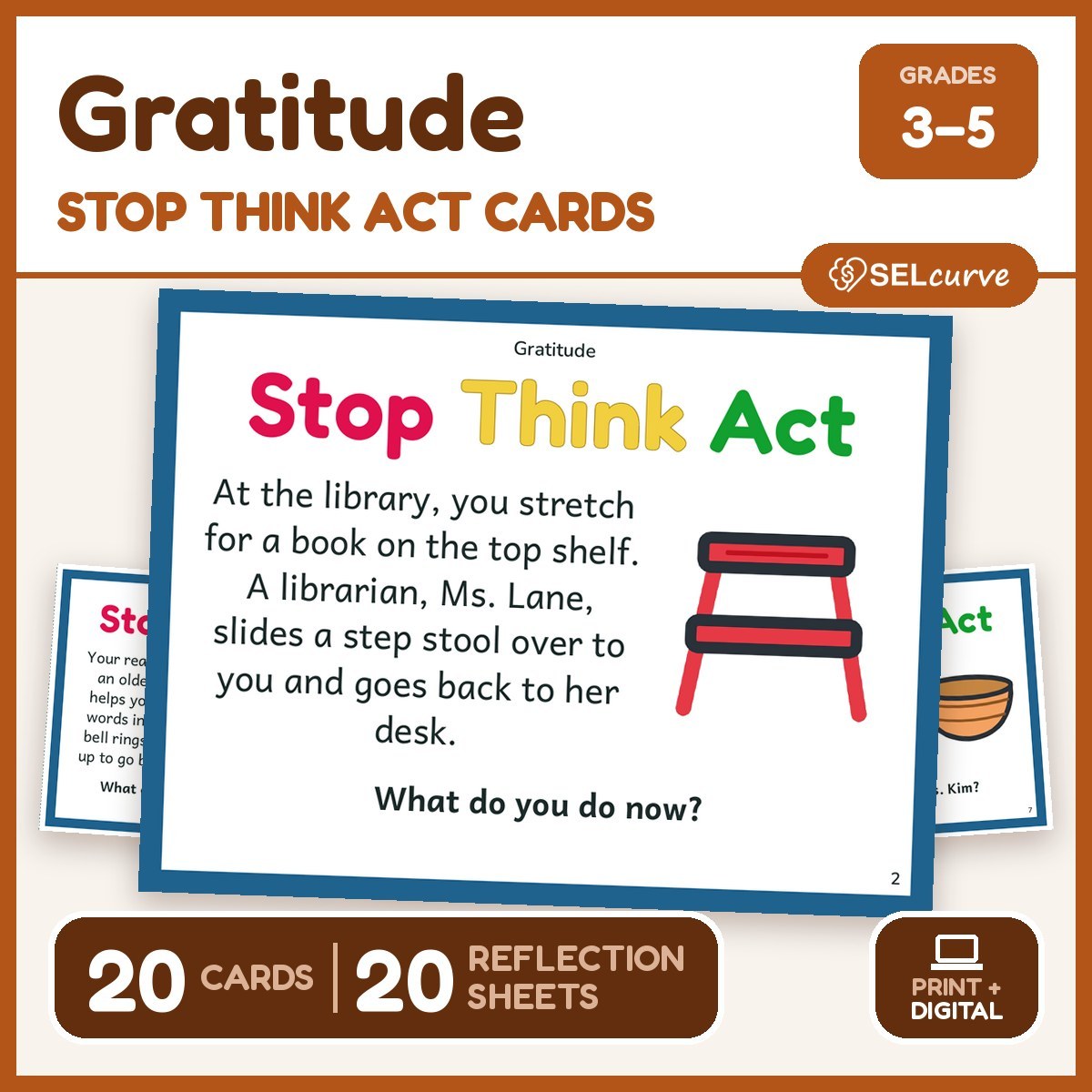
In these gratitude stop think act cards, Grades 3–5 find 20 moments to notice a quiet helper or a good thing right in front of them: a big sister whose sleeve is soaked from holding the umbrella over you, a bus driver who stops at your buil…
- 20 Stop Think Act cards
- 20 reflection sheets
- Print + digital
In the full library, with 18 more on Gratitude & Appreciation
Scenario cards, worksheets, role play and more (grades K–8).
Get the free Social Awareness Stop Think Act CardsFree account · school email works · See the full library
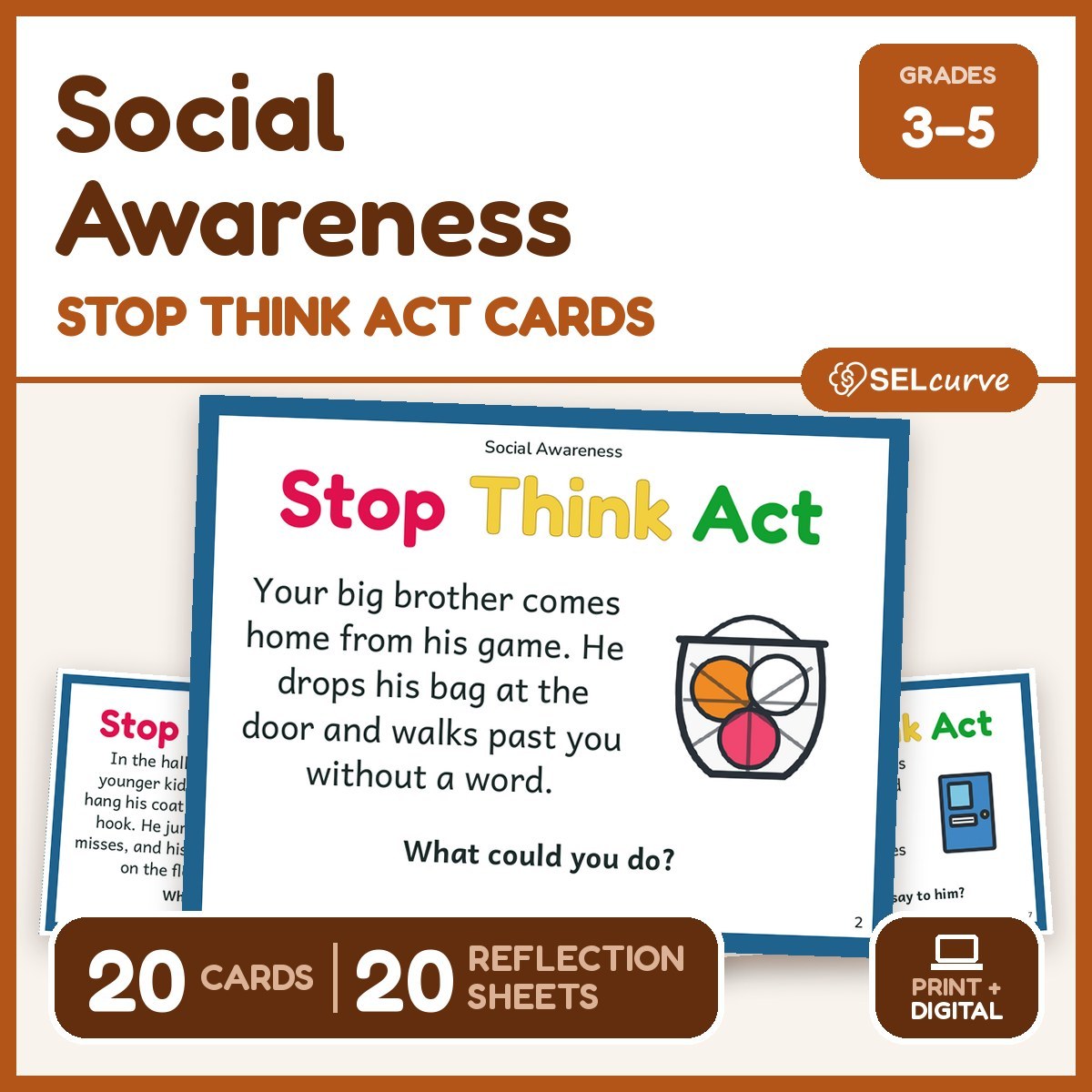 Same format, free with a free account: Social Awareness Stop Think Act CardsOpen it →
- Grades
- 2–5
- What you get
- 20 Stop Think Act cards at school
- Type
- Task Cards
- Use it
- Print + digitaldigital = any device, no student logins
- Competency
- Social Awareness
About this resource
In these gratitude stop think act cards, Grades 3–5 find 20 moments to notice a quiet helper or a good thing right in front of them: a big sister whose sleeve is soaked from holding the umbrella over you, a bus driver who stops at your building on a snowy morning, crickets chirping by the open window as the street lamps blink on. Students practice a thank-you that names what the person did, and finding one good thing even on a hard day. It is a Social Awareness resource. Find more in our gratitude activities and worksheets.
What students practice
- Noticing what others do for you
- Saying thank you so it shows you mean it
- Spotting everyday good things
- Finding something good on a hard day and thanking family
What’s inside these think before you act gratitude cards
- Full-page and four-per-page versions, so you can hold up one card for the class or cut a set apart for groups and stations
- A 4-page teacher guide with a five-step routine, tips such as naming the help, differentiation and Cards at a Glance
- A Family Connection page with a specific thank-you game for a meal or a ride, and a digital activity on any device, with no student logins
A look inside
Card 7: “In art, your clay bowl falls flat for the third time. Ms. Kim shows you how to add a long roll of clay, and now it stands tall.”
Card 14: rain cancels Saturday’s park plan, and your little sister flops on the couch and groans that it is the worst day. The question: “What could you say to her?”
How to lead a gratitude discussion
- Read the card: students imagine they are the one being helped or the one seeing the good thing.
- Look for the good: “Who helped here, or what good thing is in this moment?” Then, “What could you say or do to show you noticed?”
- Practice a real thank-you: brainstorm two or three ways to show thanks, choose the best fit, and act it out with a thank-you that names what the person did.
- Write or post: students fill in the reflection sheet for that card, or you post the digital activity in Google Classroom or Teams, or show a QR code. Students answer on any device and send you their answer sheet.
Grade fit
Younger students in Grades 3–5 start with “Thank you for…” or “One good thing is…” and a card done together. Older students find a quiet helper on a card and explain why that help is easy to miss. Mixed-ability pairs can plan one thank-you in words and one in actions.
Printing
- Full-page cards: one-sided, cardstock or plain paper; the cards print sideways, so turn the page to read.
- 4-per-page cards: one-sided; cut apart on the dashed lines and laminate to reuse.
- Family Connection: plain paper, cut in half for two take-home notes.
Good to know
The guide notes that hard days are real: finding one good thing does not mean the hard part did not matter. Students may pass, and when they share a time someone helped them, they leave classmates’ names out.
Questions teachers ask
Why are some cards about hard days?
A few cards show a rainy Saturday, a lost game or missed spelling words, so students practice finding one good thing without pretending the hard part did not matter.
What grades are these gratitude stop think act cards for?
Grades 3–5. Younger students use thank-you starters, and older students look for the quiet helpers whose help is easy to miss.
What routine does the guide suggest?
“Notice it. Name it. Say thank you.” Post it near your classroom door so students can use it on their own.
Can I assign the gratitude cards online?
Yes. Post it in Google Classroom or Teams, or show a QR code. Students work on any device with no student logins and send you their answer sheet.
More for Social Awareness
See all in the library →


Every resource, one library.
775 SEL resources for elementary classrooms — printables, digital activities and answer sheets, and every new one we add.