
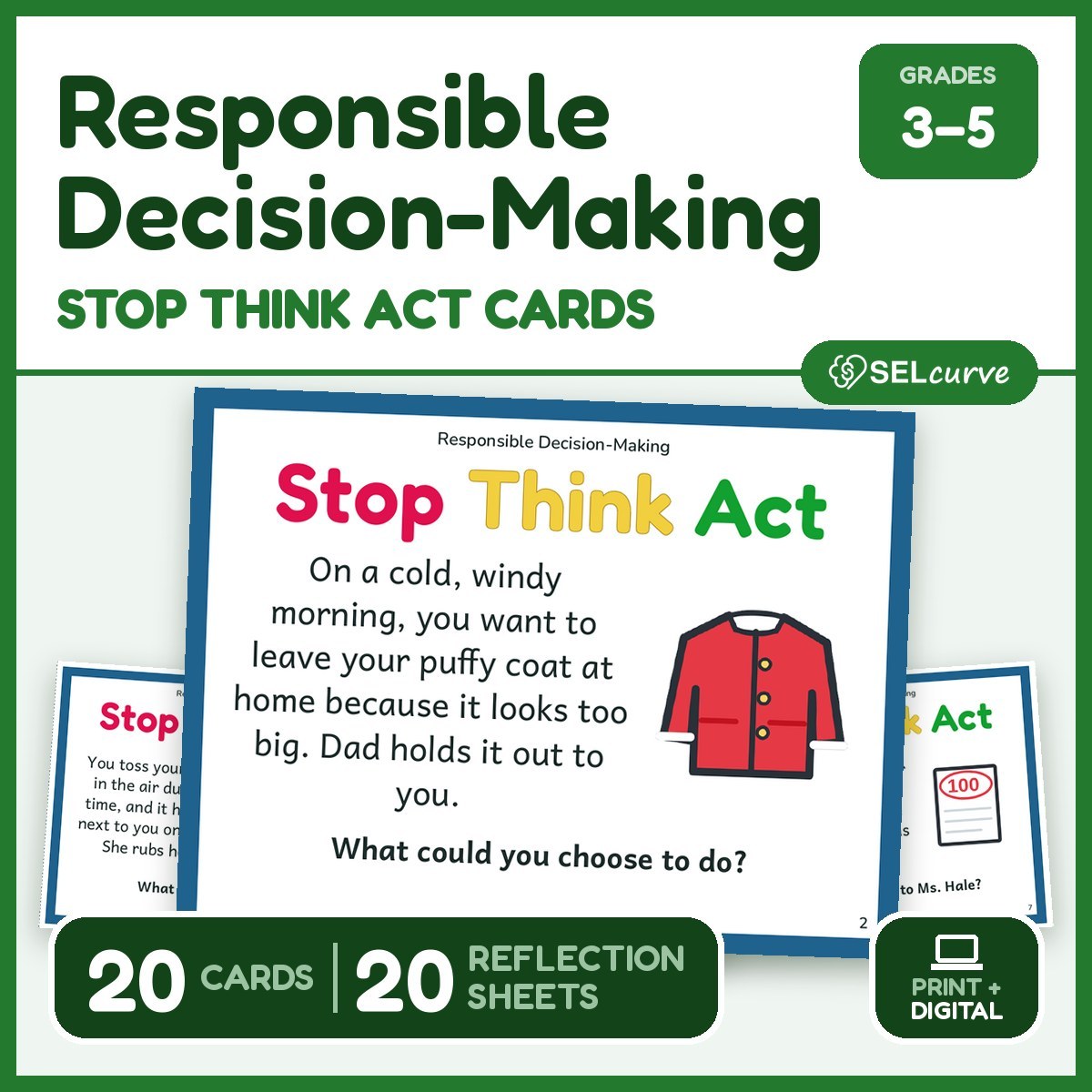
Decision-Making Stop Think Act Cards — Printable & Digital
A paper boat that sinks on the first try with ten minutes left, a piece knocked off your brother’s block bridge while he is outside, a stack of five finished library books you are about to leave on the table: these decision-making stop thin…
Free — just create a free account
- View & Print all 20 Stop Think Act cards
- Digital version for any device — no student logins
- No credit card, nothing to cancel
Have an account? Log in
- Grades
- 2–5
- What you get
- 20 Stop Think Act cards
- Type
- Task Cards
- Use it
- Print + digitaldigital = any device, no student logins
- Competency
- Responsible Decision‑Making
About this resource
A paper boat that sinks on the first try with ten minutes left, a piece knocked off your brother’s block bridge while he is outside, a stack of five finished library books you are about to leave on the table: these decision-making stop think act cards give Grades 3–5 a set of 20 choices to stop and think through. Students weigh what could happen after each option and pick the one that is safe, honest and fair. This complete set is one of our free resources. It is a Responsible Decision-Making resource. Find more in our decision making activities.
What students practice
- Thinking about what could happen before choosing
- Solving problems step by step
- Taking responsibility and being honest and fair
- Making safe choices online
- Asking for help and helping their community
What’s inside these decision-making scenarios for Grades 3–5
- Both card sizes: full page, printed sideways, for class talks, display or one card per group, and four per page for small groups, partners and stations
- A 4-page teacher guide with the step-by-step discussion guide, tips such as Think Ahead and Own It, and differentiation, followed by Cards at a Glance and a printing guide
- A Family Connection page that suggests a what-could-happen question before a small choice at home, and a digital activity for any device, with no student logins
A look inside
Card 7: “Ms. Hale hands back your quiz with 100 at the top. You see she marked one of your wrong answers as right.” The question is “What could you say to Ms. Hale?”
Card 20: as your class lists ideas to make recess more fun, a friend says no one will listen. The card asks “What could you say to your friend?”
How to use these decision-making cards
Grade fit
For younger students in Grades 3–5, the guide offers the starter “If I… then… so I will…” and a card solved together first. Older students explain how their choice could affect two different people on the card, and mixed-ability groups list the choices on each card together.
Printing
- Full-page cards, pages 10–29: one-sided on cardstock or plain paper, turned sideways to read.
- Four-per-page cards, pages 31–35: one-sided, then cut on the dashed lines; laminate them to keep for later.
- Reflection sheets: one per student on plain paper, printed after the card discussion.
- No need to print the section pages, and black and white works for every card.
Good to know
Passing is always fine, and students talk about the situation on the card, not about classmates. The guide asks you to remind students that telling a trusted grown-up about a hurt or a safety worry is always a good choice, and the screen cards take place with a grown-up close by.
Questions teachers ask
Is this the full set?
Yes. The whole set is here, 20 cards, 20 reflection sheets and the teacher guide, as one of our free resources.
Do the decision-making stop think act cards cover online safety?
Yes, in two cards with a grown-up nearby: a pop-up on the family computer with Mom right there, and an unkind comment on the class page while the teacher is at his desk. Students practice the safe choice and asking for help.
What routine can students remember?
The guide’s teacher tip is “Stop. Think it through. Choose. Own it.” You can also model owning a mistake with “That was me. I can fix it.”
Can the class use these on devices?
Yes. Post it in Google Classroom or Teams, or show a QR code. Students work on any device with no student logins and send you their answer sheet.
More for Responsible Decision‑Making
See all in the library →
Every resource, one library.
775 SEL resources for elementary classrooms — printables, digital activities and answer sheets, and every new one we add.

