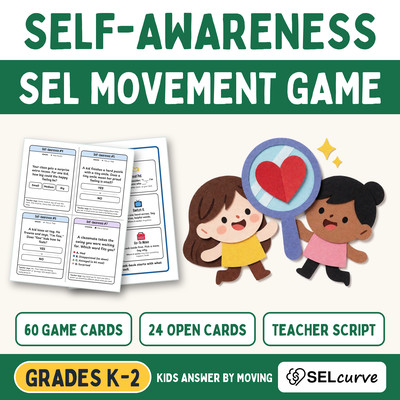
Paid·Grades K–2·Self-Awareness·Brain Breaks
Body Awareness Brain Breaks
- 60 game cards
- 24 Open Practice Cards
- 6 Round Cards
- Printable
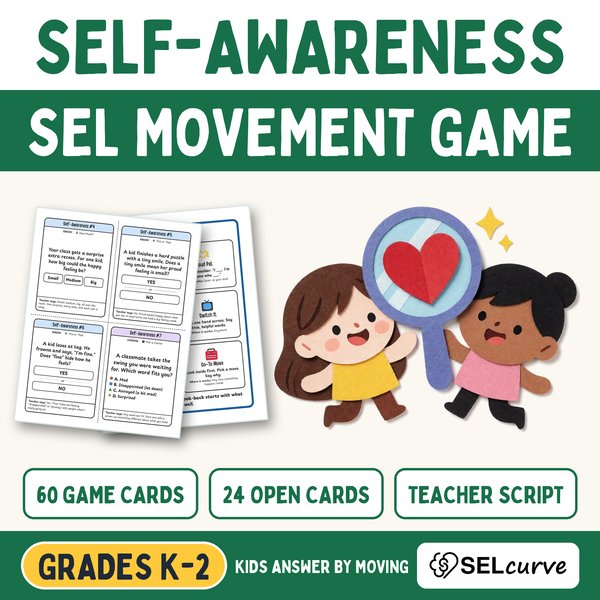 Free with a free accountSelf-Awareness Brain Breaks60 game cards · 6 Round Cards · 24 Open Practice Cards · Printable
What a free account gives you
- 81 free resources across all five SEL areas, ready to print
- Digital activities: post them in Google Classroom or Teams. Any device · No student logins
- A planner and collections to keep your SEL week organized
- Grades
- K–2
- What you get
- 60 game cards, ten per round
- Type
- Brain Breaks
- Use it
- PrintView & Print in your browser
- Competency
- Self-Awareness
- Topic
- Body Awareness
About this resource
With these body awareness brain breaks, Grades K–2 classes practice noticing what their bodies tell them, through 60 game cards in six lessons of 15–20 minutes and 24 Open Practice Cards for a 3-minute pause. Children stand up if they have ever had the hiccups, step to YES or NO on whether a kid who feels fine has stopped getting body signals, and sway slowly if their heart has ever beat fast after playing. It is a Self-Awareness resource. Find more in our body awareness activities.
What students practice
Each round has its own big idea:
- My body sends signals
- Noticing inside
- Thirsty, wiggly, too warm
- Strong and still
- Moving safely together
- Signal, then tell
Right for your grade
Grades K–2
Since you read the cards aloud, nonreaders join in from the first card. The moments are familiar ones like art time, music, lining up, the playground and the gym, and the focus is kept to the basics: noticing a signal, noticing a change, body control and telling a grown-up. The colored, shaped corner signs help children who are still learning letters.
Everything included
What’s inside these body awareness activities
- 60 game cards, ten per round, kept in playing order from the Round Card at the top to the Reflect card at the end
- 24 Open Practice Cards that work alone, from Move If prompts to True or False and Say It & Move cards
- 6 Round Cards with 6 blank Make Your Own cards, each Round Card naming the cards to read first and where to stop if time runs short
- A Detailed Script for Teachers with the words to say for all six rounds, plus a Movement Menu
- Print-once extras: the Body Signal Moves Poster of six moves, 17 Movement Cards for quick reference, 6 Room Signs and a Family Connection page for home


A look inside
Real pages, real moments
In the classroom
How to use these body awareness brain breaks
- 1Short pause: any 3–5 Open Practice Cards will do; read each exactly, give the class a moment to move, then share its teaching line.
- 2One round as a lesson: read the Round Card first, check the cards it asks you to read ahead, then play the ten cards with the Quick Start moves.
- 3Before Round 3: set your class signal for I need something, such as a hand flat on the desk, palm up, and check in quietly when a child shows it.
- 4With kindergarten: a first game of 4–5 cards works best, after a practice run of each move.
Printing and prep
Ready to print
- Single-sided on US Letter at Actual size; pick Fit to page when printing on A4.
- Works in color or black and white. Laminate or use cardstock for a set that lasts.
- For a first try, print just Round 1 and the corner signs.
Questions teachers ask
FAQ
What are body signals in these body awareness brain breaks?
Messages from inside the body, like a dry mouth, a wiggly feeling after sitting a long time, tingly feet or breath that goes fast after hard play.
What if a child often seems hungry, tired or in pain?
Keep those questions out of class time. The guide asks you to follow your school’s process, and to tell a hurt child to go to a grown-up or the nurse.
How much time does one round take?
Rounds 1, 2, 4 and 5 take about 15 minutes, and Rounds 3 and 6 run 15–20 minutes.
Does an older version exist?
Yes. It builds on these ideas with inside and outside signals, signals that feel alike, and signal paths.
More for Self-Awareness
See all in the library →
Try it in class this week
Start with the free Self-Awareness Brain Breaks, or unlock it with Monthly.