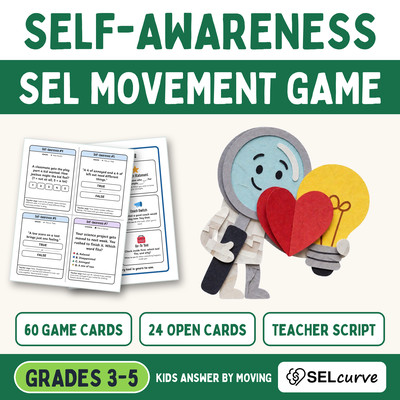
Paid·Grades 3–5·Self-Awareness·Brain Breaks
Body Awareness Brain Breaks
- 60 game cards
- 24 Open Practice Cards
- Printable
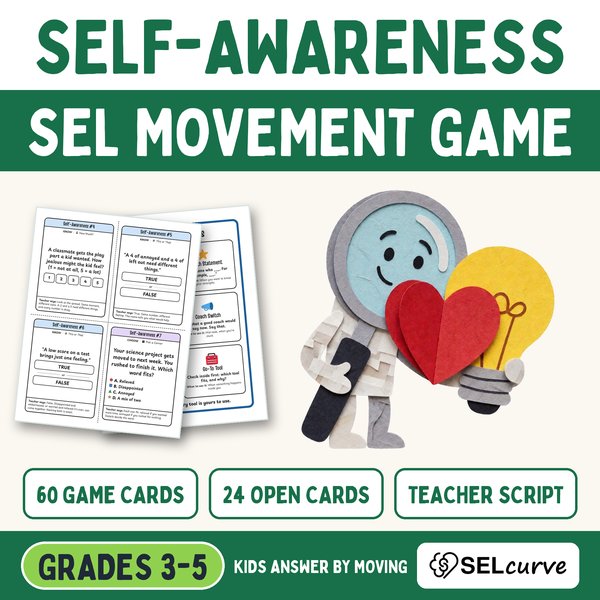 Free with a free accountSelf-Awareness Brain Breaks60 game cards · 6 Round Cards · 24 Open Practice Cards · Printable
What a free account gives you
- 81 free resources across all five SEL areas, ready to print
- Digital activities: post them in Google Classroom or Teams. Any device · No student logins
- A planner and collections to keep your SEL week organized
- Grades
- 3–5
- What you get
- 60 game cards printed 4 per page
- Type
- Brain Breaks
- Use it
- PrintView & Print in your browser
- Competency
- Self-Awareness
- Topic
- Body Awareness
About this resource
Grades 3–5 students sort inside signals from outside ones in these body awareness brain breaks, which pair six 15–20 minute lessons and 60 game cards with 24 Open Practice Cards for a 3-minute break. They shake out their hands if writing has ever left them stiff, decide whether music playing in the next room counts as a body signal, and choose what to check first in PE when they hear the coach’s whistle and notice their own fast breathing. It is a Self-Awareness resource. Find more in our body awareness activities.
What students practice
The six rounds build from one idea to the next:
- Signals from inside
- Practicing noticing
- Reading the signal
- Control and balance
- Signals in busy places
- Signal paths
Right for your grade
Grades 3–5
The situations come from upper-elementary life: group projects, PE, crowded hallways, class events and science experiments. Instead of just reacting, students weigh inside or outside, before or after, thirsty or tired, and they compare signals and practice asking for what they need. Every tool has a seated or arms-only version.
Everything included
What’s inside these SEL games for Grades 3–5
- 60 game cards printed 4 per page, ten per round, each round opening with a Round Card and ending with a blank Make Your Own card
- 24 Open Practice Cards, standalone prompts you can use singly or in a stack, each with a seated version
- A Detailed Script for Teachers that lists the cards to read ahead in every round, then the opening words, card groups and calm close
- A Movement Menu and Quick Start page with the default answer move for every kind of card
- The Body Signal Tools Poster naming the six tools students practice, with 20 Movement Cards, corner and line-end Room Signs (6 in all) and a Family Connection page


A look inside
Real pages, real moments
In the classroom
How to use these body awareness brain breaks in Grades 3–5
- 1Three-minute break: read 3–5 Open Practice Cards word for word, let the class move, then add the Teacher says line.
- 2Class signal: the guide asks you to name one before Round 1 that students can use to show they need something.
- 3Lesson rounds: follow the Round Card, keep to about a minute per card and, when a Know card splits the class, ask each side why.
- 4Student leaders: from Round 2 on, students can read the cards and pick the movement.
Printing and prep
Ready to print
- Pages are US Letter; print one side only at Actual size, or Fit to page on A4.
- Color and black and white both print well, and cards on cardstock or laminated hold up all year.
- Cut on the dashed lines, then keep each round in its own envelope or on a binder ring, Round Card first.
Questions teachers ask
FAQ
Do these body awareness brain breaks ask students to close their eyes?
No. Every tool is done with eyes open, and the cards about balance are talked through rather than tested with closed eyes.
What if a student often seems tired, hungry or in pain?
Don’t ask about it in class. Follow your school’s process, and send pain or a bump to an adult or the nurse, even if it feels better.
What is a signal path?
A signal path has three steps: signal, need, action. In Round 6, students put the whole path together with the Three-Step Match and Signal Path cards.
Is there a pack for younger children?
Yes. The Grades K–2 version focuses on everyday signals, noticing a change and the class signal.
More for Self-Awareness
See all in the library →

Try it in class this week
Start with the free Self-Awareness Brain Breaks, or unlock it with Monthly.