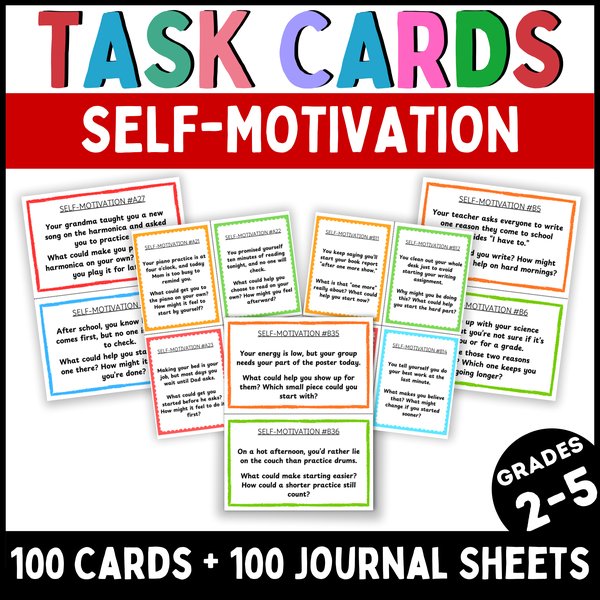
Full library·Grades 2–5·Self-Management·Task Cards
Motivation Task Cards
It’s time to practice the recorder, and the case is still closed on the bed.
- 100 cards
- Print + digital
In the full library, with 8 more on Self-Motivation
Scenario cards, role play, reading passages and more (grades K–6).
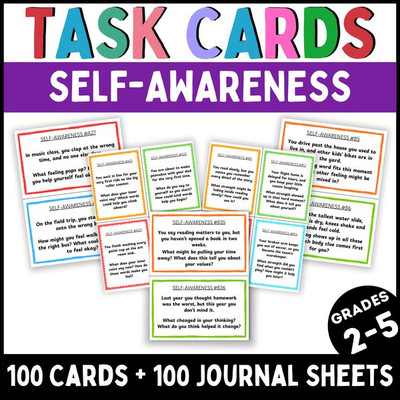
Get the free Self-Awareness Task CardsFree account · school email works · See the full library
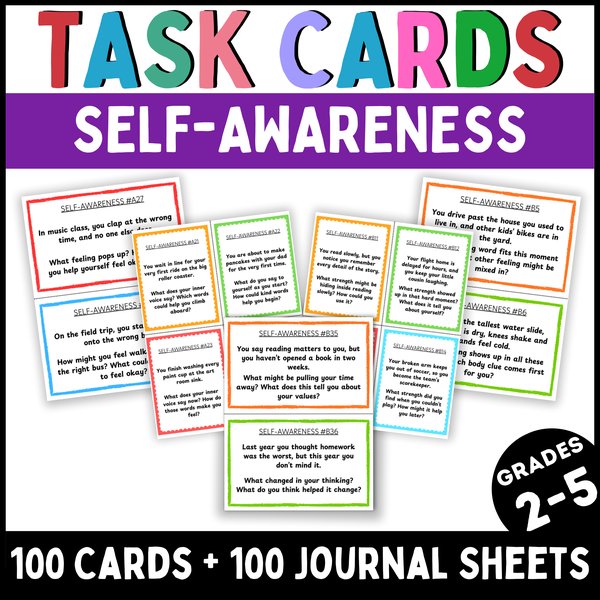 Same format, free with a free account: Self-Awareness Task CardsOpen it →
- Grades
- 2–5
- What you get
- 100 cards in total
- Type
- Task Cards
- Use it
- Print + digitaldigital = one link, no student logins
- Competency
- Self-Management
- Topic
- Self-Motivation
About this resource
It’s time to practice the recorder, and the case is still closed on the bed. These motivation task cards live in that gap between knowing and starting: 100 prompts for Grades 2–5 on getting going, sticking with boring jobs and finding a reason to try that comes from inside. The set builds Self-Management, the CASEL competency of steering your own effort.
What students practice
- Taking the first small step on a big job
- Sticking with tasks that feel boring
- Starting their own jobs without reminders
- Catching procrastination habits like “one more show”
- Finding reasons to try that don’t depend on a prize
What’s inside
- Set A for Grades 2–3 (A1–A50): getting started; when I feel bored; starting my jobs without reminders; keeping going when it’s not fun; finding my reason to try
- Set B for Grades 4–5 (B1–B50): finding my ‘why’; beating procrastination; motivation without rewards; getting going on low-energy days; doing more than the minimum
- Reflection sheets for each card in a second file (81 + 103 pages)
A look inside
Set A: “You need to clean the hamster cage, and it looks like a really big job. What small part could you do first? How might the rest feel once you start?”
Set B: “Your science project has sat untouched for a week, and thinking of it feels heavy. What might be behind putting it off? What tiny step could get you moving?”
Set B: “You learned the name of every bird in your backyard just because you wanted to. Why might curiosity be such a strong push? What else do you learn just for fun?”
How to use these motivation task cards
Grade fit
Set A (Grades 2–3) uses chores and practice younger students know, like folding towels with Grandma, making the bed before Dad asks or raking leaves. Set B (Grades 4–5) asks whose reason it is, for example staying in chess club after a friend quits, and what keeps students going when there is no sticker or grade.
Digital version
The interactive digital task cards share as one link: you choose Set A or Set B, and students type their answers on any device with no student logins. At the end they download an answer sheet to hand in.
Good to know
The cards stay on the student’s own drive to start and keep going. Setting goals, managing time and bouncing back after failure are not the focus here.
Pairs well with

Questions teachers ask
What does ‘motivation without rewards’ cover?
It is one of Set B’s five themes (B21–B30): students think about what keeps them going when there is no sticker, prize or grade, such as finishing a 500-piece puzzle.
Which set should I use?
Set A is labeled Grades 2–3 and Set B Grades 4–5; pick the one that fits how your students talk about their own effort.
More for Self-Management
See all in the library →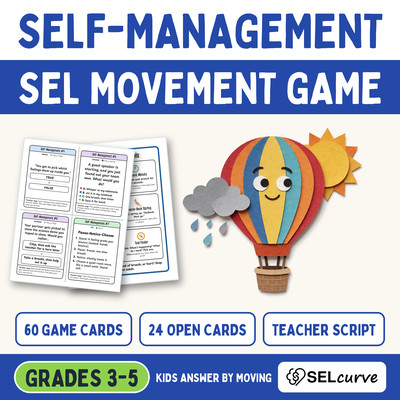

Every resource, one library.
672 SEL resources for elementary classrooms — printables, digital activities and answer sheets, and every new one we add.